Welcome to this UK AstraZeneca produced and funded website

This website is intended for UK Healthcare Professionals only.


The website contains both promotional and non-promotional content.


If you are a patient or a carer of a patient prescribed an AstraZeneca product, please visit myazmed.co.uk


For any other UK residents please visit astrazeneca.co.uk

I am not a Healthcare Professional
Prescribing Information Forxiga® (dapagliflozin)
Adverse Event Reporting

This website is intended for UK Healthcare Professionals only. Other UK residents please visit astrazeneca.co.uk

AstraZeneca-logo
  • Our Medicines
    • Cardiovascular, Renal & Metabolism
      • ATTR Amyloidosis
        • WAINZUA®▼(eplontersen)
      • Chronic Kidney Disease (CKD)
        • FORXIGA® (dapagliflozin)
      • Heart Failure
        • FORXIGA® (dapagliflozin)
      • Hyperkalaemia
        • LOKELMA® (sodium zirconium cyclosilicate)
      • Type 2 Diabetes (T2D)
        • FORXIGA® (dapagliflozin)
    • Oncology
      • Breast Cancer
        • LYNPARZA® (olaparib)
        • TRUQAP®▼(capivasertib)
      • Bladder Cancer
        • IMFINZI® (durvalumab)
      • Endometrial Cancer
        • IMFINZI® (durvalumab)
        • LYNPARZA® (olaparib)
      • Gastrointestinal Cancer
        • IMFINZI® (durvalumab)
        • IMJUDO®▼(tremelimumab)
      • Lung Cancer
        • IMFINZI® (durvalumab)
        • TAGRISSO® (osimertinib)
      • Ovarian Cancer
        • LYNPARZA® (olaparib)
      • Prostate Cancer
        • LYNPARZA® (olaparib)
        • ZOLADEX® (goserelin)
    • Respiratory
      • Asthma
        • TEZSPIRE®▼ (tezepelumab)
        • SYMBICORT® (budesonide/formoterol)
      • Chronic Obstructive Pulmonary Disease(COPD)
        • TRIXEO AEROSPHERE® (formoterol fumarate dihydrate/glycopyrronium/budesonide)
        • BEVESPI® (glycopyrronium/formoterol fumarate dihydrate)
    • Vaccines
      • Flu
        • FLUENZ® nasal spray suspension (influenza vaccine, live attenuated, nasal)
  • Therapy Areas
    • Cardiovascular, Renal & Metabolism
      • ATTR Amyloidosis
      • Chronic Kidney Disease (CKD)
      • Heart Failure
      • Hyperkalaemia
      • Type 2 Diabetes (T2D)
    • Oncology
      • Breast Cancer
      • Bladder Cancer
      • Endometrial Cancer
      • Gastrointestinal Cancer
      • Lung Cancer
      • Ovarian Cancer
      • Prostate Cancer
    • Respiratory
      • Asthma
      • Chronic Obstructive Pulmonary Disease(COPD)
    • Vaccines
      • Flu
  • About us
    • AZ Commitment
  • Contact us
  • AstraZeneca UK
  • Forxiga (dapagliflozin)
  • Type-2-Diabetes
  • Welcome to Forxiga
  • Type 2 Diabetes
  • Chronic Kidney Disease
  • Heart Failure
  • Safety
FORXIGA (dapagliflozin) and Type 2 Diabetes | AstraZeneca UK


FORXIGA (dapagliflozin) and type 2 diabetes

Dapagliflozin can help protect the heart and kidneys, whilst lowering haemoglobin A1c (HbA1c) in patients with type 2 diabetes (T2D)1

While ~60% of patients have controlled HbA1c, they are still at long-term risk of cardiorenal complications2-4

The presence of T2D and a lack of appropriate management can cause a physiological cascade, potentially affecting the renal and cardiovascular systems.5

Dapagliflozin is a sodium-glucose co-transporter-2 inhibitor (SGLT2i) recommended by NICE and indicated for the treatment of insufficiently controlled T2D, symptomatic chronic heart failure (HF) and chronic kidney disease (CKD).1,6-8


t2d-kidney-icon t2d-kidney-icon

The benefits of dapagliflozin go beyond glycaemic control. Dapagliflozin is an oral, once-daily SGLT2i that can help manage long-term cardiorenal risk in your patients with T2D.1,9

The unmet need in type 2 diabetes

There is an increased risk of CV complications and death in T2D, with the presence of CKD or HF10-13

Impact of T2D on CKD

drop-icon

Diabetes is one of the most common risk factors of CKD, with 40% of T2D patients developing CKD

wallet-icon

Increasingly higher healthcare costs are incurred at each CKD stage in patients with T2D15

T2D and risk of HF

t2d-kidney-Icon

Diabetes is one of many risk factors and comorbidities associated with CV disease16

hospital-icon

~24% of HF patients and ~40% of patients with hospitalisations for heart failure (hHF) have diabetes mellitus17

t2d-graph t2d-graph
93

Approximately 93%* of T2D patients in a UK study had a QRISK®2† score greater than 10% or had established HF or ASCVD.18 The NICE guidelines recommend considering SGLT2i treatment, such as with dapagliflozin, as first-line treatment alongside metformin in patients with T2D at high risk of CVD.8,19‡

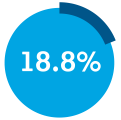
18

However, on average, only 18.8%§ of eligible patients in Great Britain are prescribed an SGLT2i.20


*Estimates are derived from a UK cohort of people with T2D (Clinical Practice Research Datalink, n=568,524 actively registered with a GP practice in February 2020). People with chronic kidney disease stage 4–5 were excluded (n=18,594).19

†QRISK®2 is a tool used to assess whether people are at high risk of developing CVD. Adults over 40 with T2D and a QRISK®2 score more than 10% are at high risk of developing CVD.8

‡First-line treatment with SGLT2i alongside metformin (as soon as metformin tolerability is confirmed) in eligible patients at high risk of CVD. High risk is defined as a QRISK®2 score of 10% or higher, or an elevated lifetime risk (defined as the presence of 1 or more cardiovascular risk factors in someone under 40).8

§The analysis used to create this SGLT2i data is based on a series of assumptions and estimates made by AstraZeneca and is only intended to act as a guide to the proportion of patients receiving treatment with an SGLT2i.20

Dapagliflozin in type 2 diabetes treatment guidelines

The latest guidelines recommend dapagliflozin for the treatment of type 2 diabetes (T2D) in appropriate patients

In national guidelines, SGLT2 inhibitors like dapagliflozin are recommended for the treatment and risk management of T2D and associated co-morbidities such as HF and CKD8,21–23

Dapagliflozin in type 2 diabetes treatment UK guidelines

The NICE guidelines recommend considering SGLT2i treatment, such as with dapagliflozin, as first-line treatment alongside metformin in patients with T2D at high risk of CVD.8*

  • For the treatment of adults with T2D and chronic heart failure or established atherosclerotic CV disease, a SGLT2i with proven CV benefit should be offered with metformin8

The NICE guidelines for T2D include a focus on manging long-term cardiorenal risk, signalling a shift from focusing solely on HbA1c.8

  • For risk management, an SGLT2i with proven CV benefit with metformin should be considered for adults with T2D at a high risk of developing CV disease8

For adults with T2D and CKD, an SGLT-2i should be offered with an angiotensin receptor blocker (ARB) or angiotension-converting enzyme inhibitor (ACEi), if:8

  • Urine albumin to creatinine ratio (ACR) is >30 mg/mmol, and
  • The patient meets the marketing authorisation criteria (including estimated glomerular filtration [eGFR] thresholds)8**

All rights reserved. Subject to notice of rights. NICE guidance is prepared for the National Health Service in England. All NICE guidance is subject to regular review and may be updated or withdrawn. NICE accepts no responsibility for the use of its content in this material.

*First-line treatment with SGLT2i alongside metformin (as soon as metformin tolerability is confirmed) in patients at high risk of CVD. High risk is defined as a QRISK®2 score of 10% or higher, or an elevated lifetime risk (defined as the presence of 1 or more cardiovascular risk factors in someone under 40).8

**For cardiorenal protection, FORXIGA can be initiated in patients with eGFR ≥15 mL/min/1.73m2.1 However, there is limited experience with initiating treatment with FORXIGA in patients with eGFR <25 mL/min/1.73m2. Glycaemic efficacy of FORXIGA is reduced at an eGFR <45 mL/min/1.73m2, consider additional glucose treatment in these patients with T2D for glycaemic efficacy.1

Dapagliflozin in T2D: SMC guidelines

The SMC has accepted the use of FORXIGA (dapagliflozin) for restricted use within National Health Service (NHS) Scotland in adults ≥18 years with T2D to improve glycaemic control as add-on combination therapy with other glucose-lowering medicinal products including insulin, when these, together with diet and exercise, do not provide adequate glycaemic control22

Dapagliflozin DECLARE trial

The DECLARE trial was a large pivotal study that assessed cardiovascular outcomes with dapagliflozin in more than 17,000 patients1,24

DECLARE was a randomised, double-blind, placebo-controlled, multicentre trial designed to evaluate the efficacy and safety of dapagliflozin 10mg daily compared with placebo on cardiovascular (CV) outcomes when added to current background therapy1

The use of other glucose-lowering agents (other than an open-label sodium-glucose co-transporter-2 inhibitor (SGLT-2i), pioglitazone or rosiglitazone) was at the discretion of the treating physician.24

hospital-icon hospital-icon

This was the largest CV outcomes trial (CVOT) with an SGLT-2i to study hospitalisation for heart failure (hHF) risk reduction in both high risk primary and secondary prevention patients1,24


Co-Primary endpoints:1,24


  • Time to first event of the composite of CV death, myocardial infarction, or ischaemic stroke (major adverse CV events [MACE])

  • Time to first event of the composite of hHF or CV death


Secondary endpoints:1,24


  • Renal composite endpoint (sustained ≥40% decrease in estimated glomerular filtration rate [eGFR] to eGFR <60 mL/min/1.73m2 and/or end-stage kidney disease [ESKD]) and/or renal or CV death

  • All-cause mortality

CKD-ico


Patient population:1,24


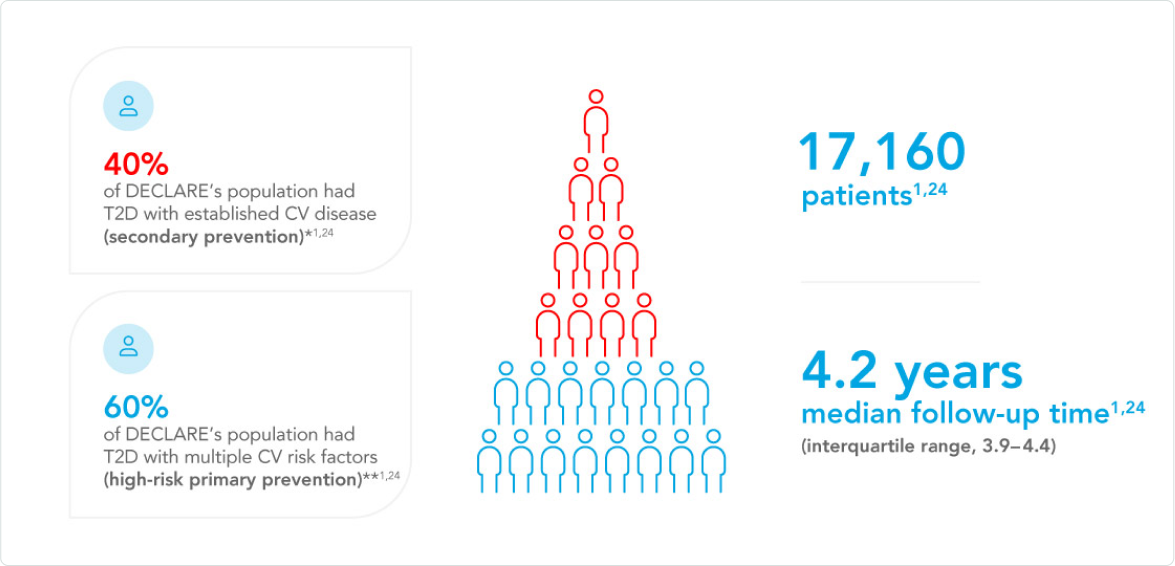
  • All patients had type 2 diabetes (T2D) and multiple risk factors for atherosclerotic CV disease (59%), or had established atherosclerotic CV disease (41%)24
  • Patients were 40 years of age or older, with an average eGFR of 85 mL/min/1.73m2.24
  • 17,160 patients were randomised to FORXIGA 10 mg (8,582 patients) or placebo (8,578 patients) and were followed for a median of 4.2 years1,24

The DECLARE trial was a pivotal study providing results in the largest patient population within SGLT-2i CVOTs to date1,241,24

declare-graph


For further information please refer to the Summary of Product Characteristics (SmPC)

*Ischaemic heart disease, peripheral artery disease or cerebrovascular disease24

** ≥55-year-old males and ≥60-year-old females plus at least one of the following: dyslipidaemia, hypertension or current smoking24

Dapagliflozin in type 2 diabetes: efficacy

Primary endpoint: Dapagliflozin demonstrated non-inferiority vs placebo for the composite of major cardiovascular events (MACE p=0.005). There was a numerical reduction in MACE in patients taking dapagliflozin vs placebo but this did not reach statistical significance for superiority (p=0.17). Therefore, all individual components are considered nominally significant.1,24

t2d-efficacy-graphs t2d-efficacy-graphs

Adapted from Wiviott SD, et al. 2019.24

Dapagliflozin 10 mg daily demonstrated superiority versus placebo in preventing the composite of hospitalisation for heart failure or cardiovascular death. The difference in treatment effect was driven by hospitalisation for heart failure, with no difference in cardiovascular death.

Exploratory endpoints: hHF and progression to nephropathy24

ted-efficacy-Icon

Exploratory Endpoint vs. Placebo

27% Relative risk reduction (RRR)

in hHF*24

0.8% Absolute risk reduction (ARR)

(2.5% vs. 3.3%) hazard ratio (HR) 0.73; 95% confidence interval (CI), 0.61, 0.88 nominal significance

t2d-kidney-Icon

Exploratory Endpoint vs. Placebo

47% RRR

in progression to nephropathy**24

1.3% ARR

(1.5% vs. 2.8%) HR 0.53; 95% CI, 0.43, 0.66 nominal significance

*hHF alone was a separate, nominally significant exploratory endpoint in DECLARE; the primary endpoint composite of CV death/hHF was driven by hHF24


**Nominally significant, prespecified exploratory renal composite outcome of a sustained decrease of ≥40% in estimated glomerular filtration rate (eGFR) to <60/min/1.73 m2 of body surface area, new end-stage kidney disease (ESKD), or death from renal or cardiovascular causes24


Safety profile

Understand key safety considerations about the use of dapagliflozin.

Find out more

For your patients living with type 2 diabetes.

A comprehensive and patient-friendly guide that helps your patients better understand type 2 diabetes.

Download Now

A short leaflet to support patients manage their type 2 diabetes treatment during an illness.

Download Now

ACEi, angiotensin-converting enzyme; ACR, albumin to creatinine ratio; ARB, angiotensin receptor blocker; ARR, absolute risk reduction; ASCVD, atherosclerotic cardiovascular disease; CI, confidence interval; CKD, chronic kidney disease; CV, cardiovascular; CVD, cardiovascular disease; CVOT, cardiovascular outcomes trial; DKA, diabetic ketoacidosis; DKD, diabetic kidney disease; DPP-4i, dipeptidyl-peptidase 4 inhibitor; eGFR, estimated glomerular filtration rate; ESKD, end-stage kidney disease; GLP-1, glucagon-like peptide 1; HbA1c, glycated haemoglobin; HF, heart failure; hHF, hospitalisation for heart failure; HR, hazard ratio; MACE, major adverse cardiovascular events; NHS, National Health Service; NICE, National Institute for Health and Care Excellence; PCDS, Primary Care Diabetes Society; RRR, relative risk reduction; SGLT2i, sodium-glucose co-transporter-2 inhibitor; SMC, Scottish Medicines Consortium; TZD, thiazolidinediones; T2D, type 2 diabetes.


  1. FORXIGA (dapagliflozin). Summary of Product Characteristics.
  2. Schnell O, et al. J Diabetes Sci Technol 2017;11(3):611-617
  3. Guigliano D, et al. Cardiovasc Diabetol 2021;20:36. 
  4. Lee CL, et al. Ther Adv Chronic Dis 2020;11:1–10. 
  5. Usman MS, et al. The interplay between diabetes, cardiovascular disease, and kidney disease. In: Chronic kidney disease and type 2 diabetes. 2021. American Diabetes Association, Arlington (VA). 
  6. Jardiance. Summary of Product Characteristics. 
  7. Steglatro. Summary of Product Characteristics. 
  8. National Institute for Health and Care Excellence (NICE) (2015). NICE guideline NG28: Type 2 diabetes in adults: management. Available at: https://www.nice.org.uk/guidance/ng28. Last accessed December 2024. 
  9. Fatima A, et al. Cureus 2023;15(9):e46243. 
  10. Birkeland KI, et al. Diabetes Obes Metab 2020;22:1607–18. 
  11. Sharaf El Din UAA, et al. World J Nephrol 2016;5(3):258–73. 
  12. National Health Service (NHS). Chronic kidney disease in England: the human and financial cost. Available at: https://www.england.nhs.uk/improvement-hub/wp-content/uploads/sites/44/2017/11/Chronic-Kidney-Disease-in-England-The-Human-and-Financial-Cost.pdf. Last accessed December 2024. 
  13. National Chronic Kidney Disease Audit. National Report: Part 2 December 2017. Available at: https://www.lshtm.ac.uk/media/9951. Last accessed December 2024. 
  14. Alicic RZ, et al. Clin J Am Soc Nephrol 2017;12:2032–45. 
  15. Blonde L, et al. Diabetes 2019;68(Supplement 1):14-OR. 
  16. Einarson TR, et al. Cardivasc Diabetol 2018;17(1):83. 
  17. Dei Cas A, et al. JACC Heart Fail 2015;3(2)136:145. 
  18. Ronco C, et al. J Am Coll Cardiol 2008;52(19):1527–39. 
  19. Young KG, et al. Cardiovasc Diabetol 2023;22:302. 
  20. AstraZeneca UK Ltd. data on file; REF-211825. 
  21. How to use SGLT2 inhibitors safely and effectively. PCDS. Available at: https://diabetesonthenet.com/wp-content/uploads/pdf/dotn387122a69b15e5425084cf0fc1b2a1dc.pdf. Last accessed December 2024. 
  22. Wiviott SD, et al. N Eng J Med 2019;380(4):347–57.
  23. Dashora U, et al. Clin Med (Lond) 2021;21(3):204–10. 
  24. Scottish Medicines Consortium (SMC) (2023). Dapagliflozin (Forxiga®) is accepted for restricted use within NHS Scotland (SMC 799/12). Available at: https://scottishmedicines.org.uk/media/1514/dapagliflozin_forxiga_2nd_resub_final_june_2014_for_website.pdf. Last accessed December 2024. 

GB-70104 | DOP: September 2025

Adverse events should be reported. Reporting forms and information can be found at www.mhra.gov.uk/yellowcard or search for MHRA Yellow Card in the Google Play or Apple App Store. Adverse events should also be reported to AstraZeneca by visiting https://contactazmedical.astrazeneca.com/ or by calling ‌‌‌0‌‌‌8‌‌‌‌‌0‌‌‌‌0‌‌‌ ‌‌7‌‌‌‌‌‌8‌‌‌3‌‌‌ ‌‌0‌‌‌‌‌0‌‌‌‌3‌‌‌‌3‌‌‌.

Connessiallasalute.it

This website was created for UK HCPs and has been designed to provide information to educate, empower and enable them in the great work they are doing for patients across a range of therapy areas. This website is intended for doctors, nurses, and pharmacists in the UK. Other UK residents please visit astrazeneca.co.uk.

Terms of use

Privacy Policy

Cookie Policy

Contact Us

LinkedIn

Twitter

©2024 AstraZeneca. GB-70329 | DOP: September 2025