Welcome to this UK AstraZeneca produced and funded website

This website is intended for UK Healthcare Professionals only.


The website contains both promotional and non-promotional content.


If you are a patient or a carer of a patient prescribed an AstraZeneca product, please visit myazmed.co.uk


For any other UK residents please visit astrazeneca.co.uk

I am not a Healthcare Professional
Prescribing Information FLUENZ® nasal spray suspension (influenza vaccine, live attenuated, nasal)
Adverse Event Reporting

This website is intended for UK Healthcare Professionals only. Other UK residents please visit astrazeneca.co.uk

AstraZeneca-logo
  • Our Medicines
    • Cardiovascular, Renal & Metabolism
      • ATTR Amyloidosis
        • WAINZUA®▼(eplontersen)
      • Chronic Kidney Disease (CKD)
        • FORXIGA® (dapagliflozin)
      • Heart Failure
        • FORXIGA® (dapagliflozin)
      • Hyperkalaemia
        • LOKELMA® (sodium zirconium cyclosilicate)
      • Type 2 Diabetes (T2D)
        • FORXIGA® (dapagliflozin)
    • Oncology
      • Breast Cancer
        • LYNPARZA® (olaparib)
        • TRUQAP®▼(capivasertib)
      • Bladder Cancer
        • IMFINZI® (durvalumab)
      • Endometrial Cancer
        • IMFINZI® (durvalumab)
        • LYNPARZA® (olaparib)
      • Gastrointestinal Cancer
        • IMFINZI® (durvalumab)
        • IMJUDO®▼(tremelimumab)
      • Lung Cancer
        • IMFINZI® (durvalumab)
        • TAGRISSO® (osimertinib)
      • Ovarian Cancer
        • LYNPARZA® (olaparib)
      • Prostate Cancer
        • LYNPARZA® (olaparib)
        • ZOLADEX® (goserelin)
    • Respiratory
      • Asthma
        • TEZSPIRE®▼ (tezepelumab)
        • SYMBICORT® (budesonide/formoterol)
      • Chronic Obstructive Pulmonary Disease(COPD)
        • TRIXEO AEROSPHERE® (formoterol fumarate dihydrate/glycopyrronium/budesonide)
        • BEVESPI® (glycopyrronium/formoterol fumarate dihydrate)
    • Vaccines
      • Flu
        • FLUENZ® nasal spray suspension (influenza vaccine, live attenuated, nasal)
  • Therapy Areas
    • Cardiovascular, Renal & Metabolism
      • ATTR Amyloidosis
      • Chronic Kidney Disease (CKD)
      • Heart Failure
      • Hyperkalaemia
      • Type 2 Diabetes (T2D)
    • Oncology
      • Breast Cancer
      • Bladder Cancer
      • Endometrial Cancer
      • Gastrointestinal Cancer
      • Lung Cancer
      • Ovarian Cancer
      • Prostate Cancer
    • Respiratory
      • Asthma
      • Chronic Obstructive Pulmonary Disease(COPD)
    • Vaccines
      • Flu
  • About us
    • AZ Commitment
  • Contact us
  • AstraZeneca UK
  • Welcome to Fluenz
  • The Importance of Vacination
  • Welcome to Fluenz
  • About Fluenz
  • The Importance of Vaccination
  • Who is Eligible
  • FAQs and Training
  • Supportive Resources
The Importance of Vacination


The importance of vaccination

Learn about the impact of flu and the benefits of flu vaccination for children

  • Impact of Flu
  • Why Vaccinate Children?
  • How does vaccination make a difference?

Flu can have a significant burden on society and the NHS every year1-3

Flu
can be serious

An estimated 7,757 deaths in England were attributed to Influenza in the 2024-2025 season, including 53 children1

Flu
impacts society

Each year, up to 2.4 million working adults in the UK contract the flu, leading to approximately 4.8 million lost working days2

Flu
puts the 
NHS under pressure

During the peak winter weeks, flu patients occupied an average of 3,447 hospital beds daily, adding pressure to the NHS (Jan 2023)3

Vaccination can help to ease the burden4,5

Between 96,000 to 120,200 hospitalisations were avoided in England during the winter of 2024/25 due to the flu vaccine4 


Flu vaccination can help to prevent secondary bacterial infections e.g., pneumonia, reducing the need for antibiotics and easing pressure on the healthcare systems5


Back to top

Why vaccinate children?

Children are both highly affected by flu and play a major role in its transmission, making it especially important to vaccinate them:

Flu can lead to serious complications in some children

Flu symptoms are often similar to the common cold, but more intense and can lead to more serious complications, such as acute bronchitis and pneumonia.6,7

Higher risk of hospitalisation

Healthy children under 5 are the most likely age group to be admitted to hospital with flu and are over x5 more likely to be admitted to hospital than those aged over 65.8

Children with long-term conditions are at increased risk

Children with long-term health conditions are also at increased risk of flu complications, with high-risk children aged 5–14 years being x5 more likely to be admitted to hospital than those without underlying conditions.8

Children are major transmitters of flu, and illness impacts the whole family

Children are a major pathway of influenza transmission within communities and households, and with flu lasting for up to seven days, they may need to stay home from school, meaning that parents and carers may need to take time off work.9,10    

Children have a longer infectious period than adults

Children shed influenza virus for longer than adults. Young children with flu (type A) may shed virus for up to 8 days prior to the appearance of symptoms.11

Find out which children are eligible for vaccination

Hear it from the experts: Professor Adam Finn explores the impact of flu and the importance of vaccination

Learn more about Fluenz & the advantages of LAIV

Back to top

How does vaccination make a difference?

  1. Reduced hospital & GP visits
  2. Vaccination minimises
    disruption for families
  3. Why vaccinate every year?
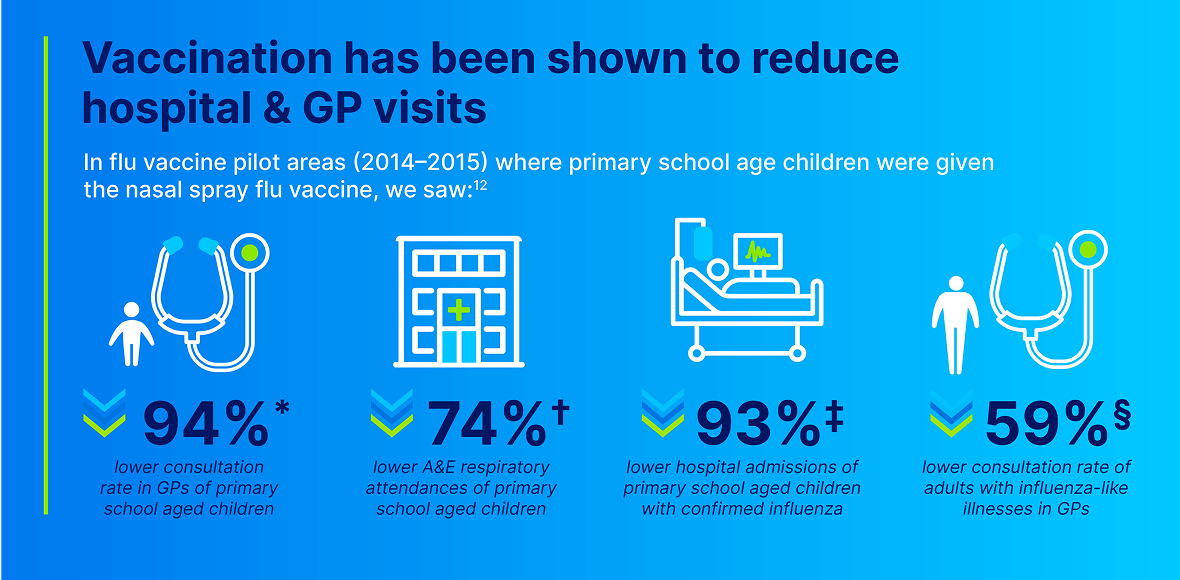
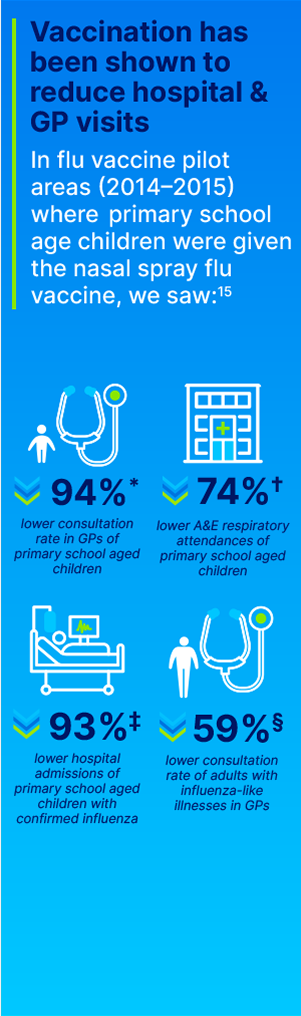
Infographic showing that vaccination has been shown to reduce hospital and GP visits Infographic showing that vaccination has been shown to reduce hospital and GP visits

*Based on GP consultations per 100,000 population. Absolute risk difference, 247 (primary 19.7/non-pilot 266.9); †Based on percentage attendance. Absolute risk difference, 9 (primary 5.3/non-pilot 14.1); ‡Based on confirmed admissions per 100,000 population. Absolute risk difference, 16 (primary 1.5/non-pilot 17.7); §Based on consultations per 100,000 population. Absolute risk difference, 289 (primary 219.1/non-pilot 508.1)

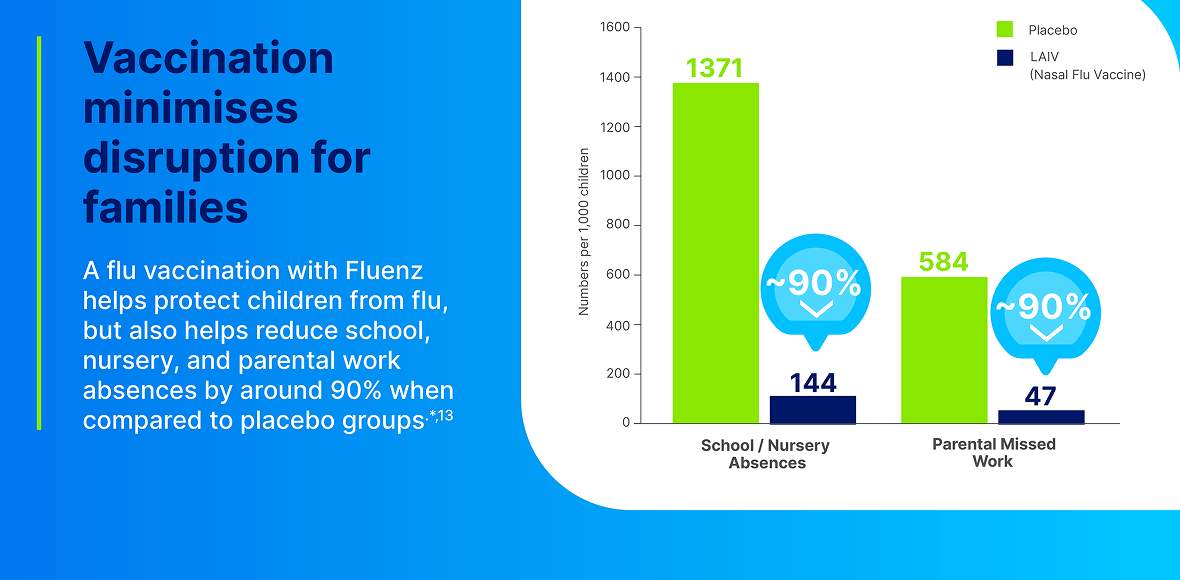
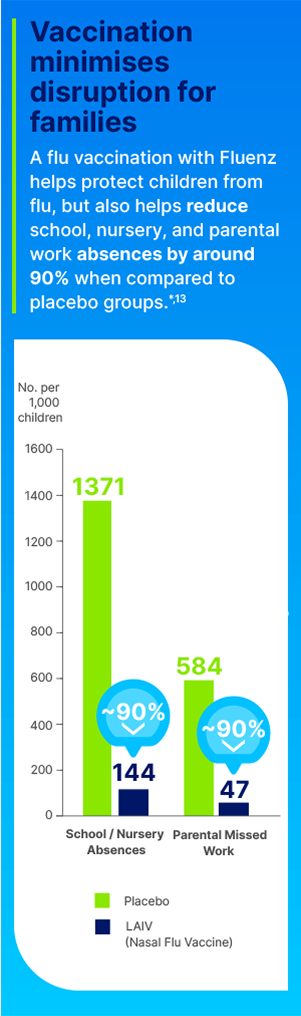
Vaccination minimises disruption for families Vaccination minimises disruption for families

*Data for this study were obtained from three previous prospective, randomized, controlled trials evaluating the efficacy and safety of LAIV in children in Europe and Israel: Study 1 (Vesikari et al.): Examined LAIV versus placebo in 1,784 children aged 6–35 months attending day care. Study 2 (Ashkenazi et al.): Investigated LAIV versus IIV in 2,187 children aged 6–71 months with recurrent respiratory tract infections. Study 3 (Fleming et al.): Compared LAIV versus IIV in 2,229 children aged 6–17 years with asthma.

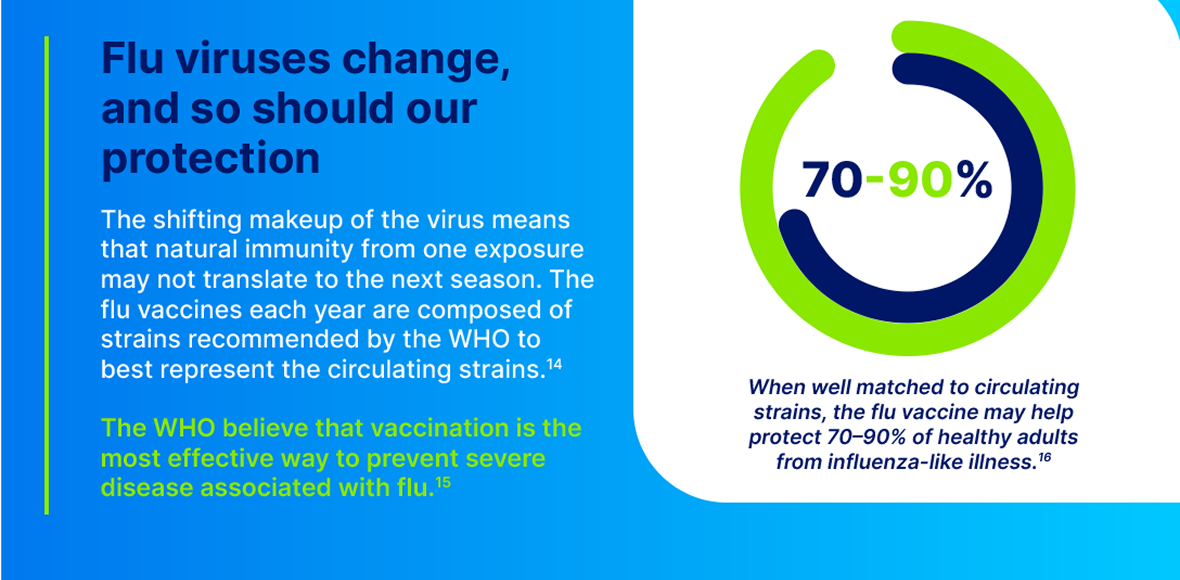
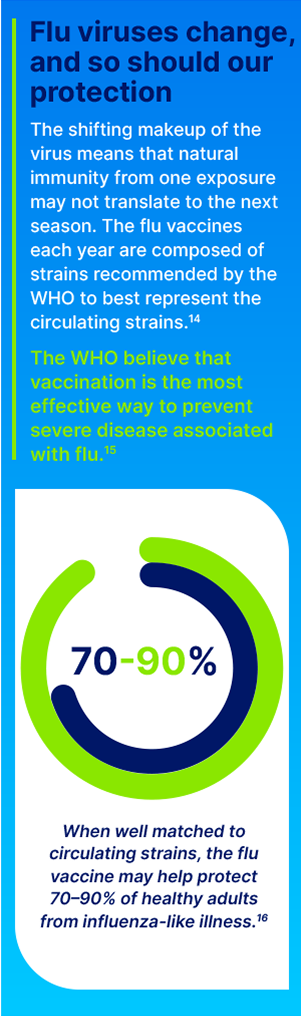
Flu viruses change, and so should our protection Flu viruses change, and so should our protection

Back to top

For a full list of ingredients, please refer to the FLUENZ nasal spray suspension (influenza vaccine, live attenuated, nasal)
Summary of Product Characteristics.

Sign up now

Would you like to opt in to promotional and non-promotional service and product information?

Find out more

Resources for you and those you care for

Explore the resources available to you in our Resource Hub

View Resources

Get in touch

For additional administration support, request a call back

from the AZExchange team.

Contact us

ETAGE, European Technical Advisory Group of Experts; WHO, World Health Organization; LAIV, live attenuated influenza vaccine; GP, general practitioner; A&E, accident and emergency.

  1. GOV.UK (2025) Influenza in the UK, annual epidemiological report: Winter 2024 to 2025. Available at: https://www.gov.uk/government/statistics/influenza-in-the-uk-annual-epidemiological-report-winter-2024-to-2025/influenza-in-the-uk-annual-epidemiological-report-winter-2024-to-2025#:~:text=estimated%20at%207%2C757%20deaths (Accessed: August 2025).
  2. Romanelli RJ, et al. Rand Health Q. 2023 Sep 15;10(4):2.
  3. NHS England (2023) NHS pressure continues as hospitals deal with high bed occupancy. Available at: https://www.england.nhs.uk/2023/01/nhs-pressure-continues-as-hospitals-deal-with-high-bed-occupancy/ (Accessed: August 2025).
  4. UK Health Security Agency (2025) Flu vaccine prevented around 100,000 hospital admissions, GOV.UK. Available at: https://www.gov.uk/government/news/flu-vaccine-prevented-around-100000-hospital-admissions (Accessed: August 2025).
  5. Zavaleta-Monestel E,et al. Cureus. 2024 Jul 31;16(7):e65840.
  6. Centers for Disease Control and Prevention (2021) Epidemiology and Prevention of Vaccine-Preventable Diseases, 14th ed. Washington DC: Public Health Foundation. Available at: https://www.cdc.gov/pinkbook/hcp/table-of-contents/chapter-12-influenza.html?CDC_AAref_Val=https://www.cdc.gov/vaccines/pubs/pinkbook/flu.html (Accessed: August 2025)
  7. NHS (2023) Children's flu vaccine. Available at: https://www.nhs.uk/conditions/vaccinations/child-flu-vaccine/ (Accessed: March 2025)
  8. Cromer D, et al. J Infect. 2014;68(4):363-371.
  9. Weycker D, et al. Vaccine 2005;23:1284–93
  10. NHS Inform (2024) Flu. Available at: https://www.nhsinform.scot/illnesses-and-conditions/infections-and-poisoning/flu (Accessed: October 2025)
  11. Czumbel I, et al. BMC Infect Dis 2018;18:199
  12. Pebody RG, et al. Euro Surveill 2015;20(39):30029
  13. Ambrose, C.S., Antonova, E.N. Eur J Clin Microbiol Infect Dis. 2014;33, 569–575.
  14. World Health Organization (2025) Global Influenza Programme. Available at: https://www.who.int/teams/global-influenza-programme/vaccines (Accessed: October 2025)
  15. World Health Organization (2018) Influenza vaccination coverage and effectiveness. Available at: https://www.who.int/europe/news-room/fact-sheets/item/influenza-vaccination-coverage-and-effectiveness (Accessed: October 2025)
  16. Sambhara S, McElhaney JE. Immunosenescence and influenza vaccine efficacy. Curr Top Microbiol Immunol. 2009;333:413-29.

GB-69531 | November 2025

Adverse events should be reported. Reporting forms and information can be found at www.mhra.gov.uk/yellowcard or search for MHRA Yellow Card in the Google Play or Apple App Store. Adverse events should also be reported to AstraZeneca by visiting https://contactazmedical.astrazeneca.com/ or by calling ‌‌‌0‌‌‌8‌‌‌‌‌0‌‌‌‌0‌‌‌ ‌‌7‌‌‌‌‌‌8‌‌‌3‌‌‌ ‌‌0‌‌‌‌‌0‌‌‌‌3‌‌‌‌3‌‌‌.

Connessiallasalute.it

This website was created for UK HCPs and has been designed to provide information to educate, empower and enable them in the great work they are doing for patients across a range of therapy areas. This website is intended for doctors, nurses, and pharmacists in the UK. Other UK residents please visit astrazeneca.co.uk.

Terms of use

Privacy Policy

Cookie Policy

Contact Us

LinkedIn

Twitter

©2024 AstraZeneca. GB-75991 | April 2026