This is a promotional website developed by AstraZeneca and intended for UK Healthcare Professionals only. Other UK residents please visit astrazeneca.co.uk.




For full dosing and administration information, please refer to the TRUQAP (capivasertib) and fulvestrant SmPCs.1,2
The intermittent dosing schedule of TRUQAP aims to manage side effects whilst optimising inhibition of the PI3K/AKT pathway.1
TRUQAP: 4 days on, 3 days off.1
Dosing schedule
In this combination treatment, the recommended dose of TRUQAP is 400 mg (two 200 mg tablets) taken orally, twice a day, approximately 12 hours apart (total daily dose of 800 mg).1
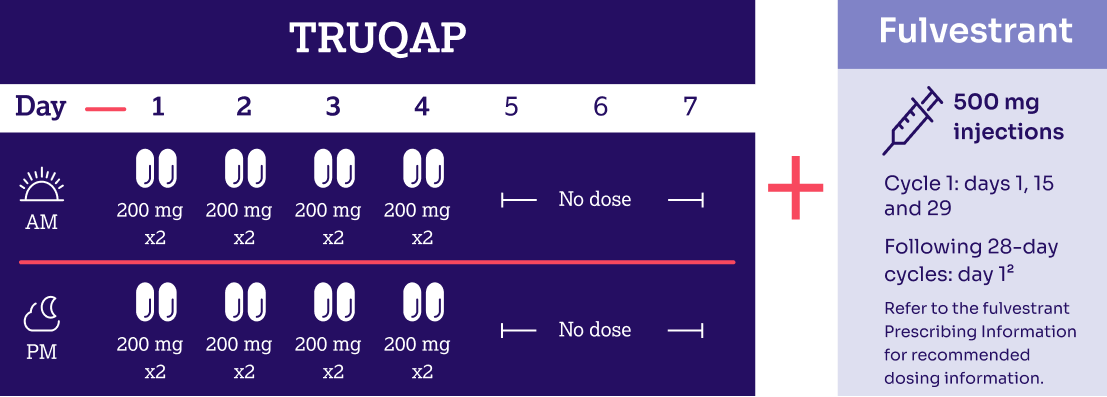
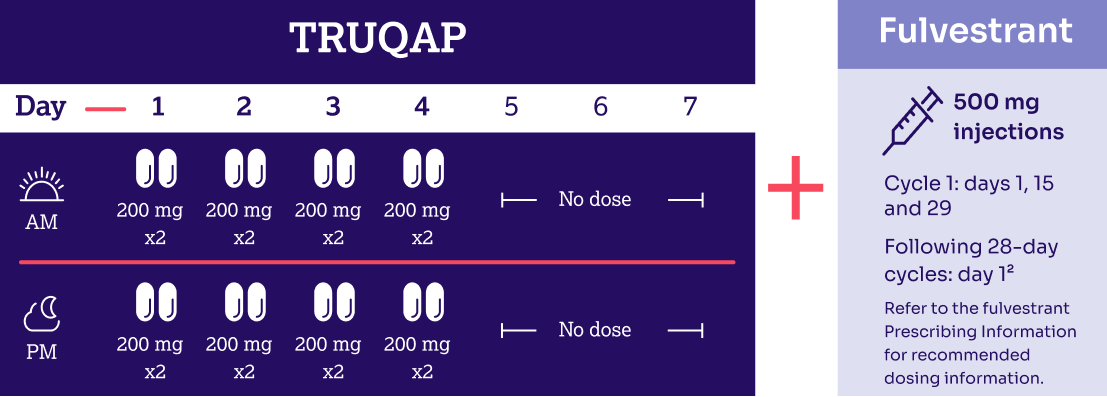
TRUQAP has the same dosing schedule, even when modifications need to be made1
Reduce the burden of potential side effects for your patients without changing their dosing schedule.
Dose modifications to manage AEs such as diarrhoea, hyperglycaemia, rash and other toxicities may allow patients to continue to benefit from TRUQAP plus fulvestrant, rather than having their treatment discontinued.
The table here provides guidance on dose modifications relating to adverse reactions, which can be further explored in the tabs below.
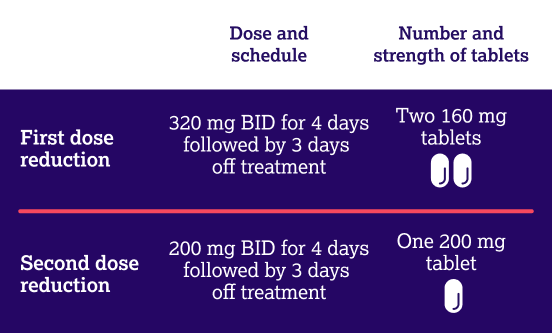
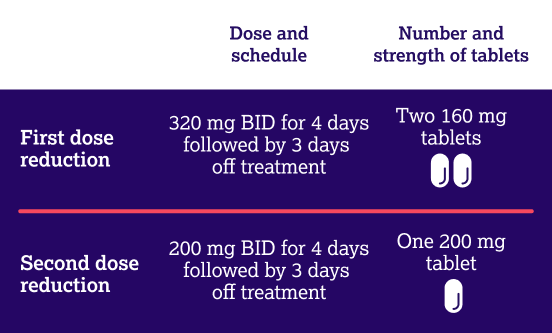
The dose of TRUQAP can be reduced up to two times.1
AE management
Explore guidance on selected adverse reactions
Grade 1
(Fasting glucose: >ULN–160 mg/dL or >ULN–8.9 mmol/L or HbA1c >7%)1
- No dose adjustment required
- Consider initiation or intensification of oral anti-diabetic treatment†
Grade 2
(Fasting glucose: >160–250 mg/dL or >8.9–13.9 mmol/L)1
- Initiate or intensify oral anti-diabetic treatment
- Withhold TRUQAP until fasting glucose level decreases to ≤8.9 mmol/L (or ≤160 mg/dL)
- If recovery occurs in ≤28 days, resume TRUQAP at the same dose and maintain initiated or intensified anti-diabetic treatment
- If improvement to ≤8.9 mmol/L (or ≤160 mg/dL) is reached in more than 28 days, restart at one lower dose level and maintain initiated or intensified anti-diabetic treatment
Grade 3
(Fasting glucose: >250–500 mg/dL or >13.9–27.8 mmol/L)1
- Withhold TRUQAP until fasting glucose level decreases to ≤8.9 mmol/L (or ≤160 mg/dL) and consult a diabetologist
- Initiate or intensify oral anti-diabetic treatment
- Consider additional anti-diabetic medicinal products such as insulin‡, as clinically indicated. Consider intravenous hydration and provide appropriate clinical management as per local guidelines
- If fasting glucose decreases to ≤8.9 mmol/L (or ≤160 mg/dL) within 28 days, restart TRUQAP at one lower dose level and maintain initiated or intensified anti-diabetic treatment
- If fasting glucose does not decrease to ≤8.9 mmol/L (or ≤160 mg/dL) within 28 days following appropriate treatment, permanently discontinue TRUQAP
Grade 4
(Fasting glucose: >500 mg/dL or >27.8 mmol/L)1
- Withhold TRUQAP and consult a diabetologist
- Initiate or intensify appropriate anti-diabetic treatment
- Consider insulin‡, as clinically indicated, intravenous hydration and provide appropriate clinical management as per local guidelines
- If fasting glucose decreases to ≤27.8 mmol/L (or ≤500 mg/dL) within 24 hours, then follow the guidance for the relevant grade
- If fasting glucose is confirmed at ≥27.8 mmol/L (or >500 mg/dL) after 24 hours, permanently discontinue TRUQAP treatment
Consultation with a diabetologist should be considered when selecting, initiating or intensifying an antidiabetic treatment.
If DKA is suspected, immediately interrupt TRUQAP. If DKA is confirmed, permanently discontinue TRUQAP.
*The SmPC categorises hyperglycaemia to include hyperglycaemia, blood glucose increased, diabetes mellitus, type 2 diabetes mellitus and diabetic metabolic decompensation.1
†Consultation with a diabetologist should be considered when selecting the anti-diabetic medicinal product. A potential for hypoglycaemia with anti-diabetic medicinal product administration on non-TRUQAP dosing days should be taken into account. Patients should also consider consultation with a dietitian to make lifestyle changes that may reduce hyperglycaemia.1
‡There is limited experience in patients receiving insulin when being treated with TRUQAP.1
Grade 1
- No dose adjustment required
- Initiate appropriate anti-diarrhoeal therapy, maximise supportive care and monitor as clinically indicated
Grade 2
- Initiate or intensify anti-diarrhoeal treatment and monitor as clinically indicated
- Withhold TRUQAP for up to 28 days until recovery to ≤grade 1 and resume at same dose or one lower dose level, as clinically indicated
- Persistent/recurrent: maintain appropriate medical therapy and restart at one lower dose level, as clinically indicated
Grade 3
- Withhold TRUQAP until recovery to ≤grade 1
- Initiate or intensify appropriate anti-diarrhoeal treatment and monitor as clinically indicated
- If recovery occurs in ≤28 days, resume TRUQAP at one lower dose level
- If recovery to ≤grade 1 in >28 days, permanently discontinue TRUQAP
Grade 4
- Permanently discontinue TRUQAP
Grade 1
- No dose adjustment required
- Initiate emollients and consider adding oral non-sedating antihistamine treatment as clinically indicated to manage symptoms
Grade 2
- Withhold TRUQAP until recovery to ≤grade 1
- Initiate or intensify topical steroid treatment and consider non-sedating oral antihistamines
- If recovery occurs in ≤28 days, resume TRUQAP at the same dose level
- Persistent/recurrent: restart TRUQAP by one lower dose level
Grade 3
- Withhold TRUQAP until recovery to ≤grade 1
- Initiate appropriate dermatological treatment with topical steroid of moderate/higher strength, non-sedating oral antihistamines and/or systemic steroids
- If recovery occurs in ≤28 days, restart TRUQAP on one lower dose level
- If the symptoms do not improve to ≤grade 1 within 28 days, discontinue TRUQAP
- In patients with reoccurrence of intolerable grade 3 rash, permanently discontinue TRUQAP
Grade 4
- Permanently discontinue TRUQAP
*The SmPC categorises cutaneous adverse drug reactions to include butterfly rash, dermatitis, dermatitis exfoliative generalised, drug eruption, drug reaction with eosinophilia and systemic symptoms (DRESS), erythema, erythema multiforme, papule, rash, rash erythematous, rash follicular, rash macular, rash maculopapular, rash papular, rash pruritic, skin reaction and toxic skin eruption.1
Grade 1
- No TRUQAP dose adjustment required
- Initiate appropriate medical therapy and monitor as clinically indicated
Grade 2
- Withhold TRUQAP until symptoms improve to ≤grade 1
Grade 3
- Withhold TRUQAP until symptoms improve to ≤grade 1
- If symptoms improve, restart TRUQAP at same dose or one lower dose level as clinically appropriate
Grade 4
- Permanently discontinue TRUQAP
Hyperglycaemia, diarrhoea, cutaneous adverse drug reactions (including rash) and use in patients receiving bisphosphonates or RANK-ligand inhibitors are listed as special warnings in the TRUQAP SmPC.1
Please see the TRUQAP SmPC for further information on AEs and their management.
Hyperglycaemia monitoring
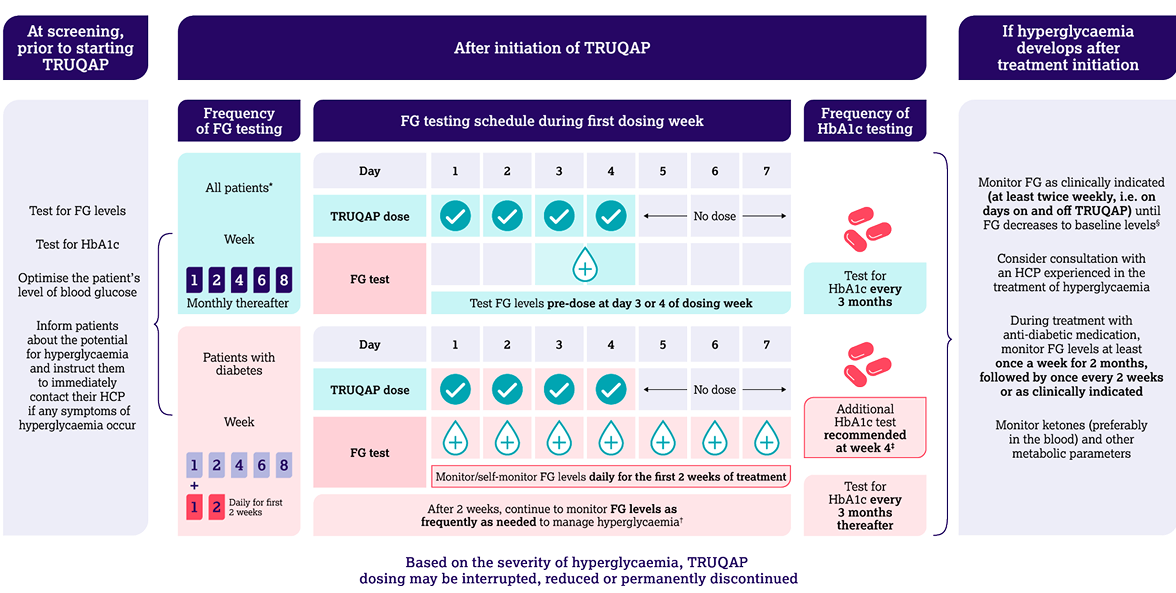
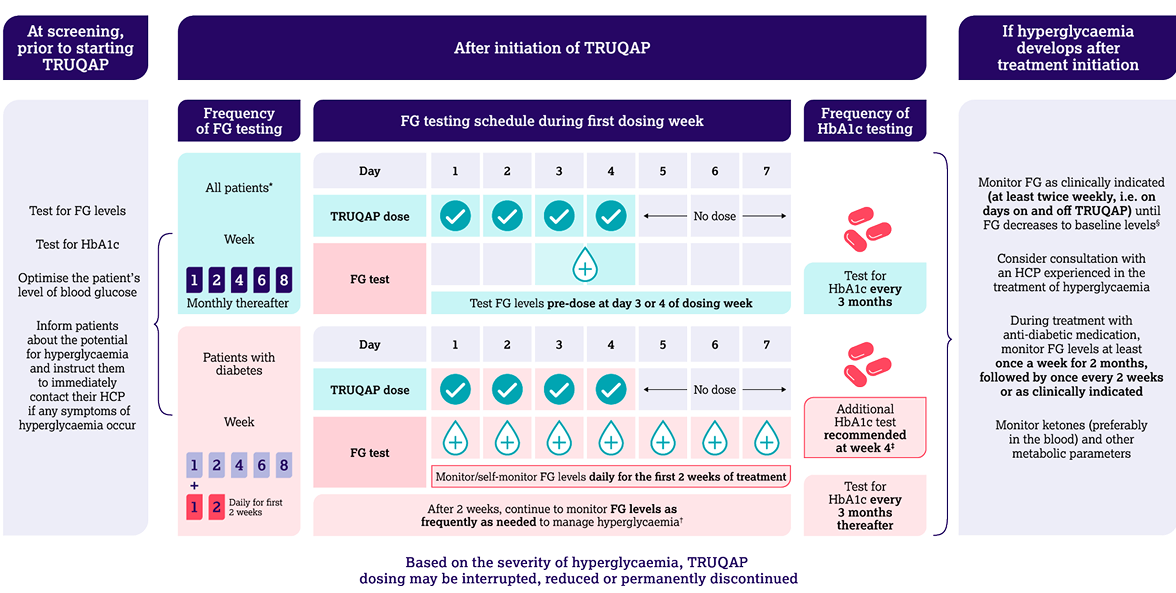
More frequent FG testing is required in:
- Patients with a medical history of diabetes mellitus
- Patients without prior history of diabetes mellitus and showing FG of >ULN 160 mg/dL (>ULN 8.9 mmol/L) during treatment
- Patients with concomitant use of corticosteroids or in those with intercurrent infections or other conditions that may require intensified hyperglycaemia management to prevent worsening of impaired glucose metabolism and potential complications, namely DKA
*Additional FG monitoring/self-monitoring may be required more frequently in the first 4 weeks and especially within the first 2 weeks of treatment, according to the instructions of an HCP.1
†All FG monitoring should be performed at the physician’s discretion as clinically indicated.1
‡Additional HbA1c testing is recommended at week 4 in patients with diabetes, pre-diabetes or hyperglycaemia at baseline.1
§Recommended to test FG levels pre-dose at day 3 or 4 of dosing week.1


Multiple factors influence the risk of hyperglycaemia3–6
It is important to recognise these and advise patients on appropriate lifestyle changes.
There are several factors that increase the risk of hyperglycaemia and/or DKA. These include, but are not limited to:3–6






Dosing and treatment advice to discuss with your patients1












AE=adverse event; AKT=serine/threonine protein kinase; AST=aspartate aminotransferase; BID=twice daily; BMI=body mass index; CrCl=creatinine clearance; CYP3A4=cytochrome P450 3A4; DKA=diabetic ketoacidosis; FG=fasting glucose; HbA1c=glycated haemoglobin; HCP=healthcare professional; LHRH=luteinising hormone releasing hormone; PI3K=phosphatidylinositol-3 kinase; RANK=receptor activator of nuclear factor-κB; SmPC=Summary of Product Characteristics; ULN=upper limit of normal.
- TRUQAP (capivasertib) 160 mg and 200 mg. Summary of Product Characteristics.
- Faslodex (fulvestrant). Summary of Product Characteristics.
- Shahid RK, et al. Cancers. 2021;13:5735.
- Lizzo JM, et al. Adult Diabetic Ketoacidosis. [Updated 2023 Jul 10]. In: StatPearls [Internet]. Treasure Island (FL): StatPearls Publishing; 2024 Jan. Available at: https://www.ncbi.nlm.nih.gov/books/NBK560723/. Accessed April 2026.
- Umpierrez GE, et al. Diabetes Care. 2024;47:1257–1275.
- Umpierrez GE. Endocrinology. Springer, Cham. 2018. Available at: https://doi.org/10.1007/978-3-319-44433-8_21. Accessed April 2026.
GB-68394 | April 2026
Adverse events should be reported. Reporting forms and information can be found at www.mhra.gov.uk/yellowcard or search for MHRA Yellow Card in the Google Play or Apple App Store. Adverse events should also be reported to AstraZeneca by visiting https://contactazmedical.astrazeneca.com/ or by calling 0800 783 0033.

This website was created for UK HCPs and has been designed to provide information to educate, empower and enable them in the great work they are doing for patients across a range of therapy areas. This website is intended for doctors, nurses, and pharmacists in the UK. Other UK residents please visit astrazeneca.co.uk.