This is a promotional website developed by AstraZeneca and intended for UK Healthcare Professionals only. Other UK residents please visit astrazeneca.co.uk.




Adaptive changes along the PI3K/AKT pathway can drive treatment resistance and disease progression in patients with
HR+/HER2-negative aBC.1,2
TRUQAP (capivasertib) plus fulvestrant is a targeted therapy that uses AKT inhibition and ER downregulation to address this treatment resistance.1
| Key genetic alterations | Consequence |
|---|---|
| Point mutations of PIK3CA4 | Hyperactivation of PI3K |
| Point mutations of AKT15 | Constitutive signal activation of AKT |
| Point mutations, large deletions and genomic rearrangements involving PTEN6 | Loss of function of PTEN |
Biomarker testing for patients with HR+/HER2-negative aBC is vital to ensure actionable biomarkers are identified at the time of diagnosis and reported to help inform appropriate treatment decisions.7
All genetic tests carried out in the UK are provided by a network of Genomic Laboratory Hubs.8 The tests available for patients with breast cancer are outlined in the National Genomic Test Directory for Cancer (this external link is not owned by AstraZeneca), which provides testing information with
respect to:9








The National Genomic Test Directory for Cancer is updated each year to ensure healthcare professionals have access to the latest diagnostics and treatments for patients.9
Most tests for breast cancer genomic analysis in the UK utilise NGS panel testing, which is a high-throughput approach to DNA sequencing using the concept of mass parallel processing.10 Employing this technique for your patients with HR+/HER2-negative aBC can help to provide a comprehensive profile of potential alterations in the PI3K/AKT pathway.11
Tissue testing
Test at aBC diagnosis with M3.6 test code using tissue biopsy9
Test code M3.6 utilises a tissue-based, multi-target NGS panel to detect small variants and CNVs, providing a molecular level assessment of the PIK3CA/ATK1/PTEN genes to aid diagnosis and management of breast cancer.
Archival tissue: if diagnostic biopsy tissue is unavailable, archival tissue (such as from primary tumour resection) may be used instead.12
ctDNA testing
Test at disease progression with M3.13 test code using ctDNA
liquid biopsy9
Test code M3.13 utilises a ctDNA-based, multi-target NGS panel to detect small variants and CNVs in PIK3CA/AKT1/PTEN genes to aid treatment decisions in patients with HR+/HER2-negative locally advanced or metastatic breast cancer that has progressed on 1L endocrine treatment.*
*Aromatase inhibitor plus CDK4/6 inhibitor.
It is important to first look back at previous NGS reports and consult with your genomic testing provider to see if further information on PIK3CA/AKT1/PTEN status can be made available from the original test.
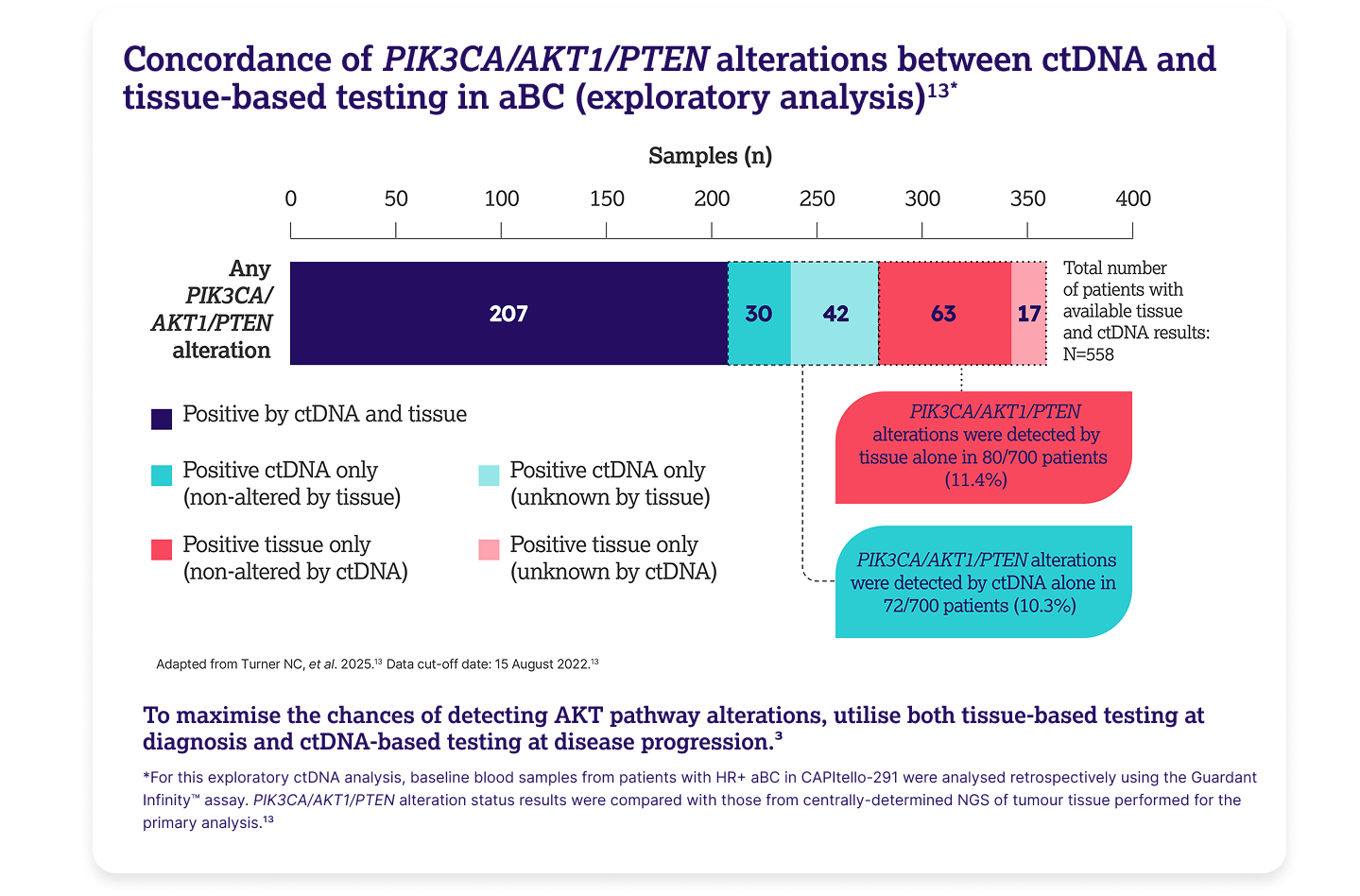
If you have identified one or more PIK3CA/AKT1/PTEN alterations, your patient may be eligible for treatment with TRUQAP plus fulvestrant.


Resources for you and
your patients
Learn more about genomic testing in our comprehensive
resources and explore materials designed to support
your patients throughout the treatment journey with
TRUQAP plus fulvestrant.
GB-68389 | April 2026
Adverse events should be reported. Reporting forms and information can be found at www.mhra.gov.uk/yellowcard or search for MHRA Yellow Card in the Google Play or Apple App Store. Adverse events should also be reported to AstraZeneca by visiting https://contactazmedical.astrazeneca.com/ or by calling 0800 783 0033.

This website was created for UK HCPs and has been designed to provide information to educate, empower and enable them in the great work they are doing for patients across a range of therapy areas. This website is intended for doctors, nurses, and pharmacists in the UK. Other UK residents please visit astrazeneca.co.uk.