Welcome to this UK AstraZeneca produced and funded website

This website is intended for UK Healthcare Professionals only.


The website contains both promotional and non-promotional content.


If you are a patient or a carer of a patient prescribed an AstraZeneca product, please visit myazmed.co.uk


For any other UK residents please visit astrazeneca.co.uk

I am not a Healthcare Professional
Prescribing Information Tezspire®▼(tezepelumab)
Adverse Event Reporting
Safety Information

This website is intended for UK Healthcare professionals only. Other UK residents please visit astrazeneca.co.uk

AstraZeneca-logo
  • Our Medicines
    • Cardiovascular, Renal & Metabolism
      • ATTR Amyloidosis
        • WAINZUA®▼(eplontersen)
      • Chronic Kidney Disease (CKD)
        • FORXIGA® (dapagliflozin)
      • Heart Failure
        • FORXIGA® (dapagliflozin)
      • Hyperkalaemia
        • LOKELMA® (sodium zirconium cyclosilicate)
      • Type 2 Diabetes (T2D)
        • FORXIGA® (dapagliflozin)
    • Oncology
      • Breast Cancer
        • LYNPARZA® (olaparib)
        • TRUQAP®▼(capivasertib)
      • Bladder Cancer
        • IMFINZI® (durvalumab)
      • Endometrial Cancer
        • IMFINZI® (durvalumab)
        • LYNPARZA® (olaparib)
      • Gastrointestinal Cancer
        • IMFINZI® (durvalumab)
        • IMJUDO®▼(tremelimumab)
      • Lung Cancer
        • IMFINZI® (durvalumab)
        • TAGRISSO® (osimertinib)
      • Ovarian Cancer
        • LYNPARZA® (olaparib)
      • Prostate Cancer
        • LYNPARZA® (olaparib)
        • ZOLADEX® (goserelin)
    • Respiratory
      • Asthma
        • TEZSPIRE®▼ (tezepelumab)
        • SYMBICORT® (budesonide/formoterol)
      • Chronic Obstructive Pulmonary Disease(COPD)
        • TRIXEO AEROSPHERE® (formoterol fumarate dihydrate/glycopyrronium/budesonide)
        • BEVESPI® (glycopyrronium/formoterol fumarate dihydrate)
    • Vaccines
      • Flu
        • FLUENZ® nasal spray suspension (influenza vaccine, live attenuated, nasal)
  • Therapy Areas
    • Cardiovascular, Renal & Metabolism
      • ATTR Amyloidosis
      • Chronic Kidney Disease (CKD)
      • Heart Failure
      • Hyperkalaemia
      • Type 2 Diabetes (T2D)
    • Oncology
      • Breast Cancer
      • Bladder Cancer
      • Endometrial Cancer
      • Gastrointestinal Cancer
      • Lung Cancer
      • Ovarian Cancer
      • Prostate Cancer
    • Respiratory
      • Asthma
      • Chronic Obstructive Pulmonary Disease(COPD)
    • Vaccines
      • Flu
  • About us
    • AZ Commitment
  • Contact us
  • AstraZeneca UK
  • Tezspire
  • Efficacy
  • Study Design
  • Welcome to Tezspire
  • CRSwNP
  • How it works
  • Efficacy
    • Overview
    • Study Design
    • Exacerbation Data
    • Lung Function
    • Quality of Life
  • Patient Profiles
  • Safety
  • Dosing
  • Resources
    • Resources
    • Video Library
TEZSPIRE® (tezepelumab): Study Design
hero_campaign_image.png

TEZSPIRE® (tezepelumab): study designs


See full indication


The phase IIb PATHWAY study examined the efficacy and safety of three doses of tezepelumab in adults with uncontrolled asthma1

pathway-desktop

View fullscreen

Adapted from Corren J, et al. NEJM. 2017.1

  • Patient population: Non-smokers, 18–75 years, ACQ ≥1.5,medium- or high-dose ICS + LABA for ≥6 months ± other controllers, ± OCS, ≥2 exacerbations requiring SCS or 1 requiring hospitalisation in past year1
  • Patients stratified by location (Japan or ROW), bEOS count (≥250 or <250 cells/μL), and dose level of inhaled glucocorticoids (medium or high)
  • Primary endpoint: AAER over 52 weeks1
  • Key secondary endpoints: Change from baseline in:1
    • Pre-BD and post-BD FEV1
    • ACQ-6
    • AQLQ(S)+12
    • Asthma symptom score
  • Safety outcome: Adverse event incidence1

AAER=annualised asthma exacerbation rate; ACQ-6=asthma control questionnaire-6 items; AQLQ(S)+12=standardised asthma quality of life questionnaire for 12 years and older; bEOS=blood eosinophils; BD=bronchodilator; FEV1=forced expiratory volume in the first second; ICS=inhaled corticosteroids; LABA=long-acting beta agonist; OCS=oral corticosteroids; Q2W=every 2 weeks; Q4W=every 4 weeks; R=randomisation; SC=subcutaneous; SCS=systemic corticosteroid.

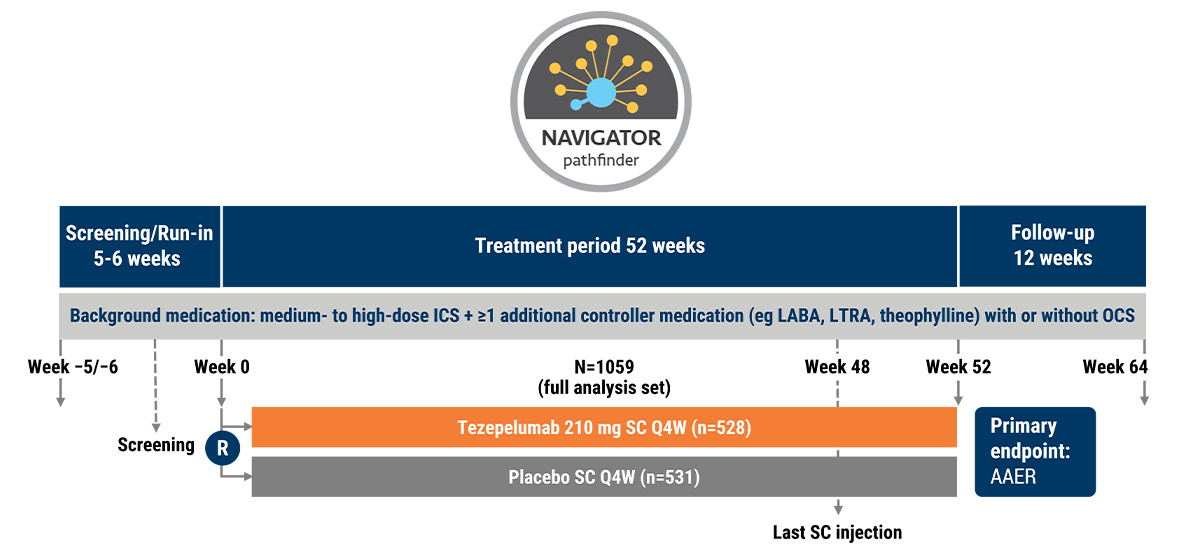
NAVIGATOR phase III exacerbation study in adults and adolescents with severe, uncontrolled asthma2,3

navigator

View fullscreen

Adapted from Menzies-Gow A, et al. NEJM. 2021 and Menzies-Gow A et al Respir Res. 2020.2,3

  • Patient population: Non-smokers, 12–80 years, ACQ ≥1.5,medium- or high-dose ICS + LABA for ≥12 months, ± OCS, and + ≥1 additional controller medication for ≥3 months, ≥2 exacerbations requiring SCS or 1 requiring hospitalisation in past year3
  • 7.7% of subjects were adolescents (≥12 - <18 years, n=82)2
  • Exclusion criteria: any pulmonary disease other than asthma, infection requiring antibiotic or antiviral treatment in 2 weeks prior, helminth/parasitic infection in 6 months prior, history of cancer, HIV or hepatitis B or C , current smokers or those with a history of ≥10 pack-years, history of anaphylaxis after biologic therapy, pregnant, breastfeeding or lactating2
  • Primary endpoint:
    • AAER over 52 weeks; all patients
    • AAER over 52 weeks; Patients with baseline EOS <300 cells/µL
  • Key secondary endpoints: Change from baseline in: Pre-BD FEV1, ACQ-6 score, AQLQ(S)+12 score and ASD
  • Additional secondary endpoints:
    • AAER associated with an ED visit or hospitalisation and hospitalisation only
    • Change from baseline in FeNO, serum total IgE, bEOS
  • Safety outcome: Adverse event incidence3

AAER=annualised asthma exacerbation rate; ACQ-6=asthma control questionnaire-6 items; ASD=asthma symptom diary; AQLQ=Asthma Quality of Life Questionnaire; BD=bronchodilator; bEOS=blood eosinophils; ED=emergency department; EOS=eosinophils; FEV1=forced expiratory volume in the first second; FeNO=fractional exhaled nitric oxide; HIV=human immunovirus; IgE=immunoglobulin E; ICS=inhaled corticosteroids; LABA=long-acting beta agonist; LTRA=leukotriene receptor antagonist; OCS=oral corticosteroids; Q4W=every 4 weeks; R=randomisation; SC=subcutaneous;SCS=systemic corticosteroid.

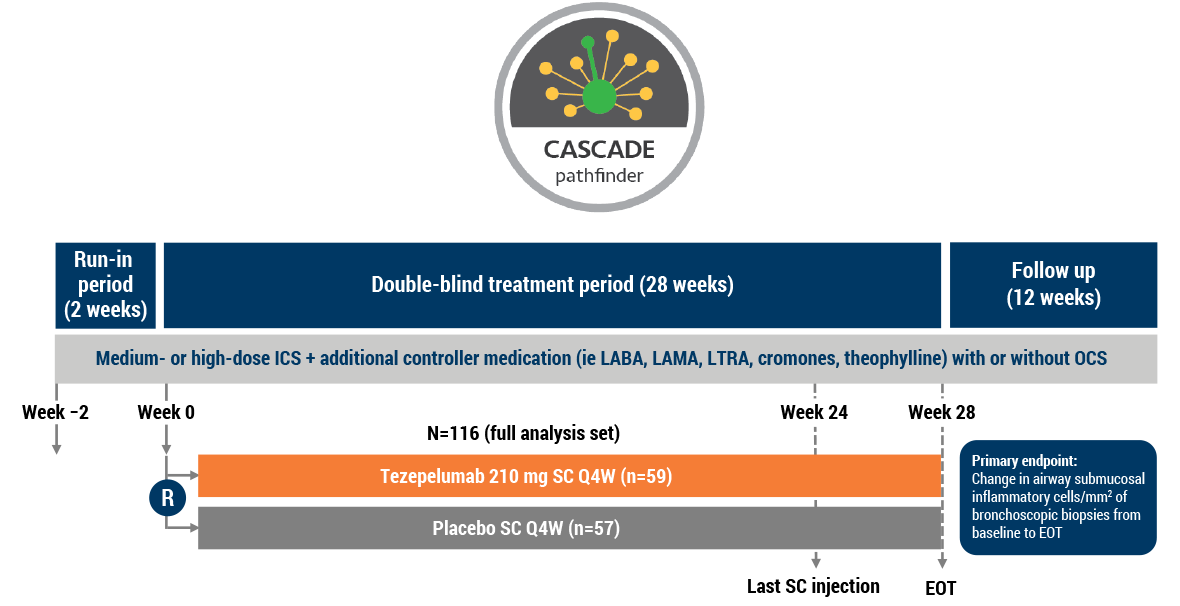
Phase II CASCADE: mechanistic study observations4-6

hospitalisation_panel_image

View fullscreen

Figure adapted from Emson C, et al. Respir Resp. 2020, Diver S, et al. Lancet Respir Med. 2021 and Diver S, et al. Poster: ATS. International Conference. 2021.4-6

  • Patient population: Medium to severe asthma, non-smokers, 18-75 years, ACQ ≥1.5, medium- or high-dose ICS  for ≥12 months, and + ≥1 additional controller medication +/- maintenance OCS for ≥3 month5
  • Primary endpoint: Change from baseline to Week 28 in airway submucosal inflammatory cells (eosinophils, neutrophils, T cells and mast cells) from bronchoscopic biopsies4
  • Key secondary endpoints: Assessing airway remodeling, from change from baseline in reticular basement membrane (RBM) thickness and epithelial integrity (proportions of damaged, denuded and intact epithelium)4
  • Selected exploratory endpoint: Change from baseline to end of treatment in airway hyperresponsiveness to mannitol4
  • Limitations: Patients were recruited to this trial mainly on the basis of treatment requirements and lung function measures, which did not translate into the expected baseline histological features. Because bronchoscopies for research purposes were not permitted during COVID-19 pandemic in countries where the study was conducted, for participants who could not visit the study site at Week 28 owing to the COVID-19 pandemic, treatment was extended to up to 52 weeks until they were able to visit the study site4,6
  • Safety outcome: Adverse event incidence4
  • The reduction in airway submucosal eosinophils with tezepelumab in this study was observed despite baseline submucosal eosinophil counts being lower than expected for patients with moderate-to-severe asthma4

TEZSPIRE (tezepelumab) is indicated as an add-on maintenance treatment in adults and adolescents 12 years and older with severe asthma who are inadequately controlled despite high dose inhaled corticosteroids plus another medicinal product for maintenance treatment7

ACQ=asthma control questionnaire; EOT=end of treatment; ICS=inhaled corticosteroid; LABA=long-acting beta agonist; LAMA=long-acting muscarinic antagonist; LTRA=leukotriene receptor antagonist; OCS=oral corticosteroids; Q4W=every 4 weeks; R=randomisation; SC=subcutaneous

  1. Corren J, Parnes JR, Wang L, et al. Tezepelumab in adults with uncontrolled asthma. N Engl J Med. 2017;377(10):936-946.
  2. Menzies-Gow A, Colice G, Griffiths JM, et al. NAVIGATOR: a phase 3 multicentre, randomized, double-blind, placebo-controlled, parallel-group trial to evaluate the efficacy and safety of tezepelumab in adults and adolescents with severe, uncontrolled asthma. Respir Res. 2020;21(1):266.
  3. Menzies-Gow A, Corren J, Bourdin A, et al. Tezepelumab in adults and adolescents with severe, uncontrolled asthma. N Engl J Med. 2021;384(19):1800-1809.
  4. Diver S, Khalfaoui L, Emson C, et al. CASCADE study investigators. Effect of tezepelumab on airway inflammatory cells, remodelling, and hyperresponsiveness in patients with moderate-to-severe uncontrolled asthma (CASCADE): a double-blind, randomised, placebo-controlled, phase 2 trial. Lancet Respir Med. 2021,9(11):1299-1312.
  5. Emson C, Diver S, Chachi L, et al. CASCADE: a phase 2, randomized, double-blind, placebo-controlled, parallel-group trial to evaluate the effect of tezepelumab on airway inflammation in patients with uncontrolled asthma. Respir Res. 2020,21:265.
  6. Diver S et al. Effect of tezepelumab on airway inflammatory cells, remodeling and hyperresponsiveness in patients with moderate-to-severe uncontrolled asthma: a randomized, double-blind, placebo-controlled trial (CASCADE) Poster presented at: ATS International Conference; May 14-19, 2021.
  7. Tezspire (tezepelumab). Summary of Product Characteristics. 2022. Available at: https://www.medicines.org.uk/emc/product/14064/smpc (last accessed: November 2024).

GB-56754 | November 2024

Adverse events should be reported. Reporting forms and information can be found at www.mhra.gov.uk/yellowcard or search for MHRA Yellow Card in the Google Play or Apple App Store. Adverse events should also be reported to AstraZeneca by visiting https://contactazmedical.astrazeneca.com/ or by calling ‌‌‌0‌‌‌8‌‌‌‌‌0‌‌‌‌0‌‌‌ ‌‌7‌‌‌‌‌‌8‌‌‌3‌‌‌ ‌‌0‌‌‌‌‌0‌‌‌‌3‌‌‌‌3‌‌‌.

Connessiallasalute.it

This website was created for UK HCPs and has been designed to provide information to educate, empower and enable them in the great work they are doing for patients across a range of therapy areas. This website is intended for doctors, nurses, and pharmacists in the UK. Other UK residents please visit astrazeneca.co.uk.

Terms of use

Privacy Policy

Cookie Policy

Contact Us

LinkedIn

Twitter

©2024 AstraZeneca. GB-78067 | DOP: July 2026