Welcome to this UK AstraZeneca produced and funded website

This website is intended for UK Healthcare Professionals only.


The website contains both promotional and non-promotional content.


If you are a patient or a carer of a patient prescribed an AstraZeneca product, please visit myazmed.co.uk


For any other UK residents please visit astrazeneca.co.uk

I am not a Healthcare Professional
Prescribing Information LOKELMA® (sodium zirconium cyclosilicate)
Adverse Event Reporting

This website is intended for UK Healthcare Professionals only. Other UK residents please visit astrazeneca.co.uk

LOKELMA® (sodium zirconium cyclosilicate) is indicated for the treatment of hyperkalaemia in adult patients.

AstraZeneca-logo
  • Our Medicines
    • Cardiovascular, Renal & Metabolism
      • ATTR Amyloidosis
        • WAINZUA®▼(eplontersen)
      • Chronic Kidney Disease (CKD)
        • FORXIGA® (dapagliflozin)
      • Heart Failure
        • FORXIGA® (dapagliflozin)
      • Hyperkalaemia
        • LOKELMA® (sodium zirconium cyclosilicate)
      • Type 2 Diabetes (T2D)
        • FORXIGA® (dapagliflozin)
    • Oncology
      • Breast Cancer
        • LYNPARZA® (olaparib)
        • TRUQAP®▼(capivasertib)
      • Bladder Cancer
        • IMFINZI® (durvalumab)
      • Endometrial Cancer
        • IMFINZI® (durvalumab)
        • LYNPARZA® (olaparib)
      • Gastrointestinal Cancer
        • IMFINZI® (durvalumab)
        • IMJUDO®▼(tremelimumab)
      • Lung Cancer
        • IMFINZI® (durvalumab)
        • TAGRISSO® (osimertinib)
      • Ovarian Cancer
        • LYNPARZA® (olaparib)
      • Prostate Cancer
        • LYNPARZA® (olaparib)
        • ZOLADEX® (goserelin)
    • Respiratory
      • Asthma
        • TEZSPIRE®▼ (tezepelumab)
        • SYMBICORT® (budesonide/formoterol)
      • Chronic Obstructive Pulmonary Disease(COPD)
        • TRIXEO AEROSPHERE® (formoterol fumarate dihydrate/glycopyrronium/budesonide)
        • BEVESPI® (glycopyrronium/formoterol fumarate dihydrate)
    • Vaccines
      • Flu
        • FLUENZ® nasal spray suspension (influenza vaccine, live attenuated, nasal)
  • Therapy Areas
    • Cardiovascular, Renal & Metabolism
      • ATTR Amyloidosis
      • Chronic Kidney Disease (CKD)
      • Heart Failure
      • Hyperkalaemia
      • Type 2 Diabetes (T2D)
    • Oncology
      • Breast Cancer
      • Bladder Cancer
      • Endometrial Cancer
      • Gastrointestinal Cancer
      • Lung Cancer
      • Ovarian Cancer
      • Prostate Cancer
    • Respiratory
      • Asthma
      • Chronic Obstructive Pulmonary Disease(COPD)
    • Vaccines
      • Flu
  • About us
    • AZ Commitment
  • Contact us
  • AstraZeneca UK
  • LOKELMA
  • About hyperkalaemia
  • About LOKELMA
  • Hyperkalaemia
    • About hyperkalaemia
    • Hyperkalaemia management and treatment guidelines
    • Hyperkalaemia and chronic kidney disease
    • ACEi, ARBs and hyperkalaemia
  • Unmet needs
  • NICE recommendation
  • Why LOKELMA
    • Mode of action
    • Efficacy
    • Safety profile
  • Dosing and administration
  • Resources
    • Resources
    • Videos and webinars
    • Quality Improvement Project tools
About Hyperkalaemia

lokelma-logo

About hyperkalaemia

What is hyperkalaemia?

Hyperkalaemia is a common electrolyte disorder characterised by high potassium levels in the blood.3 It is defined as serum or plasma potassium >5 mmol/L (for potassium 1 mmol/L = 1 mEq/L).2

Chart showing mild moderate and severe hyperkalaemia on a scale measuring serum potassium levels in the blood

Serum potassium levels, mmol/L

Adapted from Di Lullo et al. (2019)3

Hyperkalaemia can be life-threatening when severe, and is often asymptomatic2,4

Severe hyperkalaemia (plasma potassium >6 mmol/L) may be responsible for cardiac arrythmias leading to cardiac arrest and death, with a resulting mortality rate of up to 30%.2 However, for many patients hyperkalaemia symptoms are often not present.4

Life-threatening hyperkalaemia requires immediate treatment.2,5

Hyperkalaemia has acute and persistent forms6

Acute Hyperkalaemia
Persistent Hyperkalaemia
Occurrence
Single event7
Occurrence
Periodic or recurrent events7
Ongoing management
No6
Ongoing management
Yes6
Pathology
Abnormal net release of potassium from cells due to trauma, metabolic acidosis, haemolytic states6
Pathology
Impaired potassium excretion6
Treatment goals
  • To induce potassium flux into the intracellular space and induce potassium excretion to prevent cardiac arrhythmias6
  • To limit harm from hypoglycaemia5
Treatment goals
  • To prevent development or recurrence of hyperkalaemia by correcting the underlying disturbance in potassium homeostasis and induce excretion6

Adapted from National Kidney Foundation (2016), National Kidney Foundation (2017) and Alfonzo et al. (2020)5–7

What are the causes of hyperkalaemia?

There are various reasons why a patient may present as hyperkalaemic, including:

Spurious:8

  • Traumatic sample
  • Delayed sample
  • Thrombocytosis

Reduced output:

  • CKD8
  • RAAS blockade8
  • Renal tubular acidosis (type IV) with type 2 diabetes9
  • Medications — CNIs, etc.8

Increased intake:10

  • Diet
    • Fruit
    • Nuts
    • Chocolate

Cellular movement

  • β-blocker8
  • Poorly controlled diabetes8
  • Lactic acidosis — incomplete dissociation of acid11

Certain medications are associated with an increased risk of hyperkalaemia12

Particular drugs can cause high potassium levels including those used to manage CKD and HF, amongst other conditions.12

Mechanism
Drug
Defective aldosterone signallingImpaired renin productionβ-blockers and NSAIDs
Impaired renin-angiotensin signallingAliskiren, ACEis and ARBs
Impaired aldosterone synthesisHeparin and ketoconazole
MR blockadeSpironolactone and eplerenone
Defective distal electrogenic sodium reabsorptionENaC blockadeAmiloride, triamterene, trimethoprim, pentamidine and lithium
NCC activationCNIs
Cellular potassium translocationChanges in transcellular transportersα-Agonists, β-blockers, digoxin,
succinylcholine,* isoflurane, minoxidil
and somatostatin
Solvent drag in osmotic shiftsMannitol
Exogenous potassium loadHigh potassium contentPenicillins (intravenous)

Adapted from Hunter and Bailey (2019).12
*Succinylcholine is not licensed for use in the UK.

Hyperkalaemia disproportionately affects patients with CKD or HF, amongst other patient subgroups13–15

The incidence of hyperkalaemia in the general population is 2–3%, but is higher in certain patient subgroups:13

Up to 40–50% in people with advanced stages of CKD, especially with diabetes13

Up to ~50% in people with congestive HF (severe HF NYHA class III or IV and on background ACEi, ARB, or loop diuretic)14

Up to 17% in people with diabetes; 3-year incidence estimate16

~8–17% in people with resistant hypertension with add-on MRA therapy15,17

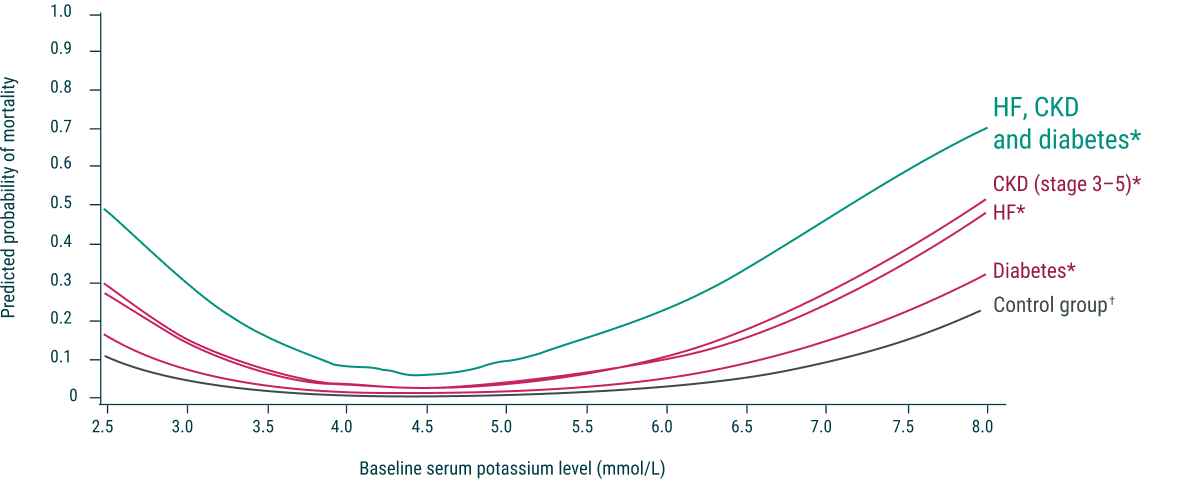
Hyperkalaemia-associated mortality is also higher in patients with cardiorenal comorbidities than in those without comorbidities18

Patients with HF and CKD have a greater risk of death from hyperkalaemia than those without these comorbidities, and those with multiple comorbidities are at even higher risk.18

Analysis of electronic medical record data from multiple US integrated health delivery networks of 911,698 patients with ≥2 potassium measurements between 2007 and 201218

Chart showing analysis of EMR data linking probability of mortality and baseline serum potassium level in heart failure, chronic kidney disease, diabetes and heart failure patients

Adapted from Collins et al. (2017)18
*Significant vs. control group;19 †Control group comprised of individuals without known HF, CKD, diabetes, CVD, or hypertension.

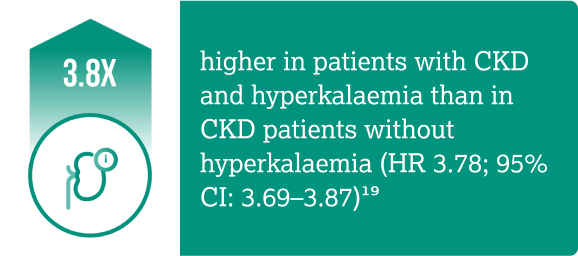
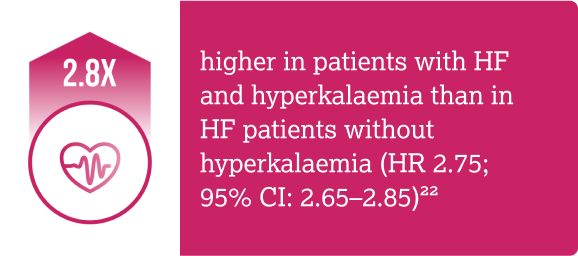
Hyperkalaemia is associated with an increase in hospitalisations in patients with CKD and HF, compared to matched controls without hyperkalaemia20,21

For patients with CKD or HF, hospitalisation associated with hyperkalaemia is:

Icon with kidney function showing relation between hyperkalaemia hospitalisation and chronic kidney disease
Icon with kidney function showing relation between hyperkalaemia hospitalisation and heart failure

Population-based cohort studies linking individual data from hospital, prescription, and laboratory databases in patients from the Danish National Patient Registry in Northern Denmark (population 1.8 million) during 2000–2012.20,21 Patients with a first-time diagnosis of CKD (N=157,766) and HF were identified (N=31,649).20,21 Hyperkalaemia defined as potassium >5.0 mmol/L.20,21

Learn more about unmet needs for cardiorenal (HF or CKD) patients in the management of hyperkalaemia


Hyperkalaemia-specific healthcare resource utilisation is of economic concern in patients with CV and renal comorbidities22

In the UK, there are high hyperkalaemia-specific costs associated with hospitalisations for patients with particular comorbidities, including:22


  • £76.6 million for CKD patients
  • £32.2 million for HF patients
  • £52.2 million for diabetes patients
  • £49.7 million for patients with hypertension
  • £6.5 million for patients on dialysis
  •  


    From a UK cohort of 498,196 patients aged ≥18 years hospitalised with hyperkalaemia between January 2003 and June 2018 and a record of relevant cardiovascular and renal comorbidities, 36.9% had hypertension, 33.8% diabetes, 35.1% CKD, 11.0% HF, and 0.6% were in receipt of dialysis.22

    Learn about how LOKELMA could help you manage hyperkalaemia in your clinical practice

    ACEi=angiotensin-converting enzyme inhibitor; ARB=angiotensin receptor blocker; CI=confidence interval; CKD=chronic kidney disease; CNI=calcineurin inhibitor; CV=cardiovascular; CVD=cardiovascular disease; ENaC=epithelial sodium channel; HF=heart failure; HR=hazard ratio; MR=mineralocorticoid receptor; MRA=mineralocorticoid receptor antagonist; NCC=sodium chloride co-transporter; NSAIDs=non-steroidal anti-inflammatory drugs; NYHA=New York Heart Association; RAAS=renin-angiotensin-aldosterone system; RAASi=renin-angiotensin-aldosterone system inhibitor.

    1. Lokelma® Summary of Product Characteristics.
    2. Rosano G, et al. Eur Heart J Cardiovasc Pharmacother. 2‌0‌1‌8;4(‌3):1‌8‌0–1‌8‌8.
    3. Di Lullo L, et al. Cardiorenal Med. 2‌0‌1‌9;9(1):8–2‌1.
    4. Galloway CD, et al. JAMA Cardiol. 2‌01‌9;4(‌5):4‌2‌8–4‌3‌6.
    5. Alfonzo A, et al. UK Renal Association. Clinical practice guidelines: Treatment of acute hyperkalaemia in adults [online], 2020. Available from: https://ukkidney.org/sites/renal.org/files/RENAL%20ASSOCIATION%20HYPERKALAEMIA%20GUIDELINE%20-%20JULY%202022%20V2_0.pdf. Accessed November 2023.
    6. National Kidney Foundation. Best Practices in Managing Hyperkalaemia in Chronic Kidney Disease [online], 2016. Available from: https://www.kidney.org/sites/default/files/02-10-7259%20Hyperkalemia%20Tool.pdf. Accessed November 2023.
    7. National Kidney Foundation. Facts About High Potassium in Patients with Kidney Disease [online], 2017. Available from: https://www.kidney.org/atoz/content/hyperkalemia/facts. Accessed November 2023.
    8. Viera A and Wouk N. Am Fam Physician. 2‌0‌1‌5;9‌2(‌6):4‌8‌7–4‌9‌5.
    9. Sousa A, et al. World J Diabetes. 2‌0‌1‌6;7(‌5):1‌0‌1–1‌1‌1.
    10. Cupisti A, et al. Nutrients. 2‌0‌1‌8;1‌0(‌3):2‌6‌1.
    11. Eleftheriadis T, et al. Hippokratia. 2‌0‌1‌2;1‌6(‌4):2‌9‌4–3‌0‌2.
    12. Hunter RW and Bailey MA. Nephrol Dial Transplant. 2019;34(3):iii2–iii11.
    13. Kovesdy CP. Nat Rev Nephrol. 2‌0‌1‌4;1‌0(1‌1):6‌5‌3–6‌6‌2.
    14. Vardeny O, et al. Circ Heart Fail. 2‌0‌1‌4;7(‌4):5‌7‌3–5‌7‌9.
    15. Chomicki J, et al. Presented at the American Society of Hypertension Annual Scientific Meeting and Exposition; 16–20 May 2014; New York, NY, USA; P-10.
    16. Nilsson E, et al. Int J Cardiol. 2‌0‌1‌7;2‌4‌5:2‌7‌7–2‌8‌4.
    17. Khosla N, et al. Am J Nephrol. 2‌0‌0‌9;3‌0(‌5):4‌1‌8–4‌2‌4.
    18. Collins AJ, et al. Am J Nephrol. 2‌0‌1‌7;4‌6(‌3):2‌1‌3–2‌2‌1.
    19. Collins AJ, et al. Am J Nephrol. 2‌0‌1‌7;4‌6(‌3):2‌1‌3–2‌2‌1. Supplementary data.
    20. Thomson R, et al. Nephrol Dial Transplant. 2‌0‌1‌8;3‌3(9):1‌6‌1‌0–1‌6‌2‌0.
    21. Thomson R, et al. J Am Heart Assoc. 2018;7(1‌1):e008‌9‌1‌2.
    22. McEwan P, et al. Value in Health. 2‌0‌2‌0;PDB5‌9:S1‌1‌9.

    GB-63501 | DOP: February 2025

    Adverse events should be reported. Reporting forms and information can be found at www.mhra.gov.uk/yellowcard or search for MHRA Yellow Card in the Google Play or Apple App Store. Adverse events should also be reported to AstraZeneca by visiting https://contactazmedical.astrazeneca.com/ or by calling 0800 783 0033.

    Connessiallasalute.it

    This website was created for UK HCPs and has been designed to provide information to educate, empower and enable them in the great work they are doing for patients across a range of therapy areas. This website is intended for doctors, nurses, and pharmacists in the UK. Other UK residents please visit astrazeneca.co.uk.

    Terms of use

    Privacy Policy

    Cookie Policy

    Contact Us

    LinkedIn

    Twitter

    ©2026 AstraZeneca. GB-76964 | DOP: May 2026