Welcome to this UK AstraZeneca produced and funded website

This website is intended for UK Healthcare Professionals only.


The website contains both promotional and non-promotional content.


If you are a patient or a carer of a patient prescribed an AstraZeneca product, please visit myazmed.co.uk


For any other UK residents please visit astrazeneca.co.uk

I am not a Healthcare Professional
Prescribing Information LOKELMA® (sodium zirconium cyclosilicate)
Adverse Event Reporting

This website is intended for UK Healthcare Professionals only. Other UK residents please visit astrazeneca.co.uk

LOKELMA® (sodium zirconium cyclosilicate) is indicated for the treatment of hyperkalaemia in adult patients.

AstraZeneca-logo
  • Our Medicines
    • Cardiovascular, Renal & Metabolism
      • ATTR Amyloidosis
        • WAINZUA®▼(eplontersen)
      • Chronic Kidney Disease (CKD)
        • FORXIGA® (dapagliflozin)
      • Heart Failure
        • FORXIGA® (dapagliflozin)
      • Hyperkalaemia
        • LOKELMA® (sodium zirconium cyclosilicate)
      • Type 2 Diabetes (T2D)
        • FORXIGA® (dapagliflozin)
    • Oncology
      • Breast Cancer
        • LYNPARZA® (olaparib)
        • TRUQAP®▼(capivasertib)
      • Bladder Cancer
        • IMFINZI® (durvalumab)
      • Endometrial Cancer
        • IMFINZI® (durvalumab)
        • LYNPARZA® (olaparib)
      • Gastrointestinal Cancer
        • IMFINZI® (durvalumab)
        • IMJUDO®▼(tremelimumab)
      • Lung Cancer
        • IMFINZI® (durvalumab)
        • TAGRISSO® (osimertinib)
      • Ovarian Cancer
        • LYNPARZA® (olaparib)
      • Prostate Cancer
        • LYNPARZA® (olaparib)
        • ZOLADEX® (goserelin)
    • Respiratory
      • Asthma
        • TEZSPIRE®▼ (tezepelumab)
        • SYMBICORT® (budesonide/formoterol)
      • Chronic Obstructive Pulmonary Disease(COPD)
        • TRIXEO AEROSPHERE® (formoterol fumarate dihydrate/glycopyrronium/budesonide)
        • BEVESPI® (glycopyrronium/formoterol fumarate dihydrate)
    • Vaccines
      • Flu
        • FLUENZ® nasal spray suspension (influenza vaccine, live attenuated, nasal)
  • Therapy Areas
    • Cardiovascular, Renal & Metabolism
      • ATTR Amyloidosis
      • Chronic Kidney Disease (CKD)
      • Heart Failure
      • Hyperkalaemia
      • Type 2 Diabetes (T2D)
    • Oncology
      • Breast Cancer
      • Bladder Cancer
      • Endometrial Cancer
      • Gastrointestinal Cancer
      • Lung Cancer
      • Ovarian Cancer
      • Prostate Cancer
    • Respiratory
      • Asthma
      • Chronic Obstructive Pulmonary Disease(COPD)
    • Vaccines
      • Flu
  • About us
    • AZ Commitment
  • Contact us
  • AstraZeneca UK
  • LOKELMA
  • Hyperkalaemia Management and Treatment
  • About LOKELMA
  • Hyperkalaemia
    • About hyperkalaemia
    • Hyperkalaemia management and treatment guidelines
    • Hyperkalaemia and chronic kidney disease
    • ACEi, ARBs and hyperkalaemia
  • Unmet needs
  • NICE recommendation
  • Why LOKELMA
    • Mode of action
    • Efficacy
    • Safety profile
  • Dosing and administration
  • Resources
    • Resources
    • Videos and webinars
    • Quality Improvement Project tools
Hyperkalaemia Management and Treatment Guidelines

lokelma-logo

Hyperkalaemia management and treatment guidelines

Hyperkalaemia treatment and management guidelines

Effective management of hyperkalaemia is crucial to maintaining optimal patient outcomes while continuing the use of Renin-Angiotensin-Aldosterone System inhibitors (RAASi). Hyperkalaemia should no longer be a barrier to optimising RAASi therapy.1


Current hyperkalaemia clinical guidelines support the use of potassium (K+) binders to manage hyperkalaemia, allowing the continuation of RAASi therapy, with dose reduction being considered only as a last resort.1-7

Chronic hyperkalaemia management guidelines

Persistent hyperkalaemia requires ongoing management to ensure effective and sustained control.6


The primary treatment goal for persistent hyperkalaemia is to prevent its development or recurrence by correcting the underlying disturbance in K+ homeostasis.7

ESC 2021 guidelines support the use of an approved K+ lowering agent in patients with chronic or recurrent hyperkalaemia on RAASi therapy as soon as K+ levels exceed 5.0 mmol/L.6


ESC guidelines state that the administration of K+-lowering agents, such as sodium zirconium cyclosilicate or patiromer, may allow the initiation or up-titration of RAASi in a larger proportion of patients.8

For the management of hyperkalaemia associated with angiotensin-converting enzyme inhibitor (ACEi) or angiotensin receptor blockers (ARB), the Kidney Disease: Improving Global Outcomes (KDIGO) guidelines, relating to the management of blood pressure and to the management of diabetes in patients with CKD, support the use of K+ binders over decreasing or discontinuing ACEi/ARB therapy.3,4


KDIGO 2024 guideline for CKD affirms that for patients with hyperkalaemia:5


  • Potassium binders may help facilitate essential use of RAASi/mineralocorticoid receptor antagonist (MRA),
  • Potassium binders should be considered before reducing RAASi, and
  • RAASi discontinuation should be the last resort.


KDIGO guidelines: actions to manage hyperkalaemia (potassium >5.5 mmol/l) in CKD5

1st line:
Address correctable factors


  • Review non-RASi medications (e.g. NSAIDs, trimethoprim)
  • Assess dietary potassium intake (dietary referral) and consider appropriate moderation of dietary potassium intake


2nd line:
Medications


Consider:

  • Appropriate use of diuretics
  • Optimize serum bicarbonate levels
  • Licensed potassium exchange agents


3rd line:
Last resort


  • Reduce dose or discontinue RASi/MRA
    (Discontinuation is associated with increased cardiovascular events.
    Review and restart RASi or MRA at a later date if patient condition allows.)


Figure reproduced with permission from KDIGO 2024 CKD Clinical Practice Guideline.

KDIGO guidelines: algorithm for monitoring of potassium and estimated glomerular filtration rate (eGFR) after the initiations of RAASi5

initiate-acei-or-arb

Figure reproduced with permission from KDIGO 2024 CKD Clinical Practice Guideline.

Management of chronic hyperkalaemia should be guided by severity and with the aims of preventing recurrence and supporting RAASi optimisation where possible, which is key to patients achieving the Four Pillars of Heart Failure.1


UKKA clinical practice guidelines for hyperkalaemia management in the community

hyperkalaemia-management-in-the-communit-new

Adapted from Alfonzo et al (2023)1, the Veltassa SmPC15 and Lokelma SmPC14


**Typically, normokalaemia is achieved within 24 to 48 hours. If patients are still hyperkalaemic after 48 hours of treatment, the same regimen can be continued for an additional 24 hours. If normokalaemia is not achieved after 72 hours of treatment, other treatment approaches should be considered.

Based on a Delphi consensus regarding best practices for hyperkalaemia management, K+ binders are recommended as the preferred agents to manage hyperkalaemia and should be used to enable and maintain optimised RAASi therapy. Additionally, RAASi use should not be reduced or discontinued solely due to hyperkalaemia, unless alternative measures of hyperkalaemia management have been optimised.2


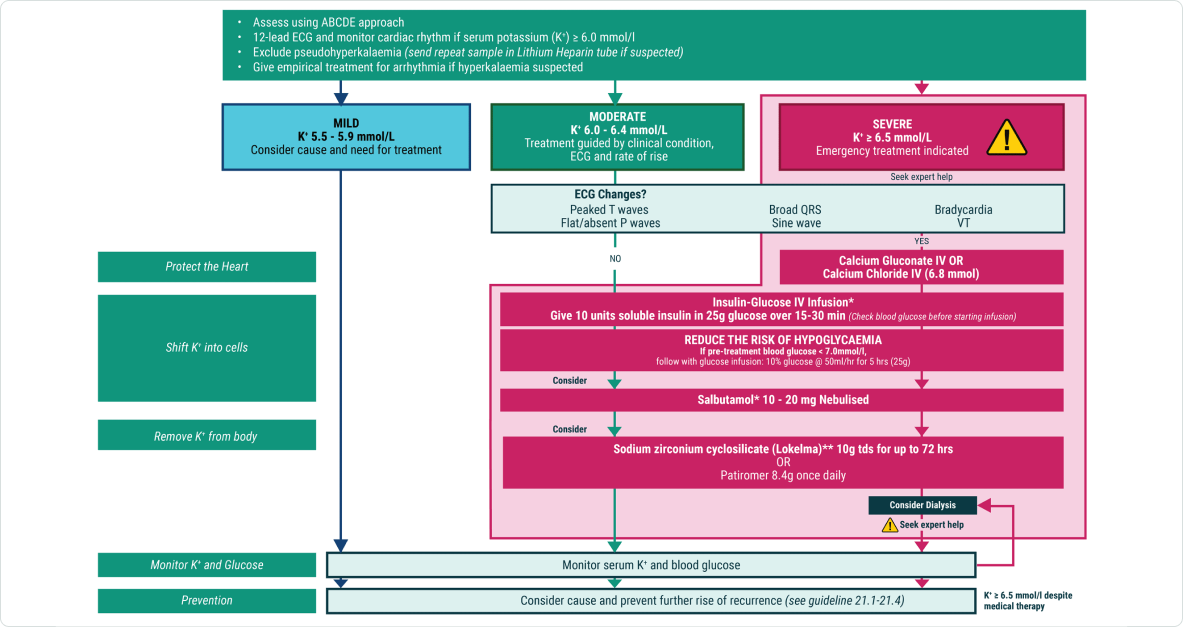
Treatment and management guidelines for acute hyperkalaemia

Treatment and management recommendations vary among hyperkalaemia clinical guidelines, and, as such, the treatment of hyperkalaemia is currently variable.1 However, there is a shared objective to manage hyperkalaemia effectively to enable patients with heart failure (HF) and CKD to maintain optimal RAASi therapy.3-10


Collaboration with specialist services such as renal and HF teams can facilitate strategies to avoid RAASi discontinuation and support the tolerable reintroduction of RAASi treatment for patients.1

Patients with severe hyperkalaemia, or who have mild-to-moderate hyperkalaemia and have acute kidney injury (AKI) or are acutely ill, should be referred to hospital for emergency treatment.1

The hyperkalaemia treatment algorithm for hospitalised patients outlines a sequential approach of 5 steps:1


  • Protect the heart
  • Shift K+ into cells
  • Remove K+ from the body
  • Monitor K+ and glucose
  • Prevent recurrence

Clear communication between primary and secondary care is key for continuity of care after hospital discharge for hyperkalaemia.1


Learn more about acute and persistent hyperkalaemia.1


UK Kidney Association (UKKA) clinical practice guidelines for the treatment of acute hyperkalaemia in adults

acute-hyperkalaemia-in-adults-new

Adapted from Alfonzo et al (2020)1, the Veltassa SmPC15 and Lokelma SmPC14


*Insulin, glucose and salbutamol are not licensed in the UK for the treatment of hyperkalaemia. Refer to their summaries of product characteristics,


**Typically, normokalaemia is achieved within 24 to 48 hours. If patients are still hyperkalaemic after 48 hours of treatment, the same regimen can be continued for an additional 24 hours. If normokalaemia is not achieved after 72 hours of treatment, other treatment approaches should be considered.


Treatment options for managing acute and chronic hyperkalaemia

The treatment goal for acute hyperkalaemia is to induce K+ flux into the intracellular space and remove K+ from the body to prevent cardiac arrhythmias.7

Treatment
Mechanism of action
Characteristics and limitations / side effects
Limitations / Side Effects
Calcium gluconate / calcium chlorideMembrane stabilisation of myocardium
  • Onset of action: 1–3 minutes
  • Duration of effect: 30–60 minutes
  • Serum K+ level is unaffected
  • Risk of hypercalcaemia
Insulin and glucose*K+ redistribution into the intracellular space
  • Onset of action: within 30 minutes
  • Duration of effect: 4–6 hours
  • Risk of hypoglycaemia
  • Does not reduce total K+ levels
  • Requires central venous access
B2-adrenergic agonists*K+ redistribution into the intracellular space
  • Onset of action: ~30 minutes
  • Duration of effect: 2–4 hours
  • Does not reduce total K+ levels
  • Use with caution in ischaemic heart disease (risk of tachycardia)
Dialysis (haemodialysis, peritoneal dialysis)K+ elimination
  • Onset of action: within minutes
  • Effects last until the end of dialysis
  • Concentration of K+ in the dialysate can contribute to hyperkalaemia
  • Limitations and complications inherent to dialysis modality
Diuretics (loop and thiazide)Promote renal K+ excretion
  • Onset of action depends on the start of diuresis
  • Beneficial in patients with volume expansion
  • Efficacy depends on residual renal function (until diuresis is present)
  • Increased risk of gout and diabetes
Low Potassium DietReduction of K+ intake
  • Low K+ diet, defined as a dietary intake of 2-3g/day (51-77 mmol/day)
  • Suitable for chronic management, not acute treatment
  • Difficult to adhere to
  • Limiting K+ rich foods can cause constipation
  • Contradicts DASH diet; may worsen chronic hypertension
Downtritation / discontinuation of RAASiPrevention of hyperkalaemia as RAASi treatment adverse event
  • RAASi reduction should only be used as a last resort
  • Suboptimal dosing puts patients at risk of losing the renal/cardioprotective effects of RAASi therapy and is associated with doubling of mortality in patients with CKD, HF and diabetes.

* Insulin, glucose and B2 agonists are not licensed in the UK for the treatment of acute hyperkalaemia. Refer to their summaries of product characteristics.


NICE guidelines and SMC advice for treating hyperkalaemia with sodium zirconium cyclosilicate

According to NICE guidance, sodium zirconium cyclosilicate is recommended for treating hyperkalaemia in adults under specific conditions. It can be used in emergency care for acute life-threatening hyperkalaemia alongside standard care. Additionally, it is recommended for people with persistent hyperkalaemia and CKD stage 3b to 5 or heart failure if they meet the following criteria:11


  • they have a confirmed serum potassium level of at least 6.0 mmol/litre and
  • they are not taking an optimised dosage of a RAAS inhibitor due to hyperkalaemia and
  • they are not on dialysis.

Sodium zirconium cyclosilicate should be discontinued if RAAS inhibitors are no longer appropriate for the patient.11


The Scottish Medicines Consortium (SMC) accepts (restricted use) sodium zirconium cyclosilicate in both the emergency care setting and in outpatients for adult patients with hyperkalaemia in Scotland.12,13


Adults admitted to an emergency care setting in Scotland with acute, life-threatening hyperkalaemia will be able to access sodium zirconium cyclosilicate as a treatment option to be used alongside standard care.


Sodium zirconium cyclosilicate was the first pharmacological therapy accepted by the SMC to treat adults in both:12,13

  • An emergency care setting for adults with acute, life-threatening hyperkalaemia alongside standard care.
  • An outpatient setting when treating patients with HF and/or CKD stage 3b to 5 with serum potassium >6.0 mmol/L, who would otherwise need to down-titrate or discontinue their RAASi therapy to maintain a clinically acceptable serum potassium level (normokalaemia).

ABCDE, airway breathing circulation disability exposure; ACEi, angiotensin-converting enzyme inhibitor; AKI, acute kidney injury; ARB, angiotensin receptor blockers; CKD, chronic kidney disease; DASH, dietary approaches to stop hypertension; ECG, electrocardiogram; ESC, European Society of Cardiology; HF, heart failure; IV, intravenous; KDIGO, Kidney Disease: Improving Global Outcomes; NICE, National Institute for Health and Care Excellence; NSAIDs, non-steroidal anti-inflammatory drugs; MRA, mineralocorticoid receptor antagonist; RAASi, renin-angiotensin-aldosterone system inhibitors; SMC, Scottish Medicines Consortium; SZC, sodium zirconium cyclosilicate; UKKA, UK Kidney Association.

  1. Alfonzo A, et al. UK renal Association. Clinical practice guidelines: Treatment of acute hyperkalaemia in adults [online], 2023. Available from: https://ukkidney.org/sites/renal.org/files/RENAL%20ASSOCIATION%20HYPERKALAEMIA%20GUIDELINE%20-%20JULY%202022%20V2_0.pdf. Accessed November 2023.
  2. Burton JO, et al. Eur J Heart Fail. 2022;24(9):1467-1477.
  3. Kidney Disease: Improving Global Outcomes (KDIGO) Blood Pressure Work Group. Kidney Int. 2021;9‌9(3S):S1–S8‌7.
  4. Kidney Disease: Improving Global Outcomes (KDIGO) Diabetes Work Group. Kidney Int. 2020;98(4S):S1–S115.
  5. Kidney Disease: Improving Global Outcomes (KDIGO) CKD Work Group. Kidney Int. 2024;105(4S):S117-S314.
  6. McDonagh TA, et al. Eur Heart J. 2021;42(48):4901-4901.
  7. National Kidney Foundation. Best Practices in Managing Hyperkalaemia in Chronic Kidney Disease [online], 2016. Available from: https://kidney.org/sites/default/files/02-10-7259%20Hyperkalemia%20Tool.pdf. Accessed August 2024.
  8. Rosano GMC, et al. Eur Heart J Cardiovasc Pharmacother. 2018;4(3):180-188.
  9. Heidenreich PA, et al. J Am Coll Cardiol. 2‌0‌2‌2;7‌9(1‌7):e2‌6‌3–e4‌2‌1.
  10. Zann V, et al. Drug Des Devel Ther. 2‌0‌1‌7;1‌1:2‌6‌6‌3–2‌6‌7‌3.
  11. Technology appraisal guidance: sodium zirconium cyclosilicate for treating hyperkalaemia (TA599). Published online September 4, 2019.
  12. SMC2288. Sodium zirconium cyclosilicate (LOKELMA) 2020. Available from: https://scottishmedicines.org.uk/medicines-advice/sodium-zirconium-cyclosilicate-lokelma-resub-smc2288/. Accessed August 2024.
  13. SMC2515. Sodium zirconium cyclosilicate (LOKELMA) 2022. Available from https://scottishmedicines.org.uk/medicines-advice/sodium-zirconium-lokelma-abb-smc2515/. Accessed August 2024
  14. LOKELMA ® Summary of Product Characteristics.
  15. Veltassa (Patiromer). Summary of Product Characteristics.

GB-63502 | DOP: February 2025

Adverse events should be reported. Reporting forms and information can be found at www.mhra.gov.uk/yellowcard or search for MHRA Yellow Card in the Google Play or Apple App Store. Adverse events should also be reported to AstraZeneca by visiting https://contactazmedical.astrazeneca.com/ or by calling ‌‌‌0‌‌‌8‌‌‌‌‌0‌‌‌‌0‌‌‌ ‌‌7‌‌‌‌‌‌8‌‌‌3‌‌‌ ‌‌0‌‌‌‌‌0‌‌‌‌3‌‌‌‌3‌‌‌.

Connessiallasalute.it

This website was created for UK HCPs and has been designed to provide information to educate, empower and enable them in the great work they are doing for patients across a range of therapy areas. This website is intended for doctors, nurses, and pharmacists in the UK. Other UK residents please visit astrazeneca.co.uk.

Terms of use

Privacy Policy

Cookie Policy

Contact Us

LinkedIn

Twitter

©2026 AstraZeneca. GB-76964 | DOP: May 2026