Prescribing information UK
TAGRISSO (osimertinib)
Prescribing information UK
IRESSA (gefitinib)
Prescribing information UK
IMFINZI (durvalumab)
Adverse Event Reporting

Welcome to this UK AstraZeneca produced and funded website

This website is intended for UK Healthcare Professionals only.


The website contains both promotional and non-promotional content.


If you are a patient or a carer of a patient prescribed an AstraZeneca product, please visit myazmed.co.uk


For any other UK residents please visit astrazeneca.co.uk

I am not a Healthcare Professional

This website is intended for UK Healthcare professionals only. Other UK residents please visit astrazeneca.co.uk

Logo test product
  • Our Medicines
    • Cardiovascular, Renal & Metabolism
      • ATTR Amyloidosis
        • WAINZUA®▼(eplontersen)
      • Chronic Kidney Disease (CKD)
        • FORXIGA® (dapagliflozin)
      • Heart Failure
        • FORXIGA® (dapagliflozin)
      • Hyperkalaemia
        • LOKELMA® (sodium zirconium cyclosilicate)
      • Type 2 Diabetes (T2D)
        • FORXIGA® (dapagliflozin)
    • Oncology
      • Breast Cancer
        • LYNPARZA® (olaparib)
        • TRUQAP®▼(capivasertib)
      • Bladder Cancer
        • IMFINZI® (durvalumab)
      • Endometrial Cancer
        • IMFINZI® (durvalumab)
        • LYNPARZA® (olaparib)
      • Gastrointestinal Cancer
        • IMFINZI® (durvalumab)
        • IMJUDO®▼(tremelimumab)
      • Lung Cancer
        • IMFINZI® (durvalumab)
        • TAGRISSO® (osimertinib)
      • Ovarian Cancer
        • LYNPARZA® (olaparib)
      • Prostate Cancer
        • LYNPARZA® (olaparib)
        • ZOLADEX® (goserelin)
    • Respiratory
      • Asthma
        • TEZSPIRE®▼ (tezepelumab)
        • SYMBICORT® (budesonide/formoterol)
      • Chronic Obstructive Pulmonary Disease(COPD)
        • TRIXEO AEROSPHERE® (formoterol fumarate dihydrate/glycopyrronium/budesonide)
        • BEVESPI® (glycopyrronium/formoterol fumarate dihydrate)
    • Vaccines
      • Flu
        • FLUENZ® nasal spray suspension (influenza vaccine, live attenuated, nasal)
  • Therapy Areas
    • Cardiovascular, Renal & Metabolism
      • ATTR Amyloidosis
      • Chronic Kidney Disease (CKD)
      • Heart Failure
      • Hyperkalaemia
      • Type 2 Diabetes (T2D)
    • Oncology
      • Breast Cancer
      • Bladder Cancer
      • Endometrial Cancer
      • Gastrointestinal Cancer
      • Lung Cancer
      • Ovarian Cancer
      • Prostate Cancer
    • Respiratory
      • Asthma
      • Chronic Obstructive Pulmonary Disease(COPD)
    • Vaccines
      • Flu
  • About us
    • AZ Commitment
  • Contact us
Login
  • AstraZeneca UK
  • TAGRISSO® (osimertinib)
  • Clinical Trials & Efficacy - ADAURA
  • Home
  • Clinical Trials
    & Efficacy
    • ADAURA
    • FLAURA
    • FLAURA2
    • LAURA
  • Safety profile
    • ADAURA
    • FLAURA
    • FLAURA2
    • LAURA
  • Dosing
    and administration
    • ADAURA
    • FLAURA
    • FLAURA2
    • LAURA
  • Mechanism of action
  • Quality of Life
  • Resources
  • Lung therapy
    • Lung pathway
    • Diagnostics
    • Prehabilitation
Clinical Trials & Efficacy - ADAURA

Logo for Tagrisso (osimertinib) which is coloured lime teal and purple and shaped like lungs

Clinical Trials & Efficacy: ADAURA


Adjuvant TAGRISSO was studied in a broad range of patients with completely resected (Stage IB-IIIA) EGFRm NSCLC (ex19del/L858R).1–6

Efficacy

Clinical trial design

Study population

Clinical trial endpoints

Safety profile

TAGRISSO offers clinically meaningful efficacy1–6

In a completely resected Stage IB-IIIA* EGFRm NSCLC (ex19del/L858R), TAGRISSO is the first and only EGFR TKI to deliver a statistically significant DFS and OS benefit vs placebo.1–6

2-year DFS

83% relative reduction in risk of recurrence or death vs placebo in the Stage II-IIIA population


ARR 46% at 24 months

HR=0.17 (99.06% CI: 0.11–0.26; P<0.001)7


Primary endpoint

4-year DFS

73% relative reduction in risk of recurrence or death vs placebo in the Stage IB-IIIA population (post-hoc analysis)


ARR 35% at 48 months

HR=0.27 (95% CI: 0.21–0.34; P not specified)2


Exploratory endpoint

5-year OS

51% relative reduction in the risk of death vs placebo in the Stage IB-IIIA population (post-hoc analysis)


ARR 10% at 60 months

HR=0.49 (95%CI: 0.34–0.70; P<0.0001)1


Secondary endpoint

*Please note:

2 year DFS: at time of planned interim analysis (data maturity, 33%), pre-specified efficacy boundary was crossed; the trial was unblinded early at recommendation of independent data monitoring committee. The mDFS (median DFS) 2 years stage II-IIIA was NR with TAGRISSO [95% CI 38.8-NC] vs 19.6 months with placebo [95% CI 16.6-24.5]. Due to early unblinding following the interimanalysis, all subsequent analyses, while pre-specified, are considered exploratory and intended to provide additional insight alongside the overall study results.

4-year DFS: Overall population (Stage IB-IIIA): ~45% data maturity; mDFS was 65.8 months (95% CI: 61.7–NC)  with TAGRISSO vs 28.1 months with placebo (95% CI: 22.1-35.0).

Primary population (Stage II-IIIA): ~51% data maturity; mDFS was 65.8 months with TAGRISSO (95% CI: 54.4–NC) vs 21.9 months with placebo (95% CI: 16.6-27.5); adjuvant TAGRISSO reduced risk of recurrence or death in stage II-IIIA by 77% vs placebo (HR = 0.23; 95% CI: 0.18-0.30). 

5 year OS: data maturity was 18%.1

Adjuvant TAGRISSO reduced the risk of disease recurrence or death by 77% in the primary endpoint subset (Stage II-IIIA)

At the primary analysis, 24-month DFS in the primary endpoint subset was 90% with TAGRISSO vs 44% with placebo (HR=0.17; 99.06% CI: 0.11–0.26; P<0.001).3

Primary endpoint: DFS in patients with Stage II-IIIA EGFRm NSCLC (post-hoc analysis)7

Graph showing the primary endpoint DFS in patients with stage 2-3A EGFRm NSCLC in ADAURA trial


Adapted from Tsuboi M et al. ESMO congress 2022.7

Data cut-off: April 2022.

Median DFS: 65.8 months in the TAGRISSO arm (95% CI: 54.4–NC) vs 21.9 months in the placebo arm (95% CI: 16.6–27.5). Data maturity was 51% at the time of analysis.7

ARR, absolute risk reduction; CI, confidence interval; DFS, disease-free survival; EGFRm, epidermal growth factor receptor mutant; HR, hazard ratio; NC, not calculated; NSCLC, non-small cell lung cancer

Adjuvant TAGRISSO reduced the risk of disease recurrence or death in overall population Stage IB-IIIA NSCLC (post-hoc analysis)2

Adjuvant TAGRISSO helped more patients across Stage IB-IIIA NSCLC (the overall population; TAGRISSO [n=339], placebo [n=343]; primary subset population [Stage II/IIIA]: TAGRISSO [n=233], placebo [n=237]) remain disease-free compared to placebo.2,7

Data cut-off: April 2022.

Median DFS: 65.8 months in the TAGRISSO arm (95% CI: 61.7– NC) vs 28.1 months in the placebo arm (95% CI 22.1– 35.0). Data maturity was 45% at the time of analysis.7

ARR, absolute risk reduction; CI, confidence interval; DFS, disease-free survival; HR, hazard ratio

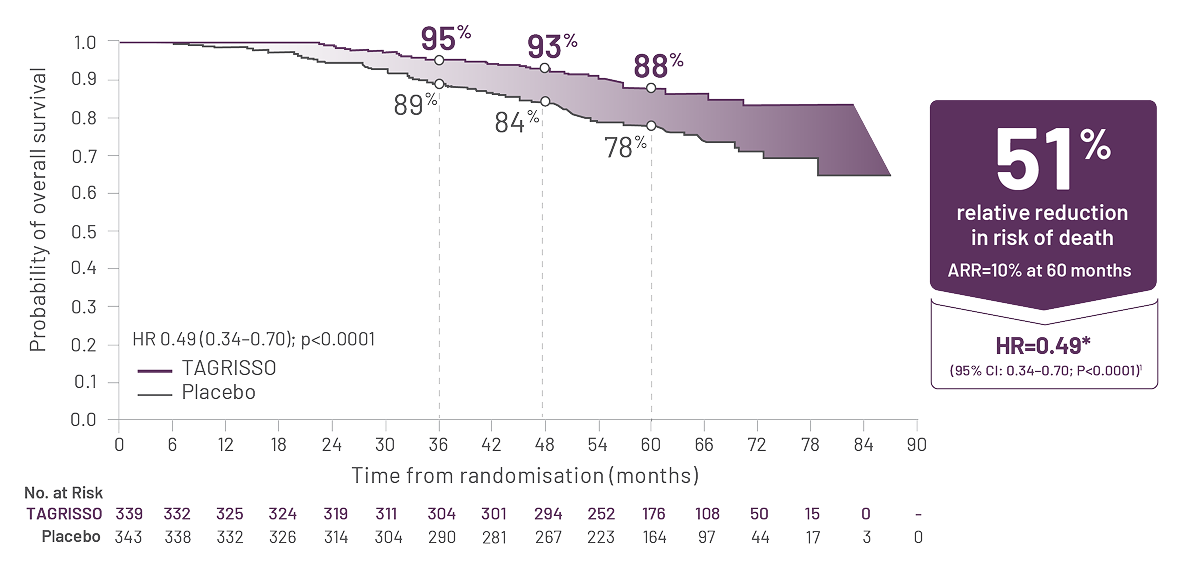
TAGRISSO is the first and only adjuvant treatment to extend survival in patients with Stage IB–IIIA resected EGFRm NSCLC (post-hoc analysis)2

TAGRISSO is the first and only adjuvant treatment to extend survival in patients with Stage IB-IIIA resected EGFRm NSCLC.1

At 5 years, 88% of patients remained alive in the adjuvant TAGRISSO arm vs 78% in the placebo arm.1

OS in patients with Stage IB-IIIA disease1
Graph showing OS in patients with Stage IB-IIIA disease in ADAURA trial Graph showing OS in patients with Stage IB-IIIA disease in ADAURA trial

Adapted from Herbst RS et al. ASCO Annual Meeting 2023.1

Data cut-off: January 2023.

*Median follow-up for OS (all patients): osimertinib 60.4 months, placebo 59.4 months. Data maturity was 18% at the time of analysis.1

ARR, absolute risk reduction; HR, hazard ratio: OS, overall survival

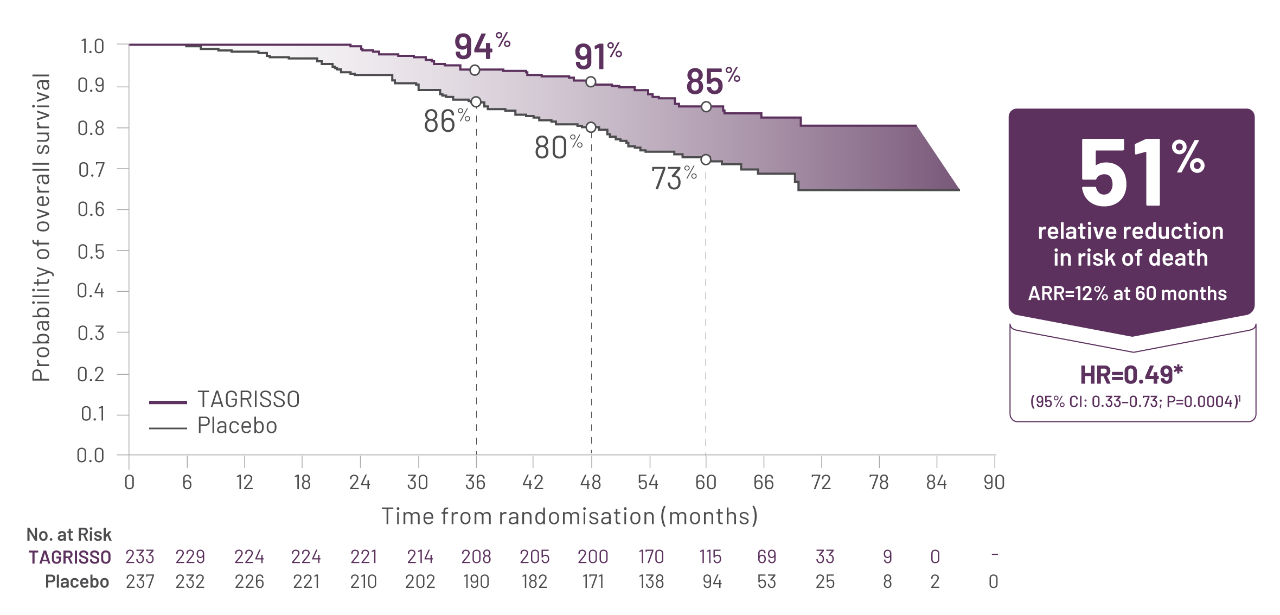
Patients with Stage II/IIIA disease also received consistent OS benefit with TAGRISSO.1 TAGRISSO achieved a statistically significant and clinically meaningful OS benefit in the adjuvant setting.1

OS in patients with Stage II-IIIA disease1
Graph showing OS in patients with Stage II-IIIA disease in ADAURA trial Graph showing OS in patients with Stage II-IIIA disease in ADAURA trial

Adapted from Herbst RS et al. ASCO Annual Meeting 2023.1

Data cut-off: January 2023.

*Median follow-up for OS (all patients): osimertinib 59.9 months, placebo 56.2 months. Data maturity was 21% at the time of analysis.1

ARR, absolute risk reduction; HR, hazard ratio: OS, overall survival

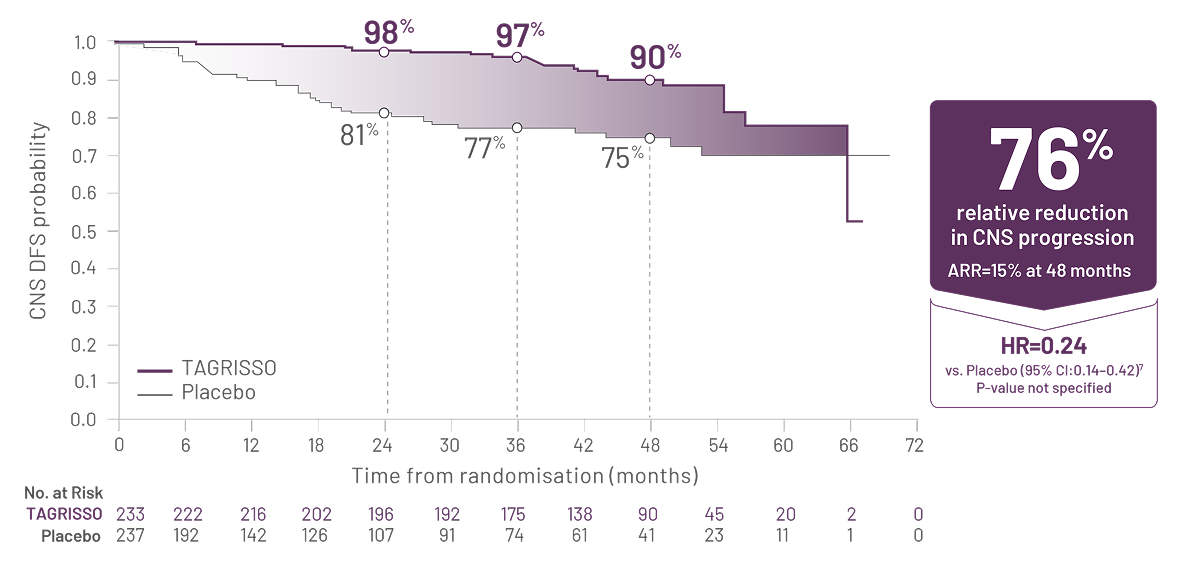
TAGRISSO helped patients reduce their risk of CNS progression.2 According to an exploratory analysis of CNS DFS, 76% relative risk reduction in CNS progression (HR=0.24; 95% CI: 0.14–0.42), P-value not specified.2

In exploratory analysis, in stage II-IIIA patients in the CNS recurrence population treated with TAGRISSO had longer DFS compared with those treated with placebo*7
Graph showing CNS DFS relative reduction in ADAURA trial Graph showing CNS DFS relative reduction in ADAURA trial

NR

TAGRISSO Median CNS DFS

(95% CI: 65.8–NC)


NR

PLACEBO Median CNS DFS

(95% CI: NC–NC)


Adapted from Tsuboi M et al. ESMO congress 2022.7

Data cut-off: April 2022.

Median follow-up: TAGRISSO 44.2 month, placebo 20.4 months. Data maturity: 13% (TAGRISSO 9%, placebo 17%).7 This was a prespecified exploratory endpoint.2

*CNS DFS is defined as CNS as the first site of disease recurrence, or death without any disease recurrence

ARR, absolute risk reduction; CNS, central nervous system; DFS, disease-free survival; HR, hazard ratio; NC, not calculated; NR, not reached

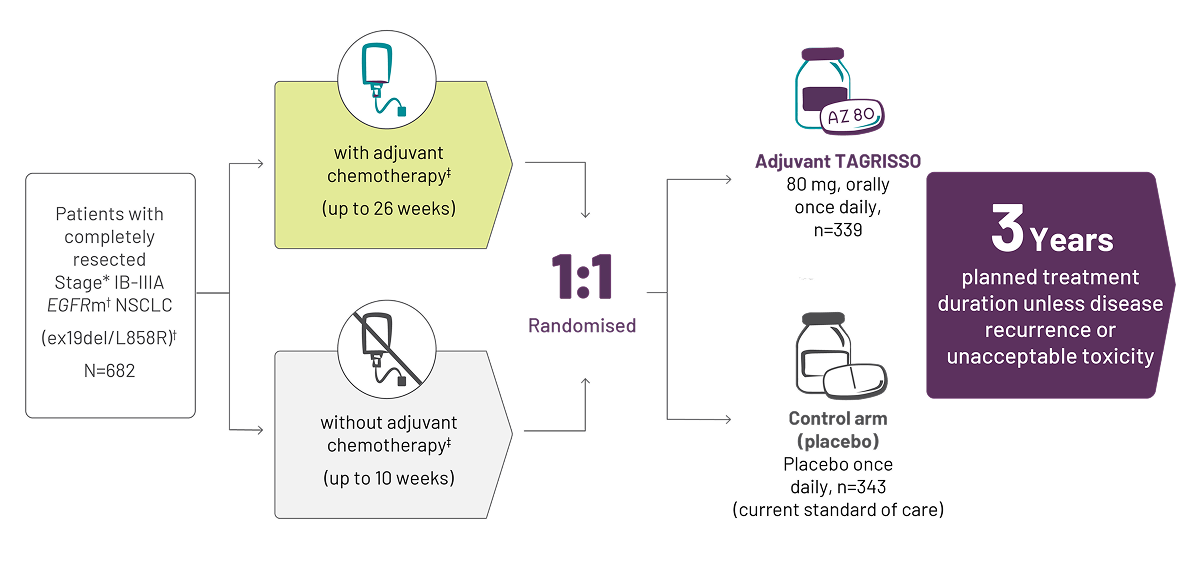
ADAURA was a global, Phase III, 1:1 randomised study of TAGRISSO vs placebo (N=682).3,5,6

Clinical trial design chart for ADAURA trial - global phase 3 randomised TAGRISSO vs placebo in ADAURA trial Clinical trial design chart for ADAURA trial - global phase 3 randomised TAGRISSO vs placebo in ADAURA trial

Adapted from Wu YL et al. N Engl J Med 2020 and TAGRISSO (osimertinib) Summary of Product Characteristics.3,5,6

*American Joint Committee on Cancer 7th edition.

†Centrally confirmed in tissue. Only actionable EGFR mutations such as ex19del and L858R were included in ADAURA.3,5,6 Patients with exon 20 deletions were not included.3

‡Per physician discretion. Prior, post, or planned radiotherapy was not allowed.3 Neoadjuvant chemotherapy was not allowed.8

EGFR, epidermal growth factor receptor; ex19del, exon 19 deletion; L858R, exon 21 substitution; NSCLC, non-small cell lung cancer; T790M, exon 20 threonine 790 methionine substitution

Baseline characteristics, including use of prior adjuvant chemotherapy, were well balanced across study arms.3

Characteristics TAGRISSO (n=339)Placebo (n=343)
SexMale32%28%
Female68%72%
Age (years)Median6462
Range30-8631–82
Smoking statusSmoker32%25%
Non-smoker68%75%
RaceAsian64%64%
Non-Asian36%36%
WHO performance status064%64%
136%36%
AJCC staging at diagnosis (7th ed.)IB32%32%
II34%34%
IIIA35%34%
HistologyAdenocarcinoma96%97%
Other4%3%
EGFRm at randomisation*ex19del55%55%
L858R45%45%
Adjuvant chemotherapyYes60%60%
No40%40%

Adapted from Wu YL et al. N Engl J Med 2020.3

*EGFR mutational status at randomisation was centrally tested. Patients may have had more than one EGFR mutation.3

AJCC, American Joint Committee on Cancer; EGFRm, epidermal growth factor receptor mutant; ex19del, exon 19 deletion; L858R, exon 21 substitution; WHO, World Health Organization


Primary endpoint: DFS in patients with Stage II-IIIA NSCLC.3

Secondary endpoints: DFS in overall population (Stage IB-IIIA); DFS at 2, 3, 4 and 5 years; OS; safety; HRQoL3 Assessment of the site(s) of recurrence, including the CNS, and the time to CNS disease recurrence or death were prespecified exploratory end points.3


ADAURA trial was unblinded at a trial level 2 years early because of evidence of a DFS efficacy benefit.3


Explore TAGRISSO’s results

Navigate the safety profile: ADAURA trial

Explore safety profile

Take a closer look at how TAGRISSO is administered: ADAURA trial

Explore dosing and administration

Learn more about how TAGRISSO works

Explore MOA

AJCC, American Joint Committee on Cancer; ARR, absolute risk reduction; CI, confidence interval; CNS, central nervous system; DFS, disease-free survival; EGFR, epidermal growth factor receptor; EGFRm, epidermal growth factor receptor mutant; ex19del, exon 19 deletion; HR, hazard ratio; HRQoL, health-related quality of life; L858R, exon 21 substitution; MOA, mode of action; NC, not calculated; NR, not reached; NSCLC, non-small cell lung cancer; OS, overall survival; TKI, tyrosine kinase inhibitor; T790M, exon 20 threonine 790 methionine substitution; WHO, World Health Organization


  1. Herbst RS, et al. Overall survival analysis from the ADAURA trial of adjuvant osimertinib in patients with resected EGFR-mutated (EGFRm) stage IB–IIIA non-small cell lung cancer (NSCLC). [oral presentation] Presented at: ASCO Congress; 2023 Jun 2–6; Chicago, IL.
  2. Herbst RS, et al. Overall survival analysis from the ADAURA trial of adjuvant osimertinib in patients with resected EGFR-mutated (EGFRm) stage IB–IIIA non-small cell lung cancer (NSCLC). Presented at ESMO Congress, 2023 Jun 2–6; Chicago, IL. Abstract #LBA3.
  3. Tsuboi M, et al. Osimertinib as adjuvant therapy in patients (pts) with resected EGFR-mutated (EGFRm) stage IB-IIIA nonsmall cell lung cancer (NSCLC): Updated results from ADAURA. Presented at ESMO Congress, 9th–13th September 2022, Paris. Abstract #LBA47.
  4. Wu YL, Tsuboi M, He J, John T, Grohe C, Majem M, et al. Osimertinib in Resected EGFR-Mutated Non-Small-Cell Lung Cancer. N Engl J Med. 2020 Oct 29;383(18):1711-23.
  5. Wu YL, Tsuboi M, He J, John T, Grohe C, Majem M, et al. Osimertinib in Resected EGFR-Mutated Non-Small-Cell Lung Cancer. (Supplementary appendix) N Engl J Med. 2020 Oct 29;383(18):1711-23.
  6. TAGRISSO (osimertinib) 40 mg Summary of Product Characteristics.
  7. TAGRISSO (osimertinib) 80 mg Summary of Product Characteristics.
  8. Tsuboi M, et al. Osimertinib as adjuvant therapy in patients (pts) with resected EGFR-mutated (EGFRm) stage IB-IIIA nonsmall cell lung cancer (NSCLC): Updated results from ADAURA. Presented at ESMO Congress, 9th–13th September 2022, Paris.
  9. Wu YL, Tsuboi M, He J, John T, Grohe C, Majem M, et al. Osimertinib in Resected EGFR-Mutated Non-Small-Cell Lung Cancer. (Protocol) N Engl J Med. 2020 Oct 29;383(18):1711-23.

GB-63981 | DOP: July 2025

Adverse events should be reported. Reporting forms and information can be found at www.mhra.gov.uk/yellowcard or search for MHRA Yellow Card in the Google Play or Apple App Store. Adverse events should also be reported to AstraZeneca by visiting https://contactazmedical.astrazeneca.com/ or by calling ‌‌‌0‌‌‌8‌‌‌‌‌0‌‌‌‌0‌‌‌ ‌‌7‌‌‌‌‌‌8‌‌‌3‌‌‌ ‌‌0‌‌‌‌‌0‌‌‌‌3‌‌‌‌3‌‌‌.

Connessiallasalute.it

This website was created for UK HCPs and has been designed to provide information to educate, empower and enable them in the great work they are doing for patients across a range of therapy areas. This website is intended for doctors, nurses, and pharmacists in the UK. Other UK residents please visit astrazeneca.co.uk.

Terms of use

Privacy Policy

Cookie Policy

Contact Us

LinkedIn

Twitter

©2025 AstraZeneca. GB-73926 | February 2026