Prescribing information UK
TAGRISSO (osimertinib)
Prescribing information UK
IRESSA (gefitinib)
Prescribing information UK
IMFINZI (durvalumab)
Adverse Event Reporting

Welcome to this UK AstraZeneca produced and funded website

This website is intended for UK Healthcare Professionals only.


The website contains both promotional and non-promotional content.


If you are a patient or a carer of a patient prescribed an AstraZeneca product, please visit myazmed.co.uk


For any other UK residents please visit astrazeneca.co.uk

I am not a Healthcare Professional

This website is intended for UK Healthcare professionals only. Other UK residents please visit astrazeneca.co.uk

Logo test product
  • Our Medicines
    • Cardiovascular, Renal & Metabolism
      • ATTR Amyloidosis
        • WAINZUA®▼(eplontersen)
      • Chronic Kidney Disease (CKD)
        • FORXIGA® (dapagliflozin)
      • Heart Failure
        • FORXIGA® (dapagliflozin)
      • Hyperkalaemia
        • LOKELMA® (sodium zirconium cyclosilicate)
      • Type 2 Diabetes (T2D)
        • FORXIGA® (dapagliflozin)
    • Oncology
      • Breast Cancer
        • LYNPARZA® (olaparib)
        • TRUQAP®▼(capivasertib)
      • Bladder Cancer
        • IMFINZI® (durvalumab)
      • Endometrial Cancer
        • IMFINZI® (durvalumab)
        • LYNPARZA® (olaparib)
      • Gastrointestinal Cancer
        • IMFINZI® (durvalumab)
        • IMJUDO®▼(tremelimumab)
      • Lung Cancer
        • IMFINZI® (durvalumab)
        • TAGRISSO® (osimertinib)
      • Ovarian Cancer
        • LYNPARZA® (olaparib)
      • Prostate Cancer
        • LYNPARZA® (olaparib)
        • ZOLADEX® (goserelin)
    • Respiratory
      • Asthma
        • TEZSPIRE®▼ (tezepelumab)
        • SYMBICORT® (budesonide/formoterol)
      • Chronic Obstructive Pulmonary Disease(COPD)
        • TRIXEO AEROSPHERE® (formoterol fumarate dihydrate/glycopyrronium/budesonide)
        • BEVESPI® (glycopyrronium/formoterol fumarate dihydrate)
    • Vaccines
      • Flu
        • FLUENZ® nasal spray suspension (influenza vaccine, live attenuated, nasal)
  • Therapy Areas
    • Cardiovascular, Renal & Metabolism
      • ATTR Amyloidosis
      • Chronic Kidney Disease (CKD)
      • Heart Failure
      • Hyperkalaemia
      • Type 2 Diabetes (T2D)
    • Oncology
      • Breast Cancer
      • Bladder Cancer
      • Endometrial Cancer
      • Gastrointestinal Cancer
      • Lung Cancer
      • Ovarian Cancer
      • Prostate Cancer
    • Respiratory
      • Asthma
      • Chronic Obstructive Pulmonary Disease(COPD)
    • Vaccines
      • Flu
  • About us
    • AZ Commitment
  • Contact us
Login
  • AstraZeneca UK
  • TAGRISSO® (osimertinib)
  • Safety profile and side effects - FLAURA2
  • Home
  • Clinical Trials
    & Efficacy
    • ADAURA
    • FLAURA
    • FLAURA2
    • LAURA
  • Safety profile
    • ADAURA
    • FLAURA
    • FLAURA2
    • LAURA
  • Dosing
    and administration
    • ADAURA
    • FLAURA
    • FLAURA2
    • LAURA
  • Mechanism of action
  • Quality of Life
  • Resources
  • Lung therapy
    • Lung pathway
    • Diagnostics
    • Prehabilitation
Safety profile and side effects - FLAURA2

Logo for Tagrisso (osimertinib) which is coloured lime teal and purple and shaped like lungs

Safety Profile and Side Effects: FLAURA2


Safety profile: TAGRISSO in combination with chemotherapy use in FLAURA21

AEs were consistent with the established profiles of the individual agents; no new safety signals were identified1


In the TAGRISSO monotherapy arm, 6% of patients discontinued TAGRISSO due to an AE, and 43% due to progression.1 In the TAGRISSO with chemotherapy arm, AEs accounted for discontinuation of 11% due to TAGRISSO, 43% due to pemetrexed, and 17% due to cisplatin/carboplatin, in this arm; progression accounted for discontinuation of 25% TAGRISSO, 11% pemetrexed, and <1% cisplatin/carboplatin.1


Interstitial lung disease (ILD) or pneumonitis (as a grouped term) was reported in 3% of patients in the combination arm and 4% in the monotherapy arm (all grades).1

TAGRISSO adverse events: FLAURA2 trial1,2

AEs with an incidence of ≥20% in the osimertinib and chemotherapy arm are shown. Patients with multiple events in the same category were counted only once in that category. Patients with events in more than one category were counted once in each of those categories.

 TAGRISSO with platinum-pemetrexed
chemotherapy (n=276)
TAGRISSO monotherapy
(n=275)
Adverse eventAny gradeGrade 3Grade 4Any gradeGrade 3Grade 4
Anaemia48%20%0%11%1%0%
Diarrhoea47%3%0%42%<1%0%
Nausea43%1%0%12%0%0%
Decreased appetite33%3%0%11%1%0%
Constipation32%<1%0%11%0%0%
Rash29%1%0%22%0%0%
Fatigue29%3%0%11%<1%0%
Vomiting29%1%0%7%<1%0%
COVID-19*26%1%0%17%0%0%
Stomatitis26%<1%0%19%<1%0%
Paronychia25%1%0%27%<1%0%
Neutropenia25%11%3%4%1%0%
Neutrophil count decrease24%9%3%7%1%0%
ALT increase21%2%0%8%1%0%
Dry skin20%0%0%25%0%0%

Adapted from Janne P et al N Engl J Med 2025.1,2

*One patient in the group that received TAGRISSO plus platinum-pemetrexed died from COVID-191

ALT, alanine aminotransferase; AST, aspartate transferase; ILD, Interstitial lung disease

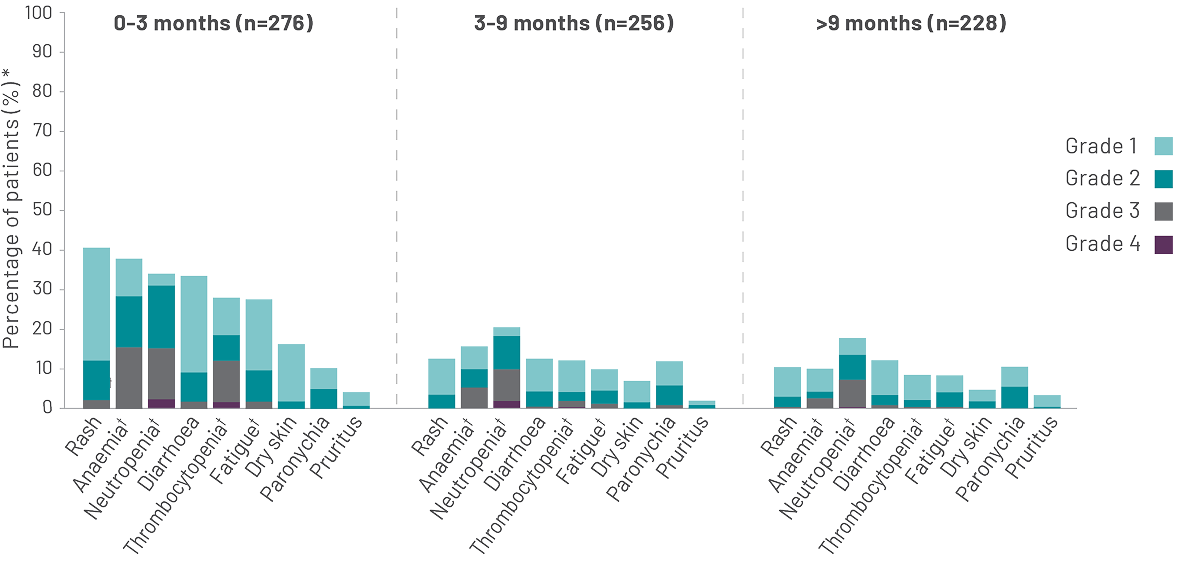
For patients receiving TAGRISSO with chemotherapy in FLAURA2, AE frequency and severity were highest during the first 3 months of treatment and reduced over time2

In the TAGRISSO with the chemotherapy arm, onset of ≥Grade 3 AEs reduced by ~50% between 0–3 months (n=135; 49%) and 3–9 months (n=62; 24%)2

AE frequency and severity safety analysis set2

AE frequency and severity safety analysis set for FLAURA2 trial

Adapted from Planchard D et al. ESMO congress 2023.2

*Includes AEs with an onset date within the study months noted, for patients still on study at the start of the respective time period

†Grouped term: anaemia/haemoglobin decreased, thrombocytopenia/platelet count decreased, neutropenia/neutrophil count decreased, and asthenia/fatigue (by preferred terms)

AE, adverse event

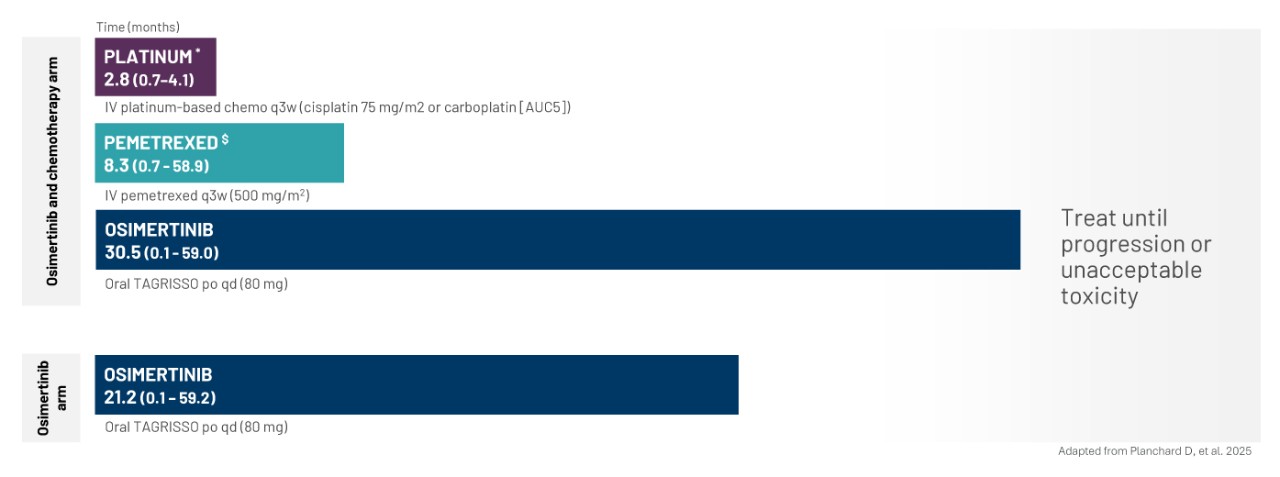
Median time of exposure of TAGRISSO and chemotherapy1,2

AE frequency and severity safety analysis set for FLAURA2 trial

Osimertinib and chemotherapy arm: n=276.

Osimertinib arm: n=275.

TAGRISSO Safety Considerations3,4

Please refer to product labelling for more information.

Patients with acute onset and/or unexplained worsening of pulmonary symptoms (dyspnoea, cough, fever) should have their treatment interrupted while investigations are performed to exclude ILD. If ILD is diagnosed, TAGRISSO should be discontinued and appropriate treatment initiated as necessary. Reintroduction should be considered only after careful consideration of the individual patient’s benefits and risk.

QTc interval prolongation occurs in patients treated with TAGRISSO. QTc interval prolongation may lead to an increased risk for ventricular tachyarrhythmias (e.g. torsade de pointes) or sudden death. When possible, TAGRISSO should be avoided in patients with congenital long QT syndrome. Periodic monitoring with electrocardiograms and electrolytes should be considered in patients with congestive heart failure, electrolyte abnormalities, or those who are taking medicinal products that are known to prolong the QTc interval. Treatment should be withheld in patients who develop a QTc interval greater than 500 msec on at least 2 separate ECGs until the QTc interval is less than 481 msec or recovery to baseline if the QTc interval is greater than or equal to 481 msec then resume TAGRISSO at a reduced dose. TAGRISSO should be permanently discontinued in patients who develop QTc interval prolongation in combination with any of the following: torsade de pointes, polymorphic ventricular tachycardia, signs/symptoms of serious arrhythmia.

Patients presenting with signs and symptoms suggestive of keratitis such as acute or worsening eye inflammation, lacrimation, light sensitivity, blurred vision, eye pain, and/or red eye should be referred promptly to an ophthalmology specialist.

Rare cases of aplastic anaemia, including fatal events, have been reported in association with TAGRISSO treatment. Before initiating treatment, patients should be advised of signs and symptoms of aplastic anaemia including, but not limited, to persistent fever, bruising, bleeding, pallor, infection and fatigue. If signs and symptoms suggestive of aplastic anaemia develop, close patient monitoring and drug interruption or discontinuation of TAGRISSO should be considered. TAGRISSO should be discontinued in patients with confirmed aplastic anaemia.

Before initiating treatment, patients should be advised of signs and symptoms of Stevens-Johnson syndrome (SJS) and toxic epidermal necrolysis (TEN). If signs and symptoms suggestive of SJS or TEN appear, TAGRISSO should be interrupted. TAGRISSO should be discontinued immediately if SJS or TEN are diagnosed.

LVEF decreases ≥10% and a drop to less than 50% occurred in 4.2% (65/1557) of TAGRISSO-treated patients who had baseline and at least one follow-up LVEF assessment. In patients with cardiac risk factors and those with conditions that can affect LVEF, cardiac monitoring, including an assessment of LVEF at baseline and during treatment, should be considered. In patients who develop relevant cardiac signs/symptoms during treatment, cardiac monitoring including LVEF assessment should be considered.


For the latest recommendations on cardiovascular monitoring, please refer to the 2022 ESC guidelines on cardio-oncology.4

Advise patients Hepatitis B Virus (HBV) reactivation can occur if treated with TAGRISSO, and in some cases, may result in fulminant hepatitis, hepatic failure, and death. Patients with evidence of positive HBV serology should be monitored for clinical and laboratory signs of HBV reactivation while receiving TAGRISSO. In patients who develop reactivation of HBV while on TAGRISSO, treatment with TAGRISSO should be withheld and they should be managed according to local institutional guidelines.

Elderly patients (>65 years) or patients with low body weight (<50 kg) may be at increased risk of developing adverse events of Grade 3 or higher. Close monitoring is recommended in these patients.

There are no or limited data from the use of TAGRISSO in pregnant women; studies in animals have shown reproductive toxicity (embryolethality, reduced foetal growth and neonatal death). TAGRISSO should not be used during pregnancy unless the clinical condition of the woman requires treatment with TAGRISSO.

Explore TAGRISSO’s results

Take a closer look at how TAGRISSO is administered: FLAURA2 trial

Explore dosing and administration

Take a look at real patient case studies: FLAURA2 trial


Explore case studies

Learn more about how TAGRISSO works

Explore MOA

AE, adverse event; ALT, alanine aminotransferase; AST, aspartate transferase; ECG, electrocardiogram; EGFR, epidermal growth factor receptor; EGFRm, epidermal growth factor receptor mutant; ILD, interstitial lung disease; LVEF, left ventricular ejection fraction; MOA, mode of action; NSCLC, non-small cell lung cancer; QTc, corrected QT interval; SJS, Stevens-Johnson syndrome; TEN, toxic epidermal necrolysis; URTI, upper respiratory tract infection


  1. Planchard D, Jänne PA, Cheng Y, Yang JC, Yanagitani N, Kim SW, et al. Osimertinib with or without Chemotherapy in EGFR-Mutated Advanced NSCLC. N Engl J Med. 2023 Nov 23;389(21):1935-48.
  2. Jänne P, Planchard D, et al; Survival with Osimertinib plus Chemotherapy in EGFR-Mutated Advanced NSCLC. N Engl J Med 2025; published online DOI: 10.1056/NEJMoa2510308
  3. TAGRISSO (osimertinib) 40 mg Summary of Product Characteristics.
  4. TAGRISSO (osimertinib) 80 mg Summary of Product Characteristics.

GB-71910 | DOP: December 2025

Adverse events should be reported. Reporting forms and information can be found at www.mhra.gov.uk/yellowcard or search for MHRA Yellow Card in the Google Play or Apple App Store. Adverse events should also be reported to AstraZeneca by visiting https://contactazmedical.astrazeneca.com/ or by calling ‌‌‌0‌‌‌8‌‌‌‌‌0‌‌‌‌0‌‌‌ ‌‌7‌‌‌‌‌‌8‌‌‌3‌‌‌ ‌‌0‌‌‌‌‌0‌‌‌‌3‌‌‌‌3‌‌‌.

Connessiallasalute.it

This website was created for UK HCPs and has been designed to provide information to educate, empower and enable them in the great work they are doing for patients across a range of therapy areas. This website is intended for doctors, nurses, and pharmacists in the UK. Other UK residents please visit astrazeneca.co.uk.

Terms of use

Privacy Policy

Cookie Policy

Contact Us

LinkedIn

Twitter

©2025 AstraZeneca. GB-73926 | February 2026