Prescribing information UK
TAGRISSO (osimertinib)
Prescribing information UK
IRESSA (gefitinib)
Prescribing information UK
IMFINZI (durvalumab)
Adverse Event Reporting

Welcome to this UK AstraZeneca produced and funded website

This website is intended for UK Healthcare Professionals only.


The website contains both promotional and non-promotional content.


If you are a patient or a carer of a patient prescribed an AstraZeneca product, please visit myazmed.co.uk


For any other UK residents please visit astrazeneca.co.uk

I am not a Healthcare Professional

This website is intended for UK Healthcare professionals only. Other UK residents please visit astrazeneca.co.uk

Logo test product
  • Our Medicines
    • Cardiovascular, Renal & Metabolism
      • ATTR Amyloidosis
        • WAINZUA®▼(eplontersen)
      • Chronic Kidney Disease (CKD)
        • FORXIGA® (dapagliflozin)
      • Heart Failure
        • FORXIGA® (dapagliflozin)
      • Hyperkalaemia
        • LOKELMA® (sodium zirconium cyclosilicate)
      • Type 2 Diabetes (T2D)
        • FORXIGA® (dapagliflozin)
    • Oncology
      • Breast Cancer
        • LYNPARZA® (olaparib)
        • TRUQAP®▼(capivasertib)
      • Bladder Cancer
        • IMFINZI® (durvalumab)
      • Endometrial Cancer
        • IMFINZI® (durvalumab)
        • LYNPARZA® (olaparib)
      • Gastrointestinal Cancer
        • IMFINZI® (durvalumab)
        • IMJUDO®▼(tremelimumab)
      • Lung Cancer
        • IMFINZI® (durvalumab)
        • TAGRISSO® (osimertinib)
      • Ovarian Cancer
        • LYNPARZA® (olaparib)
      • Prostate Cancer
        • LYNPARZA® (olaparib)
        • ZOLADEX® (goserelin)
    • Respiratory
      • Asthma
        • TEZSPIRE®▼ (tezepelumab)
        • SYMBICORT® (budesonide/formoterol)
      • Chronic Obstructive Pulmonary Disease(COPD)
        • TRIXEO AEROSPHERE® (formoterol fumarate dihydrate/glycopyrronium/budesonide)
        • BEVESPI® (glycopyrronium/formoterol fumarate dihydrate)
    • Vaccines
      • Flu
        • FLUENZ® nasal spray suspension (influenza vaccine, live attenuated, nasal)
  • Therapy Areas
    • Cardiovascular, Renal & Metabolism
      • ATTR Amyloidosis
      • Chronic Kidney Disease (CKD)
      • Heart Failure
      • Hyperkalaemia
      • Type 2 Diabetes (T2D)
    • Oncology
      • Breast Cancer
      • Bladder Cancer
      • Endometrial Cancer
      • Gastrointestinal Cancer
      • Lung Cancer
      • Ovarian Cancer
      • Prostate Cancer
    • Respiratory
      • Asthma
      • Chronic Obstructive Pulmonary Disease(COPD)
    • Vaccines
      • Flu
  • About us
    • AZ Commitment
  • Contact us
Login
  • AstraZeneca UK
  • TAGRISSO® (osimertinib)
  • Clinical Trials & Efficacy - FLAURA2
  • Home
  • Clinical Trials
    & Efficacy
    • ADAURA
    • FLAURA
    • FLAURA2
    • LAURA
  • Safety profile
    • ADAURA
    • FLAURA
    • FLAURA2
    • LAURA
  • Dosing
    and administration
    • ADAURA
    • FLAURA
    • FLAURA2
    • LAURA
  • Mechanism of action
  • Quality of Life
  • Resources
  • Lung therapy
    • Lung pathway
    • Diagnostics
    • Prehabilitation
Clinical Trials & Efficacy - FLAURA2

Logo for Tagrisso (osimertinib) which is coloured lime teal and purple and shaped like lungs

Clinical Trials & Efficacy: FLAURA2

FLAURA2 is the global Phase III study of TAGRISSO with platinum-pemetrexed chemotherapy vs TAGRISSO monotherapy with statistically significant PFS and OS data – read more below1-3

Efficacy

Clinical trial design

Study population

Clinical trial endpoints

Safety profile

Efficacy that puts patients first: first-line treatment of eligible patients with advanced EGFRm NSCLC

Putting patient welfare and quality survival at the fore. The FLAURA2 trial included pemetrexed with two platinum-based chemotherapy protocols – either cisplatin and carboplatin – allowing choice and flexibility in patient or treatment management.1-3

mPFS
25.5 months

8.8 months longer vs 16.7 months TAGRISSO monotherapy


HR=0.62 (95% CI 0.49–0.79); P<0.0011

Primary endpoint

CNS PFS benefit
24.9 months

11.1 months longer vs 13.8 months TAGRISSO monotherapy


HR=0.47 (95% CI 0.33–0.66) P value not specified1

Pre-specified exploratory analysis

mOS
4 years

47.5 months in TAGRISSO with chemotherapy vs 37.6 months TAGRISSO monotherapy


HR (95% CI) 0.77 (0.61, 0.96); p=0.023

ARR 8% at 48 months, 57% data maturity

Secondary endpoint

TAGRISSO with the addition of chemotherapy demonstrated consistent PFS results1

In the first-line treatment of advanced EGFRm NSCLC, TAGRISSO with chemotherapy significantly increased median PFS by 8.8 months, compared to the TAGRISSO monotherapy arm.1

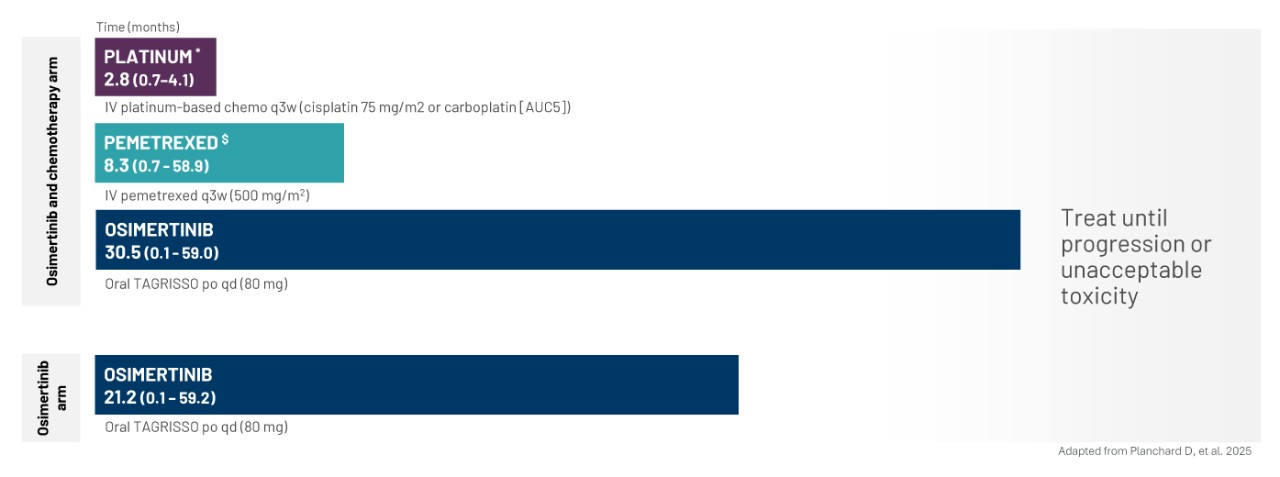
Patients in the combination arm had a median total exposure of 22.3 months for TAGRISSO, 2.8 months of platinum-based chemotherapy, and 8.3 months for pemetrexed.2–5

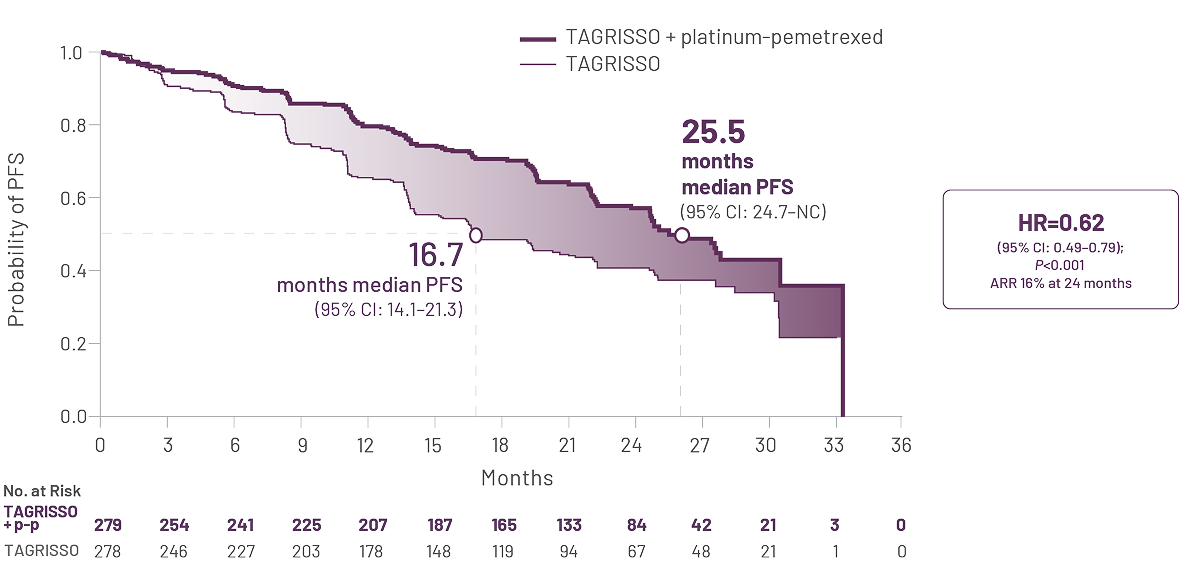
PFS by Investigator Analysis1,2
Primary endpoint

Graph showing the primary endpoint PFS investigator analysis in patients with EGFRm NSCLC in FLAURA2 trial

25.5 months mPFS in TAGRISSO with chemotherapy (95% CI 24.7, NC) vs. 16.7 months in TAGRISSO monotherapy (95% CI 14.1, 21.3)

HR=0.62 (95% CI: 0.49, 0.79); P<0.001. ARR 16% at 24 months

Overall data maturity: 51%

Adapted from Planchard D et al. N Engl J Med 2023.1

HR, hazard ratio; NC, not calculated; PFS, progression-free survival

Treatment with TAGRISSO plus chemotherapy significantly extended median PFS by 8.8 months compared to TAGRISSO monotherapy, as assessed by investigator analysis.1

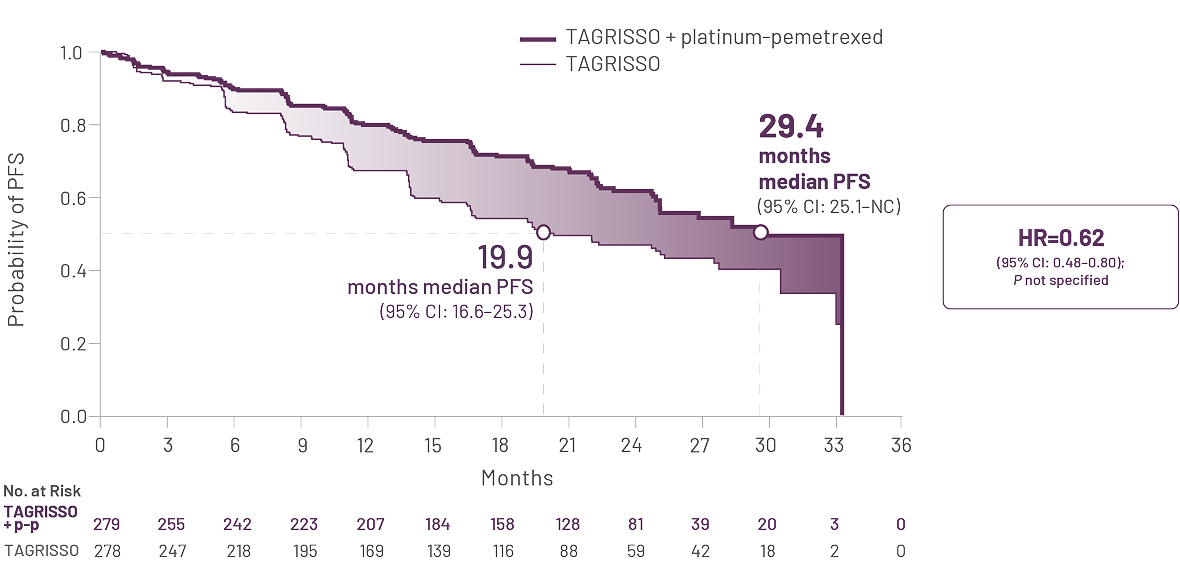
Graph showing the primary endpoint PFS BICR in patients with EGFRm NSCLC in FLAURA2 trial

29.4 months mPFS in TAGRISSO with chemotherapy (95% CI 25.1, NC) vs. 19.9 months in TAGRISSO monotherapy (95% CI 16.6, 25.3)

HR=0.62 (95% CI: 0.48, 0.80); P not specified, ARR 15% at 24 months (sensitivity analysis)

Adapted from Planchard D et al. N Engl J Med 2023.1

BICR, blinded independent central review; CI, confidence interval; HR, hazard ratio; NC, not calculated; PFS, progression-free survival

Treatment with TAGRISSO plus chemotherapy significantly extended median PFS by 9.5 months compared to TAGRISSO monotherapy, as assessed by BICR.1

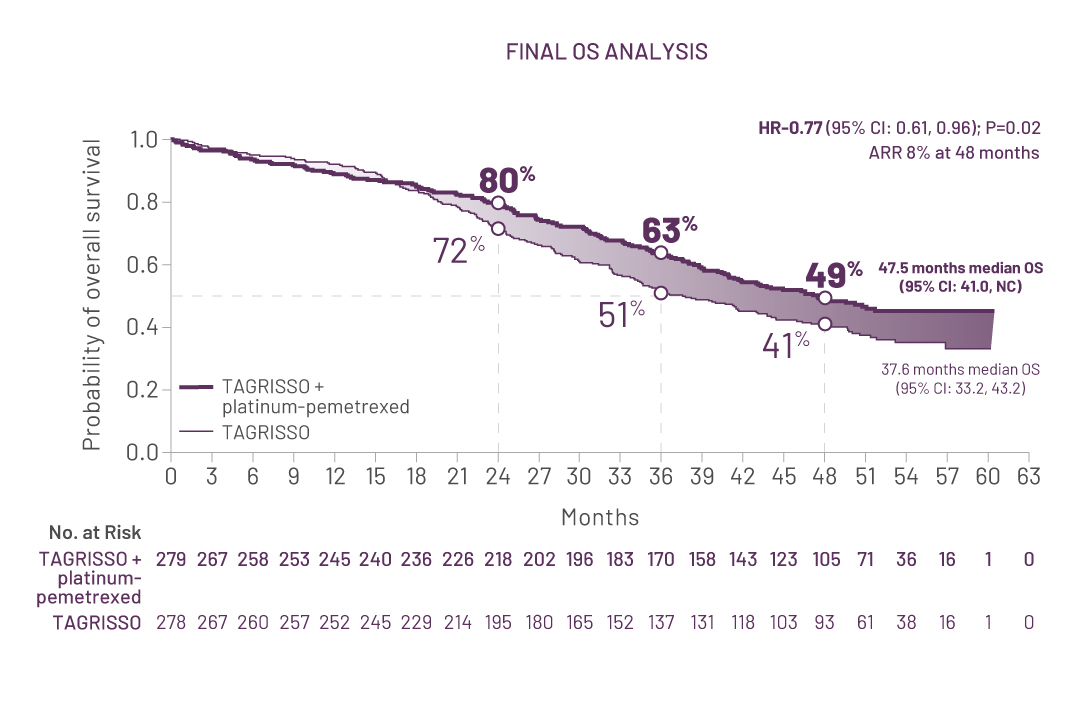
TAGRISSO with the addition of chemotherapy demonstrated statistically significant OS3

At 4 years, the longest median OS ever recorded in global phase III study, in first-line advanced EGFRm NSCLC, presented September 2025 at WCLC3

In the first-line treatment of advanced EGFRm NSCLC, TAGRISSO with chemotherapy significantly increased median OS by 9.9 months, compared to the TAGRISSO monotherapy arm.3 

The data showed 47.5 months mOS in TAGRISSO + chemotherapy (95% CI 41.0, NC), vs 37.6 months mOS in TAGRISSO arm (95% CI 33.2, 43.2).

HR (95% CI) 0.77 (0.61, 0.96); p=0.02], ARR 8% at 48 months, 57% data maturity.

Overall survival is a key secondary endpoint of FLAURA2.

Graph showing the primary endpoint PFS BICR in patients with EGFRm NSCLC in FLAURA2 trial Graph showing the primary endpoint PFS BICR in patients with EGFRm NSCLC in FLAURA2 trial

47.5 months mOS in TAGRISSO with chemotherapy (95% CI 41.0, NC) vs. 37.6 months in TAGRISSO monotherapy (95% CI 33.2, 43.2)

HR=0.77 (95% CI: 0.61, 0.96); P=0.02.  ARR 8% at 48 months (sensitivity analysis)

Adapted from: Planchard D, Jänne PA, Kobayashi K, et al. First-line osimertinib + chemotherapy versus osimertinib monotherapy in EGFRm advanced NSCLC: FLAURA2 final overall survival [oral presentation]. Presented at: World Conference on Lung Cancer; September 6-9, 2025; Barcelona, Spain.3

ARR, absolute risk reduction; CI, confidence interval; HR, hazard ratio; NC, not calculated; mOS, median overall survival

At 4 years, the longest median OS ever recorded in global phase III study, in first-line advanced EGFRm NSCLC, presented September 2025 at WCLC3

Prespecified exploratory analysis

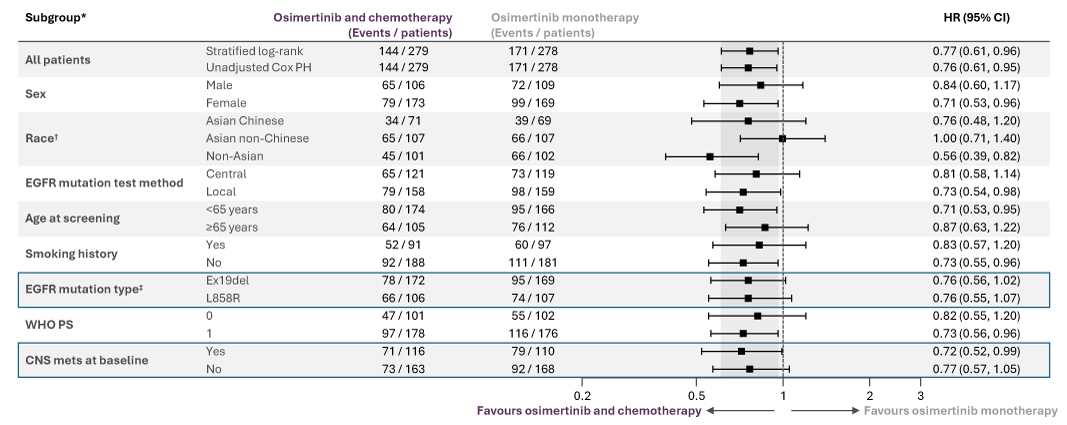
Graph showing CNS PFS in patients with EGFRm NSCLC in FLAURA2 trial Graph showing CNS PFS in patients with EGFRm NSCLC in FLAURA2 trial

Adapted from: Planchard D, Jänne PA, Kobayashi K, et al. First-line osimertinib + chemotherapy versus osimertinib monotherapy in EGFRm advanced NSCLC: FLAURA2 final overall survival [oral presentation]. Presented at: World Conference on Lung Cancer; September 6-9, 2025; Barcelona, Spain.3

Data cut-off: 12 June 2025. 


*Two additional subgroups performed to fulfil regulatory requirements for diagnostics are not included: EGFR mutations by central cobas

® tissue test and EGFR mutations by central cobas® ctDNA test

†Race was reported by the patient.

‡For EGFR mutation type, patients with both Ex19del and L858R were included in the Ex19del group.

CI, confidence interval; CNS, central nervous system; ctDNA, circulating tumour DNA; CTx, chemotherapy; EGFR, epidermal growth factor receptor; Ex19del, Exon 19 deletion; HR, hazard ratio; mets, metastases; mono, monotherapy; OS, overall survival; osi, osimertinib; PH, proportional hazard; WHO PS, World Health Organization performance status.  

Median exposure of treatment
Exploratory analysis

Graph showing CNS PFS in patients with EGFRm NSCLC in FLAURA2 trial Graph showing CNS PFS in patients with EGFRm NSCLC in FLAURA2 trial

Adapted from Planchard D, et al. 2025.

Data cut off 12 June 2025.

* Median (range) exposure in months of platinum chemotherapy is 2.8 (0.7 - 4.1); in cycles was 4 (1-6).

$ Median (range) exposure in months of pemetrexed is 8.3 (0.7 - 58.9); in cycles was 11 (1-67).

Median (range) exposure in months of osimertinib in combination arm is 30.5 (0.1 - 59.0).

Median (range) exposure in months of osimertinib in monotherapy arm is 21.2 (0.1 - 59.2).

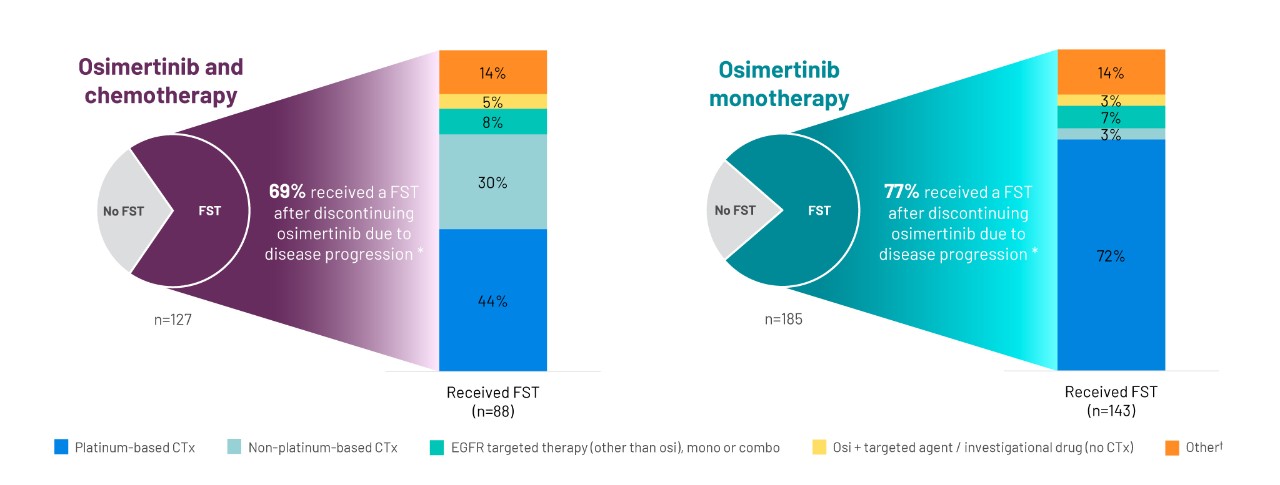
Chemotherapy was the most common FST (74%) after osimertinib and chemotherapy, nearly 6 in 10 was platinum-based.
Prespecified exploratory analysis.

Graph showing CNS PFS in patients with EGFRm NSCLC in FLAURA2 trial Graph showing CNS PFS in patients with EGFRm NSCLC in FLAURA2 trial

Subsequent treatment was per investigator choice.

Adapted from Planchard D, et al. 2025.

Data cut off 12 June 2025. 

*Denominator (127 for osi + CTx and 185 for osi mono) is the number of patients who discontinued osimertinib due to progression. 

†Other included ADCs, immunotherapies [PD-(L)1 inhibitors], other investigational anticancer therapies, antiangiogenic therapies [VEGF(R) inhibitors], catequentinib hydrochloride, savolitinib, and unspecified herbal and traditional anticancer medicines.

ADCs, antibody-drug conjugates; CTx, chemotherapy; combo, combination; EGFR, epidermal growth factor receptor; FST, first subsequent treatment; mono, monotherapy; OS, overall survival; PD-(L)1, programmed cell death (ligand)-1; VEGF(R), vascular endothelial growth factor (receptor)

Prespecified exploratory analysis

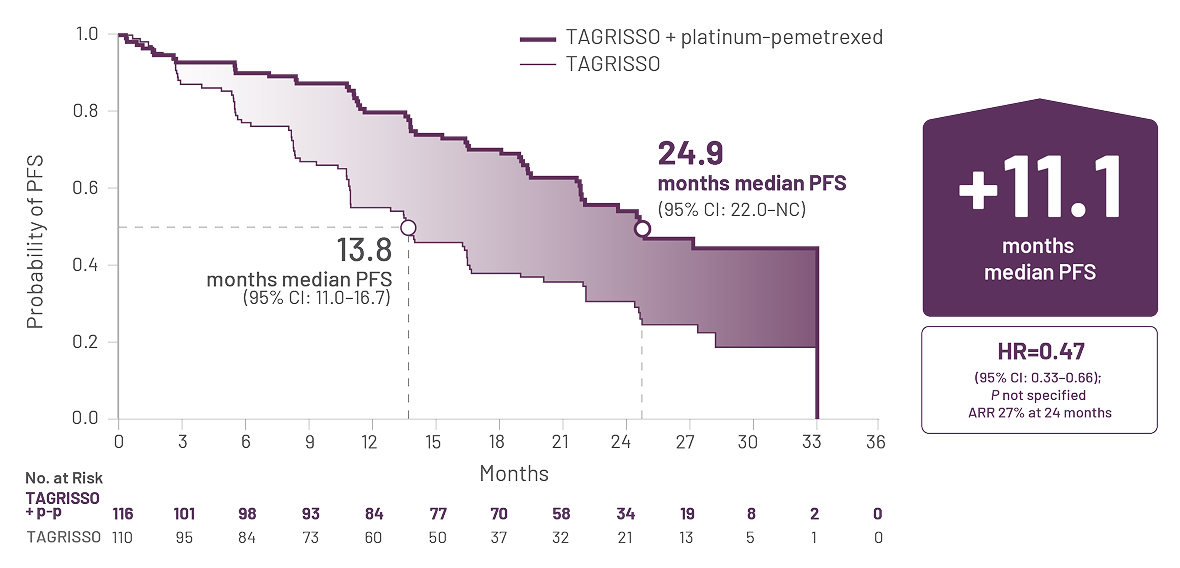
In a prespecified exploratory analysis of patients with CNS metastases at baseline, TAGRISSO with chemotherapy increased median PFS by 11 months despite pre-existing CNS metastases, compared to the TAGRISSO monotherapy arm.1

Over 2 years median PFS in patients with historically poor prognoses, receiving TAGRISSO with chemotherapy.1

PFS in patients with CNS Metastases at baseline
Graph showing CNS PFS in patients with EGFRm NSCLC in FLAURA2 trial Graph showing CNS PFS in patients with EGFRm NSCLC in FLAURA2 trial

24.9 months mPFS in TAGRISSO with chemotherapy (95% CI 22.0, NC) vs. 13.8 months in TAGRISSO monotherapy (95% CI 11.0, 16.7)

HR=0.47 (95% CI: 0.33, 0.66); P not specified.  ARR 27% at 24 months (sensitivity analysis)

Adapted from Planchard D et al. N Engl J Med 2023.1

CI, confidence interval; CNS, central nervous system; HR, hazard ratio; PFS, progression-free survival

Prespecified exploratory analysis

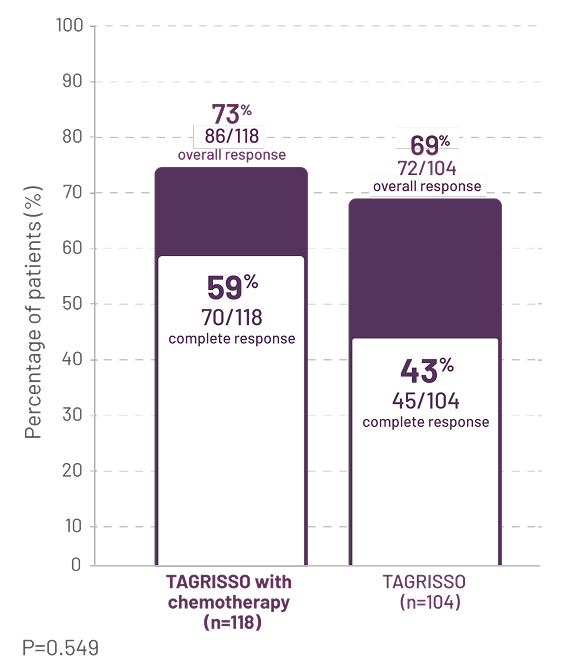
In a prespecified exploratory analysis of patients with brain metastases at baseline, TAGRISSO with chemotherapy demonstrated higher CNS responses compared to the TAGRISSO monotherapy arm, in the majority of patients, in the CNS full analysis set OR=1.19 (95% CI: 0.67–2.14); P=0.549.6 Improved CNS response rates were observed in patients who had brain metastases at baseline, a high-risk population.6

CNS responses in the majority of patients (CNS full analysis set; N=222)
Graph showing CNS responses in majority of patients in FLAURA2 trial
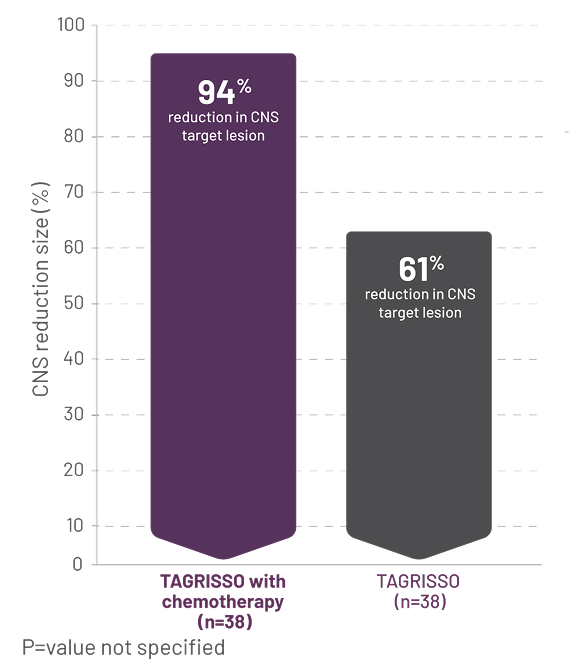
Median best reduction in CNS target lesion* size in patients with >1 measureable CNS lesion at baseline (N=76)†
Graph showing CNS target lesion median best redution in patients in FLAURA2 trial

Adapted from Janne PA et al. J Clin Oncol 2023.6

*Target lesion definition from protocol: at least 1 lesion, not previously irradiated that can be accurately measured at baseline as ≥10 mm in the longest diameter (except lymph nodes, which must have a short axis of ≥15 mm) with CT or MRI, and that is suitable for accurate repeated measurements.7

†The median best percentage change from baseline in CNS target lesion size was –94% (range, –100% to +7%) with osimertinib plus platinum-pemetrexed and –61% (range, –100% to +68%).6

CNS, central nervous system

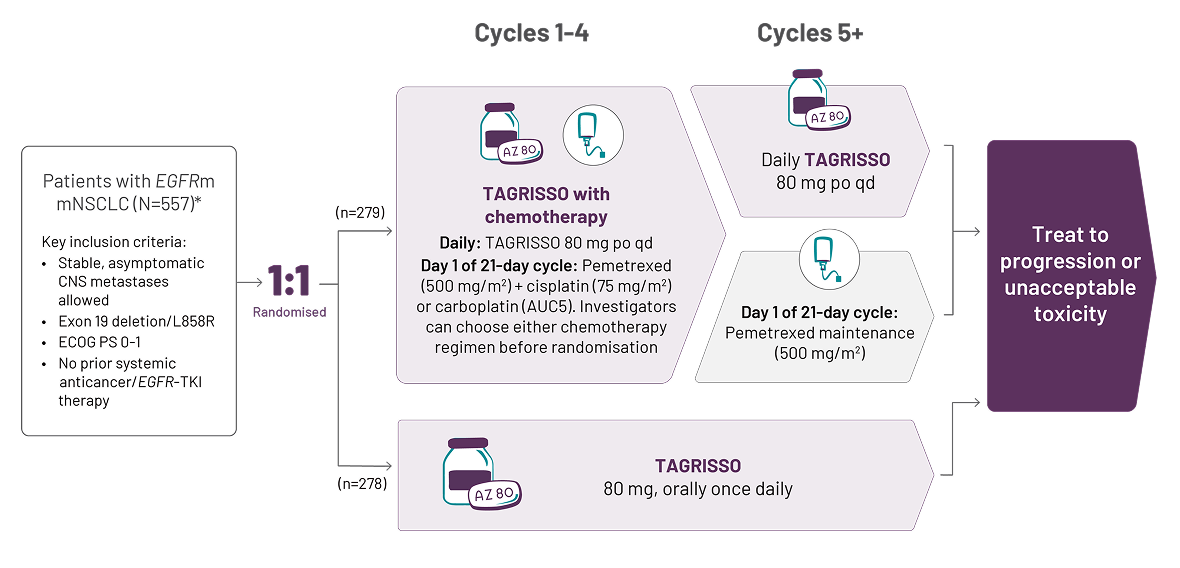
Clinical trial design chart for FLAURA2 trial - global phase 3 randomised TAGRISSO with chemotherapy vs TAGRISSO Clinical trial design chart for FLAURA2 trial - global phase 3 randomised TAGRISSO with chemotherapy vs TAGRISSO

Adapted from Planchard D et al. N Engl J Med 2023.1

*6 patients who were randomised did not receive treatment.1

AUC, area under the curve; CNS, central nervous system; ECOG, Eastern Cooperative Oncology Group; EGFRm, epidermal growth factor receptor mutant; mNSCLC, metastatic non-small cell lung cancer; po, by mouth; qd, every day; TKI, tyrosine kinase inhibitor

Baseline demographics were well-balanced between treatment arms, including ~40% of patients with CNS metastases at high risk of progression.1

Characteristics TAGRISSO with platinum-
pemetrexed (n=339)
TAGRISSO monotherapy
(n=278)
Sex
Male
38%39%
Female
62%61%
Age (years)
Median
6162
Range
26–8330–85
Ethnicity
Asian
64%63%
White
27%30%
American Indian or
Alaskan Native
4%2%
Black1%1%
Other5%4%
WHO performance status
0
37%37%
1
62%63%
Histology
Adenocarcinoma
99%99%
Adenosquamous
1%0%
Other1%1%
EGFRm at randomisation*
ex19del
61%60%
L858R
38%38%
Disease extent at study entry
Locally advanced
5%3%
Metastatic
95%97%
Site of metastates
Extrathorcic
53%54%
CNS
42%40%
Baseline tumour size (mm)Median (range)57 (10–284)57 (11–221)

Adapted from Planchard D et al. N Engl J Med 2023.1

CNS, central nervous system; EGFR, epidermal growth factor receptor; ex19del, exon 19 deletion; L858R, exon 21 substitution; WHO, World Health Organization

Primary endpoint: PFS based on investigator assessment (plus an additional sensitivity analysis per BICR assessment).1
Key secondary endpoints: Overall survival, objective response rate, duration and depth of response, disease control rate, and PFS2.1
Prespecified exploratory endpoint: Efficacy in patients with CNS metastases at baseline6

  • Brain scans were performed at screening and at the time of progression in all patients1
  • PFS2 is defined as time from randomisation until disease progression or death on the second line of therapy following the study treatment4

Explore TAGRISSO’s results

Navigate the safety profile: FLAURA2 trial

Explore safety profile

Take a closer look at how TAGRISSO is administered: FLAURA2 trial

Explore dosing and administration

Learn more about how TAGRISSO works

Explore MOA

AUC, area under the curve; BICR, blinded independent central review; CI, confidence interval; CNS, central nervous system; ECOG, Eastern Cooperative Oncology Group; EGFR, epidermal growth factor receptor; EGFRm, epidermal growth factor receptor mutant; HR, hazard ratio; mNSCLC, metastatic non-small cell lung cancer; MOA, mode of action; mPFS, median progression-free survival; NC, not calculated; NSCLC, non-small cell lung cancer; PFS, progression-free survival; PFS2, secondary progression-free survival; po, by mouth; PS, performance status; qd, every day; TKI, tyrosine kinase inhibitor


  1. Planchard D, Jänne PA, Cheng Y, Yang JC, Yanagitani N, Kim SW, et al. Osimertinib with or without Chemotherapy in EGFR-Mutated Advanced NSCLC. N Engl J Med. 2023 Nov 23;389(21):1935-48.
  2. TAGRISSO (osimertinib) 80 mg Summary of Product Characteristics.
  3. Planchard D, Jänne PA, Kobayashi K, et al. First-line osimertinib + chemotherapy versus osimertinib monotherapy in EGFRm advanced NSCLC: FLAURA2 final overall survival [oral presentation]. Presented at: World Conference on Lung Cancer; September 6-9, 2025; Barcelona, Spain.
  4. Planchard D, Jänne PA, Cheng Y, Yang JC, Yanagitani N, Kim SW, et al. Osimertinib with or without Chemotherapy in EGFR-Mutated Advanced NSCLC. (Supplementary Appendix) N Engl J Med. 2023 Nov 23;389(21):1935-48.
  5. Planchard D, et al. FLAURA2: safety and CNS outcomes of first-line osimertinib ± chemotherapy in EGFRm advanced NSCLC [oral presentation]. Presented at: ESMO Congress; October 20–24, 2023; Madrid, Spain.
  6. Jänne PA, Planchard D, Kobayashi K, Cheng Y, Lee CK, Valdiviezo N, et al. CNS Efficacy of Osimertinib With or Without Chemotherapy in Epidermal Growth Factor Receptor-Mutated Advanced Non-Small-Cell Lung Cancer. J Clin Oncol. 2024 Mar 1;42(7):808-20.
  7. Jänne PA, Planchard D, Kobayashi K, Cheng Y, Lee CK, Valdiviezo N, et al. CNS Efficacy of Osimertinib With or Without Chemotherapy in Epidermal Growth Factor Receptor-Mutated Advanced Non-Small-Cell Lung Cancer. (Protocol) J Clin Oncol. 2024 Mar 1;42(7):808-20.

GB-69303 | DOP: October 2025

Adverse events should be reported. Reporting forms and information can be found at www.mhra.gov.uk/yellowcard or search for MHRA Yellow Card in the Google Play or Apple App Store. Adverse events should also be reported to AstraZeneca by visiting https://contactazmedical.astrazeneca.com/ or by calling ‌‌‌0‌‌‌8‌‌‌‌‌0‌‌‌‌0‌‌‌ ‌‌7‌‌‌‌‌‌8‌‌‌3‌‌‌ ‌‌0‌‌‌‌‌0‌‌‌‌3‌‌‌‌3‌‌‌.

Connessiallasalute.it

This website was created for UK HCPs and has been designed to provide information to educate, empower and enable them in the great work they are doing for patients across a range of therapy areas. This website is intended for doctors, nurses, and pharmacists in the UK. Other UK residents please visit astrazeneca.co.uk.

Terms of use

Privacy Policy

Cookie Policy

Contact Us

LinkedIn

Twitter

©2025 AstraZeneca. GB-73926 | February 2026