Welcome to this UK AstraZeneca produced and funded website

This website is intended for UK Healthcare Professionals only.


The website contains both promotional and non-promotional content.


If you are a patient or a carer of a patient prescribed an AstraZeneca product, please visit myazmed.co.uk


For any other UK residents please visit astrazeneca.co.uk

I am not a Healthcare Professional
IMFINZI (durvalumab) UK Prescribing Information
IMJUDO (tremelimumab) ▼ UK Prescribing Information
Adverse Event Reporting

This website is intended for UK Healthcare professionals only. Other UK residents please visit astrazeneca.co.uk

AstraZeneca-logo
  • Our Medicines
    • Cardiovascular, Renal & Metabolism
      • ATTR Amyloidosis
        • WAINZUA®▼(eplontersen)
      • Chronic Kidney Disease (CKD)
        • FORXIGA® (dapagliflozin)
      • Heart Failure
        • FORXIGA® (dapagliflozin)
      • Hyperkalaemia
        • LOKELMA® (sodium zirconium cyclosilicate)
      • Type 2 Diabetes (T2D)
        • FORXIGA® (dapagliflozin)
    • Oncology
      • Breast Cancer
        • LYNPARZA® (olaparib)
        • TRUQAP®▼(capivasertib)
      • Bladder Cancer
        • IMFINZI® (durvalumab)
      • Endometrial Cancer
        • IMFINZI® (durvalumab)
        • LYNPARZA® (olaparib)
      • Gastrointestinal Cancer
        • IMFINZI® (durvalumab)
        • IMJUDO®▼(tremelimumab)
      • Lung Cancer
        • IMFINZI® (durvalumab)
        • TAGRISSO® (osimertinib)
      • Ovarian Cancer
        • LYNPARZA® (olaparib)
      • Prostate Cancer
        • LYNPARZA® (olaparib)
        • ZOLADEX® (goserelin)
    • Respiratory
      • Asthma
        • TEZSPIRE®▼ (tezepelumab)
        • SYMBICORT® (budesonide/formoterol)
      • Chronic Obstructive Pulmonary Disease(COPD)
        • TRIXEO AEROSPHERE® (formoterol fumarate dihydrate/glycopyrronium/budesonide)
        • BEVESPI® (glycopyrronium/formoterol fumarate dihydrate)
    • Vaccines
      • Flu
        • FLUENZ® nasal spray suspension (influenza vaccine, live attenuated, nasal)
  • Therapy Areas
    • Cardiovascular, Renal & Metabolism
      • ATTR Amyloidosis
      • Chronic Kidney Disease (CKD)
      • Heart Failure
      • Hyperkalaemia
      • Type 2 Diabetes (T2D)
    • Oncology
      • Breast Cancer
      • Bladder Cancer
      • Endometrial Cancer
      • Gastrointestinal Cancer
      • Lung Cancer
      • Ovarian Cancer
      • Prostate Cancer
    • Respiratory
      • Asthma
      • Chronic Obstructive Pulmonary Disease(COPD)
    • Vaccines
      • Flu
  • About us
    • AZ Commitment
  • Contact us
  • AstraZeneca UK
  • IMFINZI (durvalumab)
  • About biliary tract cancer
  • Home
  • Biliary tract cancer
    • About biliary tract cancer
    • Mode of action
    • TOPAZ-1 clinical trial
    • Dosing & administration
    • Resources
  • Hepatocellular carcinoma
    • Why STRIDE?
    • About hepatocellular carcinoma
    • Mode of action
    • HIMALAYA clinical trial
    • Dosing & administration
    • Resources
  • Resources
    • Biliary tract cancer resources
    • Hepatocellular carcinoma resources
    • Gastrointestinal cancer resources
About biliary tract cancer

Biliary tract cancer: Facts and figures

View the British Society of Gastroenterology key recommendations

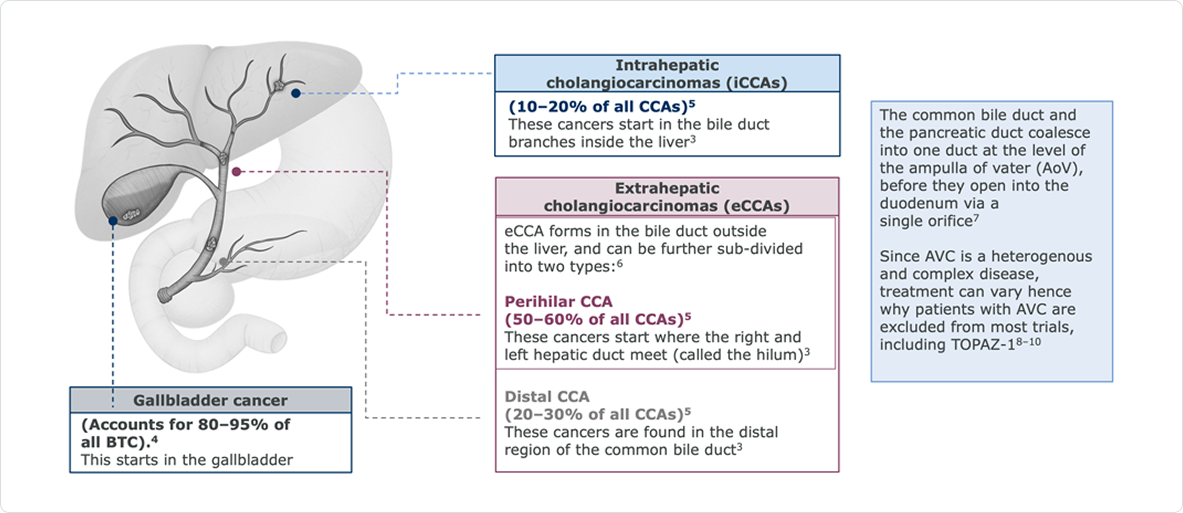
BTC is a heterogenous group of cancers, classified into subtypes dependent on their site of origin1–3

Gallbladder-cancer Gallbladder-cancer

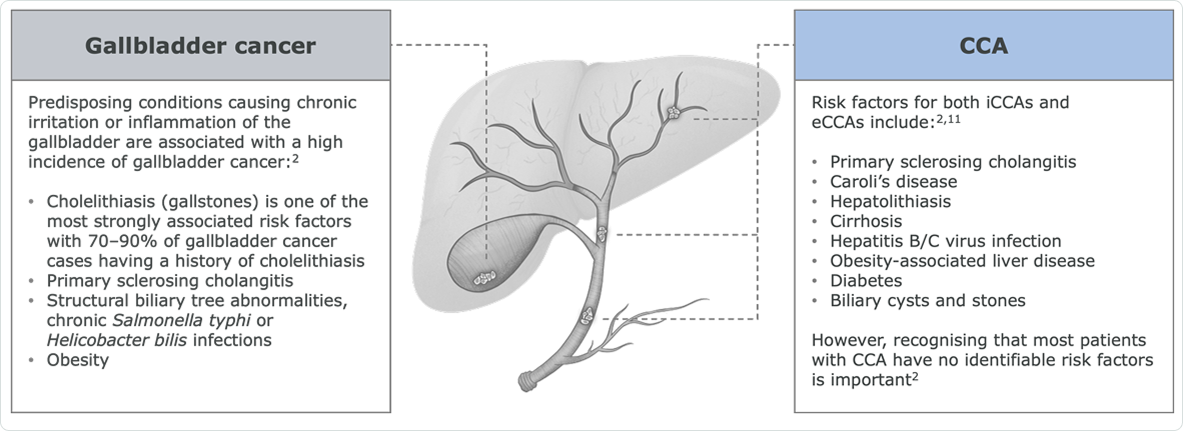
A diverse range of risk factors exists for BTC, but many are associated with chronic inflammation2

Gallbladder-cancer Gallbladder-cancer

BTC (CCA and gallbladder cancer) incidence in the UK is rare12–14

Patients are often diagnosed late and therefore have a poor prognosis1

stethoscope stethoscope

In the UK, BTC is relatively rare, affecting around 2000–2500 people per year13,14

A recent study shows the age-standardised incidence rate for CCAs in the UK was 4.0 per 100,000 in females and 4.6 per 100,000 in males14

sixty sixty

BTC is most common in people over 60 years of age although incidence appears to be increasing across all age groups12


timer timer

Most patients with BTC (>65%) are diagnosed with advanced disease1


calendar calendar

Prognosis is poor with 5-year survival rate being <10%15


In 2019 CCA was the cause of 2754 deaths in England alone12

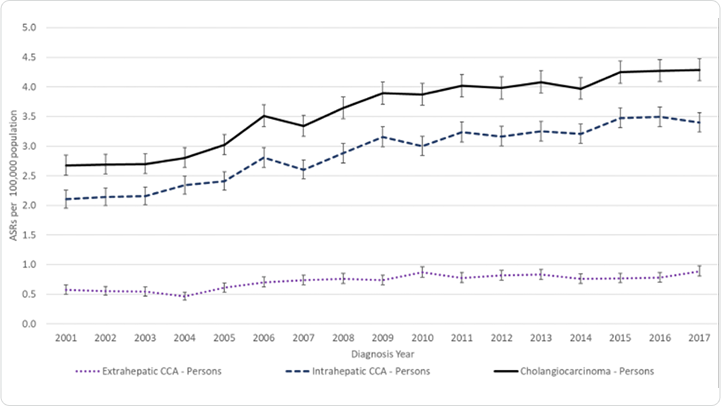
CCA incidence has been steadily increasing in England16

Age-standardised incidence rates for CCA subtype in England (2001–2017)16

Graph Graph
  • The UK incidence of gallbladder cancer has increased by 66% since the early 1990s, which may largely reflect the changing prevalence of risk factors, and improvements in diagnostic techniques17
  • In the UK, the incidence of intrahepatic cholangiocarcinomas (iCCAs) has increased, which could be due to an increase in known risk factors as well as improvement in diagnosis16,18,22
  • The incidence of extrahepatic cholangiocarcinomas (eCCAs) is lower than that of iCCAs. This may be due to the misclassification of eCCA as iCCA22

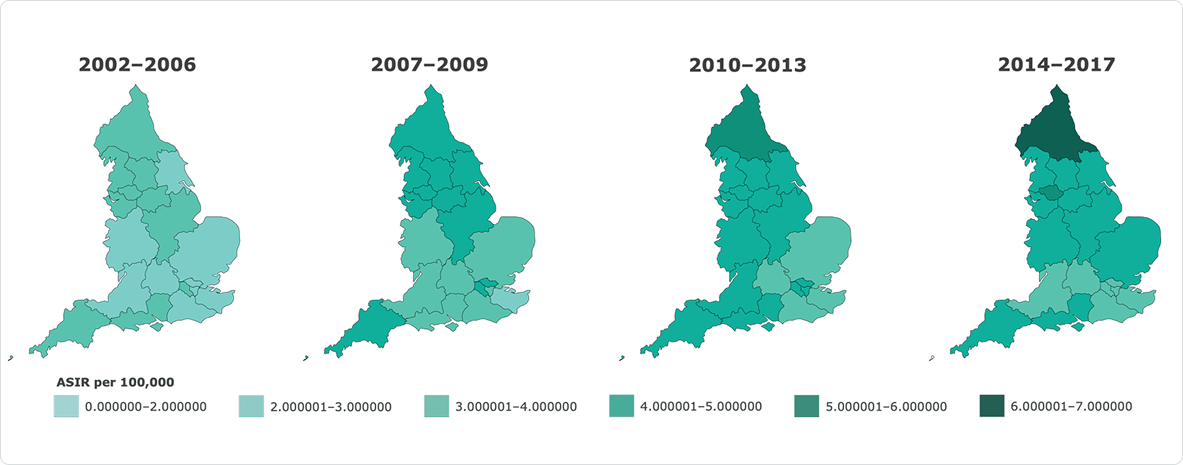
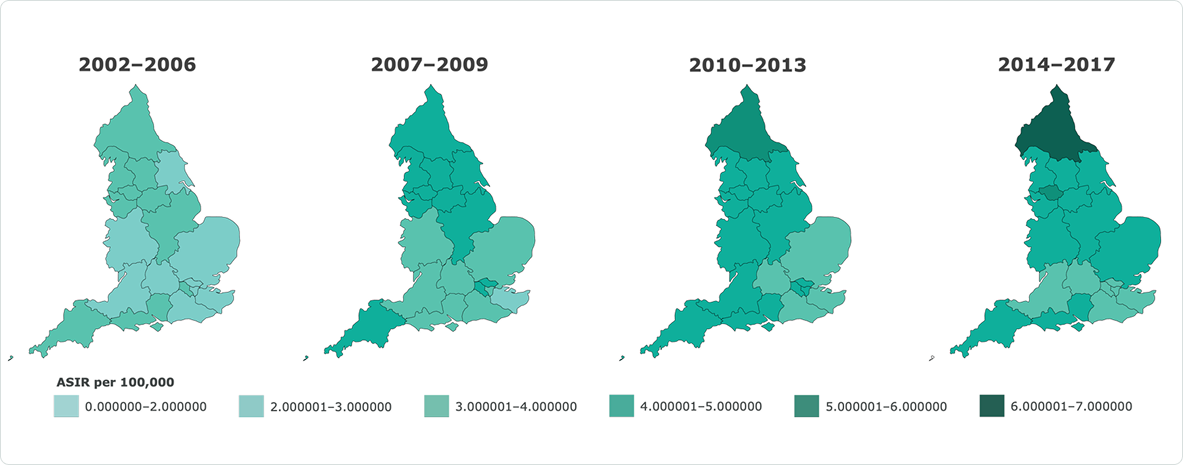
Variation in incidence across England has worsened over time15

map map

Adapted from Khan SA 2020

Given the continual increase in CCA incidence and mortality, additional research is needed to investigate the causes behind these regional variances, which may be due to differences in risk factors, clinical services, or a combination of both15

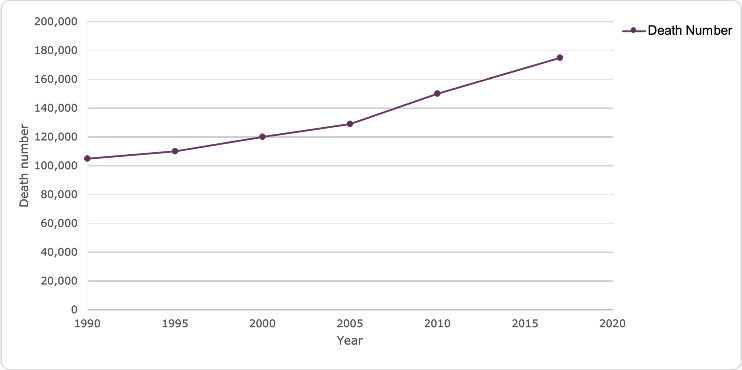
Mortality rates have generally risen for CCA4,20

Trends in global mortality rates for BTC from 19904

Graph Graph

Adapted from Ouyang G et al. 2021

Between 1990 and 2017 the global mortality rate from BTC increased by 65%4


In the UK, the mortality rate of BTC increased from an age-standardised rate (ASR) of 2.59 in 2006 to 3.83 in 201620

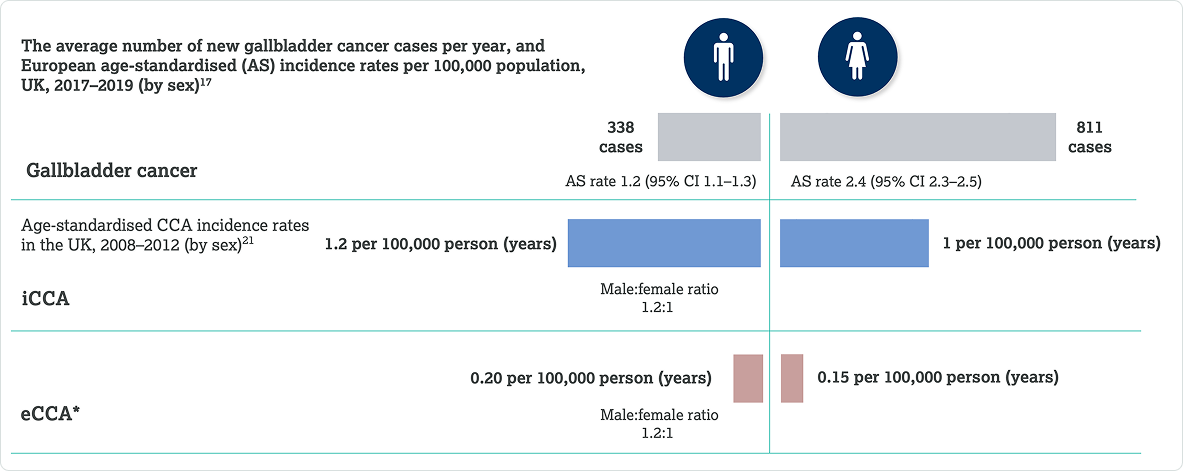
Gallbladder cancer is more common in women than men; CCAs tend to occur equally in men and women

men-and-women men-and-women

*Please note, the values presented for eCCA are estimations due to lack of accurate data values on the x-axis in the referenced article.


Watch a video highlighting the unmet need in BTC

AoV, ampulla of vater; AS, age-standardised; ASIR, age-standardised incidence rate; ASR, age-standardised rate; BTC, biliary tract cancer; CCA, cholangiocarcinoma; eCCA, extrahepatic CCA; iCCA, intrahepatic CCA.


  1. Valle J, et al. Cancer Discov. 2017;7:943–962
  2. Valle J, et al. Lancet. 2021;397:428–44
  3. Cancer Research UK. What is bile duct cancer? Available at: https://www.cancerresearchuk.org/about-cancer/bile-duct-cancer/about. Accessed April 2025
  4. Ouyang G, et al. Cancer. 2021;127:2238–2250
  5. Banales J, et al. Nat Rev Gastroenterol Hepatol. 2020;17:557–588
  6. PDQ Cancer Information Summaries. [Internet]. Bethesda (MD): National Cancer Institute. 2023. Available at: https://www.ncbi.nlm.nih.gov/books/NBK65851/. Accessed April 2025
  7. Chavalitdhamrong D, et al. World J Clin Cases. 2014;2(2):36–38
  8. Pea A, et al. World J Gastrointest Oncol. 2018;10:370–380
  9. Sung MK, et al. Ann Hepatobiliary Pancreat Surg. 2023;27(1):107-113
  10. Oh DY, et al. NEJM Evid. 2022;(Supplement 1):1(8)
  11. Clements O, et al. J Hepatol. 2020;72:95–103
  12. AMMF. Introduction to Cholangiocarcinoma. Available at: https://ammf.org.uk/cholangiocarcinoma/. Accessed April 2025
  13. Manchester Cancer Research Centre. Improving the standard of care for biliary tract cancers around the world. Available at: https://www.mcrc.manchester.ac.uk/impact-case-studies/improving-the standard-of-care-for-biliary-tract-cancers-around-the-world/. Accessed April 2025
  14. Genus T, et al. Annals of Oncol. 2019;30(Supplement 4):iv155
  15. Khan SA. An Overview of Cholangiocarcinoma. Presented at AMMF’s Cholangiocarcinoma Patients and Carers Information Day. 2020. Available at: https://ammf.org.uk/wp-content/uploads/2020/11/1.CCA_AMMF_Pt-day_29oct2020.pdf. Accessed April 2025
  16. Genus T, et al. Presented at ESMO 2019. Poster 402-P
  17. Cancer Research UK. Gallbladder cancer incidence statistics. Available at: https://www.cancerresearchuk.org/health-professional/cancer-statistics/statistics-by-cancer-type/gallbladder-cancer/incidence. Accessed April 2025
  18. Florio A, et al. Cancer 2020;126: 2666–2678
  19. Bridgewater J, et al. ASCO Educational Book. 2016;35:e193–e203
  20. Cancer Research UK. Gallbladder cancer mortality statistics. Available at: https://www.cancerresearchuk.org/health-professional/cancer-statistics/statistics-by-cancer-type/gallbladder-cancer/mortality. Accessed April 2025
  21. Baria K, et al. Gastra Hep Advances, 2022;1(4)618‐626
  22. Florio A, et al. Cancer. 2020;126:2666–2678. (Supplementary material FigS3 and FigS4)

GB-65189 | April 2025

Adverse events should be reported. Reporting forms and information can be found at www.mhra.gov.uk/yellowcard or search for MHRA Yellow Card in the Google Play or Apple App Store. Adverse events should also be reported to AstraZeneca by visiting https://contactazmedical.astrazeneca.com/ or by calling ‌‌‌0‌‌‌8‌‌‌‌‌0‌‌‌‌0‌‌‌ ‌‌7‌‌‌‌‌‌8‌‌‌3‌‌‌ ‌‌0‌‌‌‌‌0‌‌‌‌3‌‌‌‌3‌‌‌.

Connessiallasalute.it

This website was created for UK HCPs and has been designed to provide information to educate, empower and enable them in the great work they are doing for patients across a range of therapy areas. This website is intended for doctors, nurses, and pharmacists in the UK. Other UK residents please visit astrazeneca.co.uk.

Terms of use

Privacy Policy

Cookie Policy

Contact Us

LinkedIn

Twitter

©2026 AstraZeneca. GB-76920 | May 2026

Enhance your knowledge, stay informed

Be the first to know. Hear about events, products and ways to support your patients.

Thank you. We will be in touch

GB-74216| DOP : February 2026