Welcome to this UK AstraZeneca produced and funded website

This website is intended for UK Healthcare Professionals only.


The website contains both promotional and non-promotional content.


If you are a patient or a carer of a patient prescribed an AstraZeneca product, please visit myazmed.co.uk


For any other UK residents please visit astrazeneca.co.uk

I am not a Healthcare Professional
IMFINZI (durvalumab) UK Prescribing Information
Adverse Event Reporting

This website is intended for UK Healthcare professionals only. Other UK residents please visit astrazeneca.co.uk

Logo test product
  • Our Medicines
    • Cardiovascular, Renal & Metabolism
      • ATTR Amyloidosis
        • WAINZUA®▼(eplontersen)
      • Chronic Kidney Disease (CKD)
        • FORXIGA® (dapagliflozin)
      • Heart Failure
        • FORXIGA® (dapagliflozin)
      • Hyperkalaemia
        • LOKELMA® (sodium zirconium cyclosilicate)
      • Type 2 Diabetes (T2D)
        • FORXIGA® (dapagliflozin)
    • Oncology
      • Breast Cancer
        • LYNPARZA® (olaparib)
        • TRUQAP®▼(capivasertib)
      • Bladder Cancer
        • IMFINZI® (durvalumab)
      • Endometrial Cancer
        • IMFINZI® (durvalumab)
        • LYNPARZA® (olaparib)
      • Gastrointestinal Cancer
        • IMFINZI® (durvalumab)
        • IMJUDO®▼(tremelimumab)
      • Lung Cancer
        • IMFINZI® (durvalumab)
        • TAGRISSO® (osimertinib)
      • Ovarian Cancer
        • LYNPARZA® (olaparib)
      • Prostate Cancer
        • LYNPARZA® (olaparib)
        • ZOLADEX® (goserelin)
    • Respiratory
      • Asthma
        • TEZSPIRE®▼ (tezepelumab)
        • SYMBICORT® (budesonide/formoterol)
      • Chronic Obstructive Pulmonary Disease(COPD)
        • TRIXEO AEROSPHERE® (formoterol fumarate dihydrate/glycopyrronium/budesonide)
        • BEVESPI® (glycopyrronium/formoterol fumarate dihydrate)
    • Vaccines
      • Flu
        • FLUENZ® nasal spray suspension (influenza vaccine, live attenuated, nasal)
  • Therapy Areas
    • Cardiovascular, Renal & Metabolism
      • ATTR Amyloidosis
      • Chronic Kidney Disease (CKD)
      • Heart Failure
      • Hyperkalaemia
      • Type 2 Diabetes (T2D)
    • Oncology
      • Breast Cancer
      • Bladder Cancer
      • Endometrial Cancer
      • Gastrointestinal Cancer
      • Lung Cancer
      • Ovarian Cancer
      • Prostate Cancer
    • Respiratory
      • Asthma
      • Chronic Obstructive Pulmonary Disease(COPD)
    • Vaccines
      • Flu
  • About us
    • AZ Commitment
  • Contact us
Login
  • AstraZeneca UK
  • Lung Cancer
  • AEGEAN Safety Profile
  • Home
  • Efficacy and clinical trials
    • PACIFIC
    • AEGEAN
    • ADRIATIC
    • CASPIAN
  • Safety profile
    • PACIFIC
    • AEGEAN
    • ADRIATIC
    • CASPIAN
  • Dosing and administration
    • PACIFIC
    • AEGEAN
    • ADRIATIC
    • CASPIAN
  • Mechanism of action
    • PACIFIC
    • AEGEAN
    • ADRIATIC
    • CASPIAN
  • Resources
  • Lung therapy
    • Lung pathway
    • Diagnostics
    • Prehabilitation
AEGEAN Safety Profile
Imfinzi-header-MOA-monoclonal-antibody.jpg

Logo for  IMFINZI (durvalumab) which is coloured red and blue with brand and generic name

AEGEAN Safety profile

Most common adverse events


Other safety considerations

The safety profile of IMFINZI (durvalumab) in the AEGEAN study demonstrated a consistent safety profile with the known individual safety profiles of IMFINZI and the chosen chemotherapy.2 In the AEGEAN clinical trial, IMFINZI was administered intravenously at a dose of 1500 mg or placebo plus platinum-based chemotherapy Q3W for 4 cycles before surgery, followed by IMFINZI adjuvant or placebo intravenously Q4W for up to 12 cycles.2


IMFINZI was evaluated in the AEGEAN clinical trial regimen and demonstrated clinical benefit for patients with Stage IIA–IIIB (N2) resectable NSCLC.2

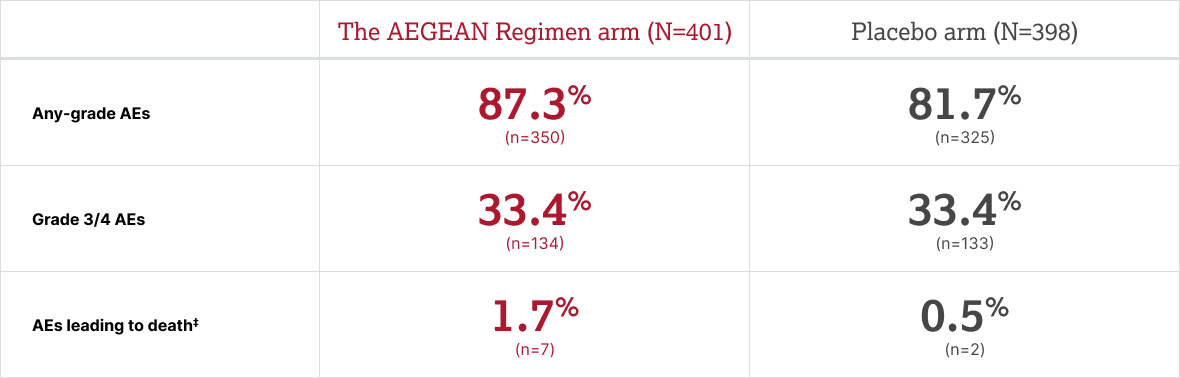
Similar rates of Grade 3/4 AEs were seen in both study arms2

Most common adverse events

Anaemia was the most common adverse event of any cause in both arms.3

Most common adverse events of any cause in the safety analysis set*

 The AEGEAN Regimen (N=401)Placebo + CT (N=398)
 Any gradeGrade 3 or 4Any gradeGrade 3 or 4
EventNumber of patients with event (%)
Anaemia136 (33.9)26 (6.5)126 (31.7)26 (6.5)
Nausea101 (25.2)1 (0.2)115 (28.9)1 (0.3)
Constipation100 (24.9)1 (0.2)84 (21.1)0
Decreased appetite†73 (18.2)1 (0.2)70 (17.6)1 (0.3)
Alopecia69 (17.2)063 (15.8)1 (0.3)
Neutropenia68 (17.0)36 (9.0)71 (17.8)38 (9.5)
Neutrophil count decreased64 (16.0)39 (9.7)57 (14.3)43 (10.8)
Rash56 (14.0)2 (0.5)34 (8.5)1 (0.3)
Diarrhoea52 (13.0)3 (0.7)49 (12.3)3 (0.8)
Fatigue52 (13.0)046 (11.6)1 (0.3)
Asthenia50 (12.5)054 (13.6)5 (1.3)
Pruritus47 (11.7)1 (0.2)22 (5.5)0
Vomiting45 (11.2)3 (0.7)42 (10.6)4 (1.0)
COVID-19‡45 (11.2)1 (0.2)35 (8.8)3 (0.8)
Procedural pain44 (11.0)1 (0.2)48 (12.1)2 (0.5)
Insomnia41 (10.2)046 (11.6)0

For a full list of AEs and warnings, please refer to the IMFINZI Summary of Product Characteristics.

Adapted from Heymach JV et al. N Engl J Med 2023 (supplementary appendix).3

Data cutoff: 10 November 2022.2


* The safety analysis set includes all patients who underwent randomisation and received at least one dose of trial treatment or placebo; adverse events were graded using Common Terminology Criteria for Adverse Events version 5.0.3


† Two patients (one in each arm) had decreased appetite with an outcome of death (max. Grade 5); the fatal event in the durvalumab arm was assessed as possibly related to study treatment by the investigator.3


‡ Six patients had COVID-19 events of max. Grade 5 (durvalumab arm, n=5; placebo arm, n=1); all COVID-19 deaths were assessed by the investigator as unrelated to study treatment.3

The incidence of AEs possibly related to IMFINZI, placebo or chemotherapy (interim analysis 2)†4

Table showing the any grade, grade 3 or 4 adverse events in the AEGEAN trial with Imfinzi (durvalumab)

Adapted from Heymach JV et al. WCLC 2024.4

Data cutoff: 10 May 2024.4


*The safety analysis set includes all patients who underwent randomisation and received at least one dose of trial treatment or placebo.4


†IA2 included data cutoff on 10 May 2024, with additional study follow up since IA1 data cutoff on 10 November 2022. All patients had discontinued or completed study treatment at EFS IA2.4


‡During the overall period, interstitial lung disease (n=2) and immune-mediated lung disease, pneumonitis, haemoptysis, myocarditis, and decreased appetite (n=1 each) were included in the D arm and pneumonia and infection (n=1 each) in the PBO arm. During the adjuvant period, interstitial lung disease was included in the D arm and infection in the PBO arm

Early diagnosis and management of imAEs is crucial to help minimise serious consequences5

  • 25.4% of patients receiving the AEGEAN Regimen (n=401) experienced an imAE of any grade, compared to 10.3% of those receiving placebo4

  • 4.5% of patients receiving the AEGEAN Regimen had a Grade 3/4 imAE, vs 2.5% for placebo4

  • For suspected imAEs, adequate evaluation should be performed to confirm etiology or exclude alternate etiologies. Based on the severity of the adverse reaction, IMFINZI should be withheld or permanently discontinued. For a full list of dosage modification please refer to section 4.2, Table 2 for recommended treatment modification5


Immune-mediated AEs are special warnings for use with IMFINZI. Please refer to the SmPC for further information on adverse events and special warnings.

Routine monitoring of patients for signs and symptoms is essential.5 Systemic corticosteroids, endocrine therapy or other immunosuppressants can be used after starting IMFINZI to treat imAEs.*5

For a full list of AEs and warnings, please refer to the IMFINZI Summary of Product Characteristics. imAEs included: pneumonitis, hepatitis, hepatitis in HCC, colitis, diarrhoea, hyperthyroidism, thyroiditis, hypothiroiditis, adrenal insufficiency or hypophysitis/hypopituitarism, type 1 diabetes mellitus, nephritis, rash or dermatitis (including pemphigoid), myocarditis, myositis, polymyositis, rhabdomyolysis, myasthenia gravis, Myelitis transverse, meningitis, encephalitis, Guillain-Barre syndrome, thrombocytopenia, pancreatitis, arthritis, uveitis, cystitis non-infective and polymyalgia rheumatica.5

Data cutoff: 10 May 2024.4


*The use of systemic corticosteroids or immunosuppressants before starting IMFINZI, except physiological dose of systemic corticosteroids (≤10 mg/day prednisone or equivalent), is not recommended because of their potential interference with the pharmacodynamic activity and efficacy of IMFINZI.5

IMFINZI other safety considerations

The safety and efficacy of IMFINZI in children and adolescents aged below 18 years of age have not been established.5


Resectable NSCLC patients with a body weight of 30 kg or less must receive weight-based dosing of IMFINZI at 20 mg/kg. In combination with platinum-based chemotherapy dose at 20 mg/kg every 3 weeks (21 days) prior to surgery, followed by monotherapy at 20 mg/kg every 4 weeks after surgery until weight increases to greater than 30 kg.5 Dose modifications based on body weight can be found here
 
Dose adjustment is not required for elderly patients (≥65 years of age). Due to limited data, no dose adjustment of IMFINZI is recommended in patients with mild or moderate renal impairment, as well as those with hepatic impairment (data from patients with severe hepatic impairment are limited). Data from patients with severe renal impairment are too limited to draw conclusions on this population.5


Monitor patients for signs and symptoms of infusion-related reactions, which should be managed in accordance with section 4.2 of the SmPC.5


Patients with pre-existing AIDs have a higher risk of immune-related adverse reactions and frequent, generally manageable flares following immune-checkpoint inhibitor therapy.5


For a detailed description of special warnings and precautions for use, please refer to Section 4.4 of the IMFINZI Summary of Product Characteristics.5


IMFINZI is contraindicated in patients with hypersensitivity to the active substance(s) or to any of the excipients listed in section 6.1 of the IMFINZI Summary of Product Characteristics.

Continue exploring the AEGEAN Regimen

Learn more about the dosing details in the AEGEAN Regimen

Explore dosing and administration

Take a closer look at how IMFINZI works within the AEGEAN Regimen

Explore MOA

Discover more about the AEGEAN study design and efficacy outcomes

Explore efficacy data

AE – adverse event; AID – autoimmune disease; COVID-19 – coronavirus disease; CT – chemotherapy; D – durvalumab; EFS – event-free survival; HCC – hepatocellular carcinoma; imAE – immune-mediated adverse event; NICE – National Institute for Health and Care Excellence; NSCLC – non-small cell lung cancer; PBO – placebo; Q3W – every 3 weeks; Q4W – every 4 weeks; UC – urothelian cancer.

  1. NICE. Durvalumab with chemotherapy before surgery (neoadjuvant) then alone after surgery (adjuvant) for treating resectable non-small-cell lung cancer. https://www.nice.org.uk/guidance/gid-ta11197/documents/674 [Accessed June 2025].
  2. Heymach JV et al. N Engl J Med. 2023;389(18):1672-1684.
  3. Heymach JV et al. N Engl J Med. 2023;389(18):1672-1684. (Supplementary Appendix).
  4. Heymach JV et al. Abstract OA13.03. Presented at WCLC 2024.
  5. IMFINZI Summary of Product Characteristics.

GB-65595 | July 2025

Adverse events should be reported. Reporting forms and information can be found at www.mhra.gov.uk/yellowcard or search for MHRA Yellow Card in the Google Play or Apple App Store. Adverse events should also be reported to AstraZeneca by visiting https://contactazmedical.astrazeneca.com/ or by calling ‌‌‌0‌‌‌8‌‌‌‌‌0‌‌‌‌0‌‌‌ ‌‌7‌‌‌‌‌‌8‌‌‌3‌‌‌ ‌‌0‌‌‌‌‌0‌‌‌‌3‌‌‌‌3‌‌‌.

Connessiallasalute.it

This website was created for UK HCPs and has been designed to provide information to educate, empower and enable them in the great work they are doing for patients across a range of therapy areas. This website is intended for doctors, nurses, and pharmacists in the UK. Other UK residents please visit astrazeneca.co.uk.

Terms of use

Privacy Policy

Cookie Policy

Contact Us

LinkedIn

Twitter

©2025 AstraZeneca. GB-73925 | February 2026

Enhance your knowledge, stay informed

Be the first to know. Hear about events, products and ways to support your patients.

Thank you. We will be in touch

GB-74216| DOP : February 2026