Welcome to this UK AstraZeneca produced and funded website

This website is intended for UK Healthcare Professionals only.


The website contains both promotional and non-promotional content.


If you are a patient or a carer of a patient prescribed an AstraZeneca product, please visit myazmed.co.uk


For any other UK residents please visit astrazeneca.co.uk

I am not a Healthcare Professional
IMFINZI (durvalumab) UK Prescribing Information
Adverse Event Reporting

This website is intended for UK Healthcare professionals only. Other UK residents please visit astrazeneca.co.uk

Logo test product
  • Our Medicines
    • Cardiovascular, Renal & Metabolism
      • ATTR Amyloidosis
        • WAINZUA®▼(eplontersen)
      • Chronic Kidney Disease (CKD)
        • FORXIGA® (dapagliflozin)
      • Heart Failure
        • FORXIGA® (dapagliflozin)
      • Hyperkalaemia
        • LOKELMA® (sodium zirconium cyclosilicate)
      • Type 2 Diabetes (T2D)
        • FORXIGA® (dapagliflozin)
    • Oncology
      • Breast Cancer
        • LYNPARZA® (olaparib)
        • TRUQAP®▼(capivasertib)
      • Bladder Cancer
        • IMFINZI® (durvalumab)
      • Endometrial Cancer
        • IMFINZI® (durvalumab)
        • LYNPARZA® (olaparib)
      • Gastrointestinal Cancer
        • IMFINZI® (durvalumab)
        • IMJUDO®▼(tremelimumab)
      • Lung Cancer
        • IMFINZI® (durvalumab)
        • TAGRISSO® (osimertinib)
      • Ovarian Cancer
        • LYNPARZA® (olaparib)
      • Prostate Cancer
        • LYNPARZA® (olaparib)
        • ZOLADEX® (goserelin)
    • Respiratory
      • Asthma
        • TEZSPIRE®▼ (tezepelumab)
        • SYMBICORT® (budesonide/formoterol)
      • Chronic Obstructive Pulmonary Disease(COPD)
        • TRIXEO AEROSPHERE® (formoterol fumarate dihydrate/glycopyrronium/budesonide)
        • BEVESPI® (glycopyrronium/formoterol fumarate dihydrate)
    • Vaccines
      • Flu
        • FLUENZ® nasal spray suspension (influenza vaccine, live attenuated, nasal)
  • Therapy Areas
    • Cardiovascular, Renal & Metabolism
      • ATTR Amyloidosis
      • Chronic Kidney Disease (CKD)
      • Heart Failure
      • Hyperkalaemia
      • Type 2 Diabetes (T2D)
    • Oncology
      • Breast Cancer
      • Bladder Cancer
      • Endometrial Cancer
      • Gastrointestinal Cancer
      • Lung Cancer
      • Ovarian Cancer
      • Prostate Cancer
    • Respiratory
      • Asthma
      • Chronic Obstructive Pulmonary Disease(COPD)
    • Vaccines
      • Flu
  • About us
    • AZ Commitment
  • Contact us
Login
  • AstraZeneca UK
  • Lung Cancer
  • PACIFIC Mechanism of Action
  • Home
  • Efficacy and clinical trials
    • PACIFIC
    • AEGEAN
    • ADRIATIC
    • CASPIAN
  • Safety profile
    • PACIFIC
    • AEGEAN
    • ADRIATIC
    • CASPIAN
  • Dosing and administration
    • PACIFIC
    • AEGEAN
    • ADRIATIC
    • CASPIAN
  • Mechanism of action
    • PACIFIC
    • AEGEAN
    • ADRIATIC
    • CASPIAN
  • Resources
  • Lung therapy
    • Lung pathway
    • Diagnostics
    • Prehabilitation
PACIFIC Mechanism of Action

Imfinzi Mechanism of Action for PACIFIC Regimen

In the UK, only ~15% with stage III lung cancer will survive for 5 years or more after they have been diagnosed.1 By targeting immune checkpoints,​​ IMFINZI (durvalumab) aims to improve survival rates in a curative intent setting for patients with stage III unresectable non-small cell lung cancer (NSCLC).2-4 IMFINZI as monotherapy is indicated for the treatment of locally advanced, unresectable non-small cell lung cancer (NSCLC) in adults whose tumours express PD-L1 on ≥ 1% of tumour cells and whose disease has not progressed following platinum-based chemoradiation therapy.8


Patients with programmed cell death ligand-1 (PD-L1)-positive lung cancer typically exhibit elevated levels of PD-L1 expression on tumour cells, underscoring the importance of PD-L1 as a predictive biomarker in lung cancer patients.6,7 Typically PD-L1 levels helps predict which patients are more likely to respond to immunotherapy in lung cancer.6,7

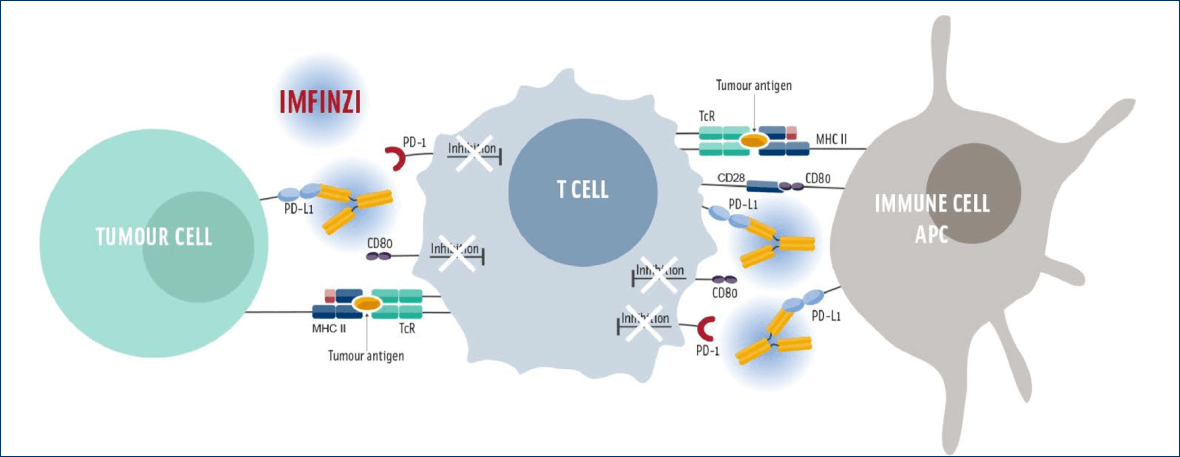
IMFINZI (durvalumab) mechanism of action as a PD-L1 immune checkpoint inhibitor

Tumor-cell Tumor-cell

Adapted from IMFINZI SmPC. AstraZeneca Pharmaceuticals LP.1
APC, antigen-presenting cell; CD, cluster of differentiation; MHC, major histocompatibility complex; PD-1, programmed death receptor 1; PD-L1, programmed death ligand 1; TcR, T-cell receptor.
1. eMC. IMFINZI™ (durvalumab) Summary of Product Characteristics – UK. https://www.medicines.org.uk/emc/product/9495 (last accessed January 2025).


IMFINZI is a human immunoglobulin G1 kappa (IgG1κ) monoclonal antibody (mAb) that selectively blocks the interaction of PD-L1 with programmed cell death-1 (PD-1) and CD80.8

Some therapeutic mAbs utilise antibody dependent cell-mediated cytotoxicity (ADCC) for their anti-tumour efficacy, where immune cells kill target cells coated with antibodies.9,10

IMFINZI's mechanism of action does not rely on ADCC, and instead focuses on enhancing T-cell activity via PD-L1 blockade– offering a distinct approach in cancer immunotherapy for NSCLC.8

With IMFINZI, the selective blockade of the PD-1/PD-L1 and PD-L1/CD80 pathways leads to increased T-cell activation and enhanced antitumor immune responses in NSCLC patients undergoing PDL-1 immunotherapy.8

IMFINZI has demonstrated statistically significant ​​efficacy in the PACIFIC clinical trials, including improvements to overall survival (OS) and progression-free survival (PFS) compared to placebo.2,3

The most common adverse reactions with Imfinzi monotherapy were cough/productive cough, diarrhoea, rash, pyrexia, upper respiratory tract infections, abdominal pain, pruritus, and hypothyroidism.8

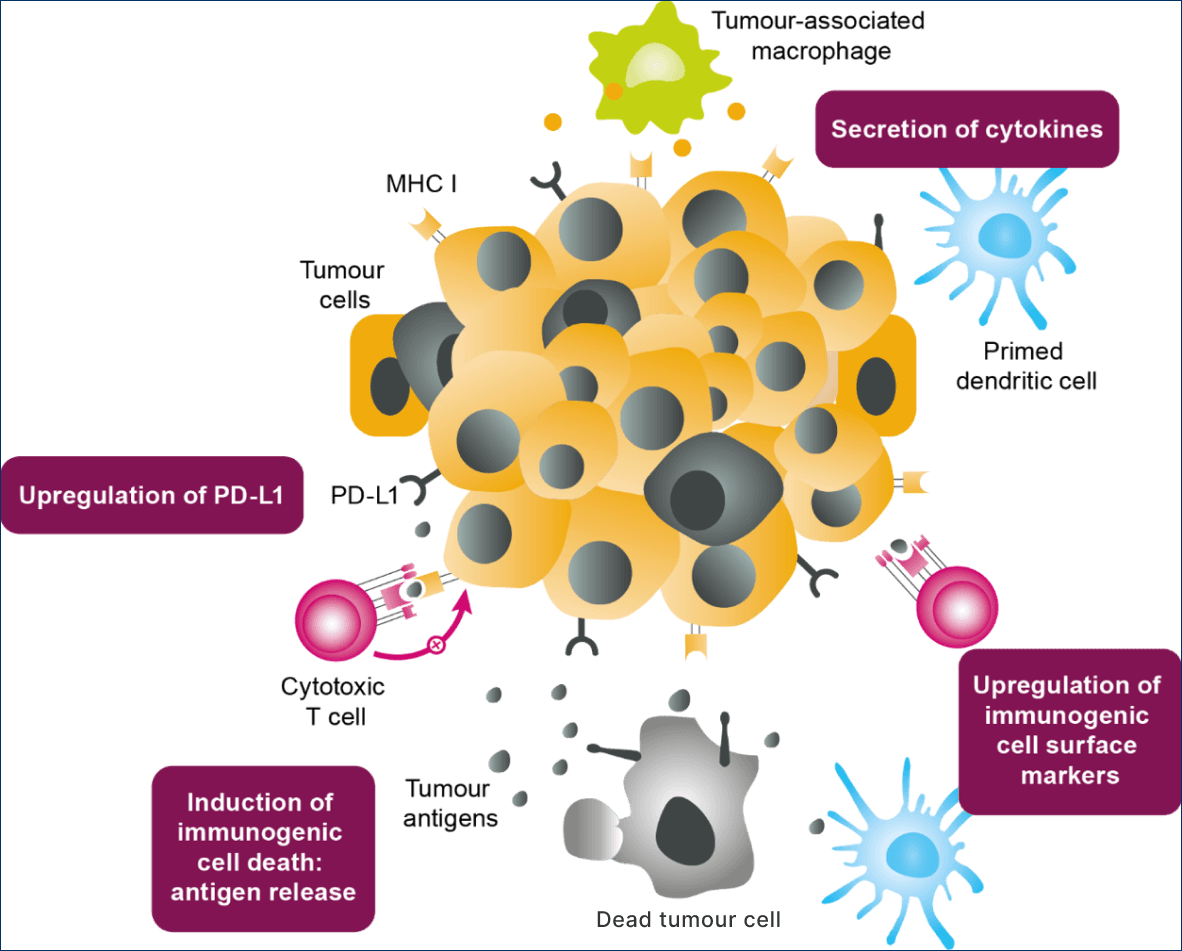
CRT induces immunomodulatory changes, providing the rationale for use before IMFINZI (durvalumab) in NSCLC

Chemoradiotherapy (CRT) has direct cytotoxic effects and induces immunomodulatory changes prior to using IMFINZI.11-13

For instance, apoptotic cells release DAMPs, chemokines, and cytokines, triggering an immune response (antigen storm).12 Effector lymphocytes secrete cytotoxic molecules (e.g. perforins, granzymes) and engage death receptors via surface expression of Fas ligand (FasL) and TRAIL, mediating anti-tumor cytotoxicity.14

The radiotherapy aspect of CRT also induces a wide range of immunomodulatory effects that potentially influence the effectiveness of immunotherapies, such as IMFINZI, in lung cancer.11

NSCLC NSCLC

Adapted from Figure 1. Daly et al. (2015).
CRT, chemoradiotherapy; MHC I, major histocompatibility complex I; PD-L1, programmed cell death-ligand-1.


Potential synergy between CRT and immune checkpoint inhibitors in NSCLC

After conducting a sub-group analysis in the ​​PACIFIC clinical trial, PFS and OS benefits were greater in patients randomised within 14 days compared to patients randomised >14 days after their last radiation therapy, suggesting possible synergy between IMFINZI and radiation therapy.15


In preclinical models, certain chemotherapy treatments have demonstrated the ability to trigger ICD, enhancing the body's immune response against cancer cells.11 These chemotherapy-induced effects may complement and enhance the efficacy of combined CRT and immunotherapy in stage III unresectable NSCLC.11 Caution is advised while interpreting data from pre-clinicial models; clinical significance is unknown.

IMFINZI structure and metabolism

IMFINZI, a IgG1κ mAb, has a protein chemical structure and is primarily eliminated by protein catabolism via the reticuloendothelial system or through target-mediated disposition.16 The terminal half-life of IMFINZI is approximately 18 days based on baseline IMFINZI clearance.8 

ADCC, antibody dependent cell-mediated cytotoxicity; APC, antigen-presenting cell; CRT, Chemoradiotherapy; CD, cluster of differentiation; DAMP, damage-associated molecular patterns; FasL, Fas ligand; ICD, immunogenic cell death; IgG1κ, immunoglobulin G1 κ light chain; IFN-γ, interferon-gamma; mAb, monoclonal antibody; MHC, major histocompatibility complex; NSCLC, non-small cell lung cancer; OS, overall survival; PD-1, Programmed Cell Death Protein 1; PD-L1, Programmed Cell Death Ligand 1; PFS, progression-free survival; TAA, tumour-associated antigen; TAM, tumour-associated macrophages; TcR, T-cell receptor; TME, tumour microenvironment; TRAIL, TNF-related apoptosis-inducing ligand.

  1. CRUK. About Cancer: Survival for lung cancer [Internet]. cancerresearchuk.org. 2022 [cited 2024 Apr 4]. Available from: https://www.cancerresearchuk.org/about-cancer/lung-cancer/survival (last accessed January 2025)
  2. Antonia SJ, Villegas A, Daniel D, Vicente D, Murakami S, Hui R, et al. Overall Survival with Durvalumab after Chemoradiotherapy in Stage III NSCLC. N Engl J Med. 2018 Dec 13;379(24):2342–50. 
  3. Spigel DR, Faivre-Finn C, Gray JE, Vicente D, Planchard D, Paz-Ares L, et al. Five-Year Survival Outcomes From the PACIFIC Trial: Durvalumab After Chemoradiotherapy in Stage III Non-Small-Cell Lung Cancer. J Clin Oncol. 2022 Apr 20;40(12):1301–11. 
  4. Ramnath N, Dilling TJ, Harris LJ, Kim AW, Michaud GC, Balekian AA, et al. Treatment of stage III non-small cell lung cancer: Diagnosis and management of lung cancer, 3rd ed: American College of Chest Physicians evidence-based clinical practice guidelines. Chest. 2013 May;143(5 Suppl):e314S – e340S. 
  5. Cheema PK, Rothenstein J, Melosky B, Brade A, Hirsh V. Perspectives on treatment advances for stage III locally advanced unresectable non-small-cell lung cancer. Curr Oncol. 2019 Feb;26(1):37–42. 
  6. Yu H, Boyle TA, Zhou C, Rimm DL, Hirsch FR. PD-L1 Expression in Lung Cancer. J Thorac Oncol. 2016 Jul;11(7):964–75. 
  7. Pawelczyk K, Piotrowska A, Ciesielska U, Jablonska K, Gletzel-Plucinska N, Grzegrzolka J, et al. Role of PD-L1 Expression in Non-Small Cell Lung Cancer and Their Prognostic Significance according to Clinicopathological Factors and Diagnostic Markers. Int J Mol Sci [Internet]. 2019 Feb 14;20(4). Available from: http://dx.doi.org/10.3390/ijms20040824 (last accessed January 2025)
  8. Summary of Product Characteristics (SmPC). Available from: https://www.medicines.org.uk/emc/product/9495 (last accessed January 2025)
  9. Wang W, Erbe AK, Hank JA, Morris ZS, Sondel PM. NK Cell-Mediated Antibody-Dependent Cellular Cytotoxicity in Cancer Immunotherapy. Front Immunol. 2015 Jul 27;6:368. 
  10. Hashimoto G, Wright PF, Karzon DT. Antibody-dependent cell-mediated cytotoxicity against influenza virus-infected cells. J Infect Dis. 1983 Nov;148(5):785–94. 
  11. Daly ME, Monjazeb AM, Kelly K. Clinical Trials Integrating Immunotherapy and Radiation for Non-Small-Cell Lung Cancer. J Thorac Oncol. 2015 Dec;10(12):1685–93. 
  12. Kaur P, Asea A. Radiation-induced effects and the immune system in cancer. Front Oncol. 2012 Dec 17;2:191. 
  13. Deng L, Liang H, Burnette B, Beckett M, Darga T, Weichselbaum RR, et al. Irradiation and anti-PD-L1 treatment synergistically promote antitumor immunity in mice. J Clin Invest. 2014 Feb;124(2):687–95. 
  14. Aaes TL, Vandenabeele P. The intrinsic immunogenic properties of cancer cell lines, immunogenic cell death, and how these influence host antitumor immune responses. Cell Death Differ. 2021 Mar;28(3):843–60. 
  15. Azghadi S, Daly ME. Radiation and immunotherapy combinations in non-small cell lung cancer. Cancer Treat Res Commun. 2021;26:100298. 
  16. Fung S, Syed YY. Durvalumab: A Review in Advanced Biliary Tract Cancer. Target Oncol. 2023 Nov;18(6):964-72.

GB-66550 | DOP: April 2025

Adverse events should be reported. Reporting forms and information can be found at www.mhra.gov.uk/yellowcard or search for MHRA Yellow Card in the Google Play or Apple App Store. Adverse events should also be reported to AstraZeneca by visiting https://contactazmedical.astrazeneca.com/ or by calling ‌‌‌0‌‌‌8‌‌‌‌‌0‌‌‌‌0‌‌‌ ‌‌7‌‌‌‌‌‌8‌‌‌3‌‌‌ ‌‌0‌‌‌‌‌0‌‌‌‌3‌‌‌‌3‌‌‌.

Connessiallasalute.it

This website was created for UK HCPs and has been designed to provide information to educate, empower and enable them in the great work they are doing for patients across a range of therapy areas. This website is intended for doctors, nurses, and pharmacists in the UK. Other UK residents please visit astrazeneca.co.uk.

Terms of use

Privacy Policy

Cookie Policy

Contact Us

LinkedIn

Twitter

©2025 AstraZeneca. GB-73925 | February 2026

Enhance your knowledge, stay informed

Be the first to know. Hear about events, products and ways to support your patients.

Thank you. We will be in touch

GB-74216| DOP : February 2026