Welcome to this UK AstraZeneca produced and funded website

This website is intended for UK Healthcare Professionals only.


The website contains both promotional and non-promotional content.


If you are a patient or a carer of a patient prescribed an AstraZeneca product, please visit myazmed.co.uk


For any other UK residents please visit astrazeneca.co.uk

I am not a Healthcare Professional
IMFINZI (durvalumab) UK Prescribing Information
Adverse Event Reporting

This website is intended for UK Healthcare professionals only. Other UK residents please visit astrazeneca.co.uk

Logo test product
  • Our Medicines
    • Cardiovascular, Renal & Metabolism
      • ATTR Amyloidosis
        • WAINZUA®▼(eplontersen)
      • Chronic Kidney Disease (CKD)
        • FORXIGA® (dapagliflozin)
      • Heart Failure
        • FORXIGA® (dapagliflozin)
      • Hyperkalaemia
        • LOKELMA® (sodium zirconium cyclosilicate)
      • Type 2 Diabetes (T2D)
        • FORXIGA® (dapagliflozin)
    • Oncology
      • Breast Cancer
        • LYNPARZA® (olaparib)
        • TRUQAP®▼(capivasertib)
      • Bladder Cancer
        • IMFINZI® (durvalumab)
      • Endometrial Cancer
        • IMFINZI® (durvalumab)
        • LYNPARZA® (olaparib)
      • Gastrointestinal Cancer
        • IMFINZI® (durvalumab)
        • IMJUDO®▼(tremelimumab)
      • Lung Cancer
        • IMFINZI® (durvalumab)
        • TAGRISSO® (osimertinib)
      • Ovarian Cancer
        • LYNPARZA® (olaparib)
      • Prostate Cancer
        • LYNPARZA® (olaparib)
        • ZOLADEX® (goserelin)
    • Respiratory
      • Asthma
        • TEZSPIRE®▼ (tezepelumab)
        • SYMBICORT® (budesonide/formoterol)
      • Chronic Obstructive Pulmonary Disease(COPD)
        • TRIXEO AEROSPHERE® (formoterol fumarate dihydrate/glycopyrronium/budesonide)
        • BEVESPI® (glycopyrronium/formoterol fumarate dihydrate)
    • Vaccines
      • Flu
        • FLUENZ® nasal spray suspension (influenza vaccine, live attenuated, nasal)
  • Therapy Areas
    • Cardiovascular, Renal & Metabolism
      • ATTR Amyloidosis
      • Chronic Kidney Disease (CKD)
      • Heart Failure
      • Hyperkalaemia
      • Type 2 Diabetes (T2D)
    • Oncology
      • Breast Cancer
      • Bladder Cancer
      • Endometrial Cancer
      • Gastrointestinal Cancer
      • Lung Cancer
      • Ovarian Cancer
      • Prostate Cancer
    • Respiratory
      • Asthma
      • Chronic Obstructive Pulmonary Disease(COPD)
    • Vaccines
      • Flu
  • About us
    • AZ Commitment
  • Contact us
Login
  • AstraZeneca UK
  • Lung Cancer
  • ADRIATIC Safety Profile
  • Home
  • Efficacy and clinical trials
    • PACIFIC
    • AEGEAN
    • ADRIATIC
    • CASPIAN
  • Safety profile
    • PACIFIC
    • AEGEAN
    • ADRIATIC
    • CASPIAN
  • Dosing and administration
    • PACIFIC
    • AEGEAN
    • ADRIATIC
    • CASPIAN
  • Mechanism of action
    • PACIFIC
    • AEGEAN
    • ADRIATIC
    • CASPIAN
  • Resources
  • Lung therapy
    • Lung pathway
    • Diagnostics
    • Prehabilitation
ADRIATIC Safety Profile

Logo for IMFINZI (durvalumab) which is coloured red and blue with brand and generic name


ADRIATIC Safety Profile

Explore CASPIAN Data for IMFINZI in ES-SCLC


  • Most common adverse events
  • Immune-mediated adverse events

Most common adverse events

IMFINZI following cCRT in LS-SCLC was consistent with the established IMFINZI monotherapy safety profile.1,2,4,6

The safety profile of IMFINZI (durvalumab) in the ADRIATIC study was generally consistent with the known safety profile of IMFINZI, with comparable rates of Grade 3/4 adverse events observed between the IMFINZI and placebo arms. Patients with limited-stage small-cell lung cancer (LS-SCLC) whose disease had not progressed following platinum-based chemoradiotherapy (cCRT) were randomised to receive IMFINZI 1,500 mg intravenously every 4 weeks (or 20 mg/kg for patients weighing <30 kg) for up to 24 months, or until disease progression or unacceptable toxicity.1,6


Patients enrolled in ADRIATIC had completed definitive platinum-based cCRT prior to initiating IMFINZI. Depending on local practice and the approved indication, this includes either concurrent chemoradiotherapy (cCRT) or sequential chemoradiotherapy (sCRT), with prophylactic cranial irradiation (PCI) administered where clinically appropriate before IMFINZI initiation.1,6


IMFINZI was evaluated in the ADRIATIC phase III clinical trial and demonstrated statistically significant improvements in both overall survival (OS) and progression-free survival (PFS) versus placebo, in patients with LS-SCLC whose disease had not progressed following platinum-based CRT.1,6

The ADRIATIC trial investigated IMFINZI following cCRT only. NICE recommends and SMC approves durvalumab 
for use following either sCRT or cCRT for the management of limited-stage small cell lung cancer.1,2,4,6

MOST COMMON ADVERSE REACTIONS6

The most common (≥10%) adverse reactions were radiation pneumonitis (22.9%), decreased appetite (16.8%), hypothyroidism (16.0%), cough/productive cough (15.3%), pruritus (13.0%), nausea (12.6%), dizziness (12.2%), fatigue (12.2%), diarrhoea (11.1%), pneumonia (11.1%), pneumonitis (10.7%), rash (10.7%), constipation (10.3%), and hyperthyroidism (10.3%).6


The most common (≥ 2%) Grade 3 or 4 adverse reactions were pneumonitis or radiation pneumonitis (3.1%) and pneumonia (2.7%). Immune-mediated adverse reactions are special warnings for IMFINZI.6


For further information on adverse events (AEs) and their management, please refer to the Imfinzi SmPC.1

 IMFINZI (n=262)†placebo (n=265)
Adverse reaction*All grades (%)Grade 3 or 4 (%)‡All grades (%)Grade 3 or 4 (%)‡
Radiation pneumonitis22.9%1.1%23.4%1.9%
Decreased appetite16.8%0%12.8%0%
Hypothyroidism16.0%0%3.8%0%
Cough/productive cough15.3%0%12.1%0%
Pruritus13.0%0%7.2%0%
Nausea12.6%0%10.9%0%
Dizziness12.2%0%7.5%0%
Fatigue12.2%0.4%12.8%1.5%
Diarrhoea11.1%1.9%8.3%0%
Pneumonia11.1%2.7%7.5%3.4%
Pneumonitis10.7%1.1%6.0%0.8%
Rash10.7%0.4%6.0%0%
Constipation10.3%0%9.8%0%
Hyperthyroidism10.3%0%1.5%0%
Headache9.2%0.4%13.2%0%
Anaemia8.8%1.1%6.0%1.1%
Arthralgia6.9%0%10.9%0.4%
Hyperglycaemia4.2%1.1%3.8%0%
Hypertension3.4%1.1%1.5%0%
Lipase increased3.1%1.9%2.6%1.5%
Amylase increased2.7%1.1%1.1%0%
Chronic obstructive
pulmonary disease
2.3%0.4%2.6%1.5%
Pulmonary embolism2.3%1.9%1.5%1.1%

*The safety population included all patients who received a dose of trial drug or placebo. AEs shown include events of any cause with an onset date after the first dose of IMFINZI or placebo, as well as any AE occurring before the first dose that increased in severity after the first dose, through to 90 days after the last dose or until the start of the first subsequent systemic anticancer therapy (whichever occurred first).6

†One patient who had been randomly assigned to the IMFINZI group received an unlicensed combination and thus is not included in the results. The patient will be included in the respective unlicensed combination group of the safety population.6

‡The numbers and percentages of patients with an AE of a maximum grade of 3 or 4 are shown.6

The incidence of Grade 3/4 adverse events was comparable with IMFINZI and placebo.6

Back to top

Immune-mediated adverse events

Immune-mediated adverse events (imAEs) of any grade, regardless of cause, were reported in 32.1% of patients treated with IMFINZI following cCRT and 10.2% of patients treated with placebo.6†

AEGEAN Study design for resectable NSCLC randomising patients to perioperative durvalumab arm or placebo arm AEGEAN Study design for resectable NSCLC randomising patients to perioperative durvalumab arm or placebo arm


†imAEs were AEs of special interest (excluding infusion-related, hypersensitivity, or anaphylactic reactions) that were consistent with an immune-mediated mechanism and that led to treatment with systemic glucocorticoids, other immunosuppressants, or endocrine therapy.6


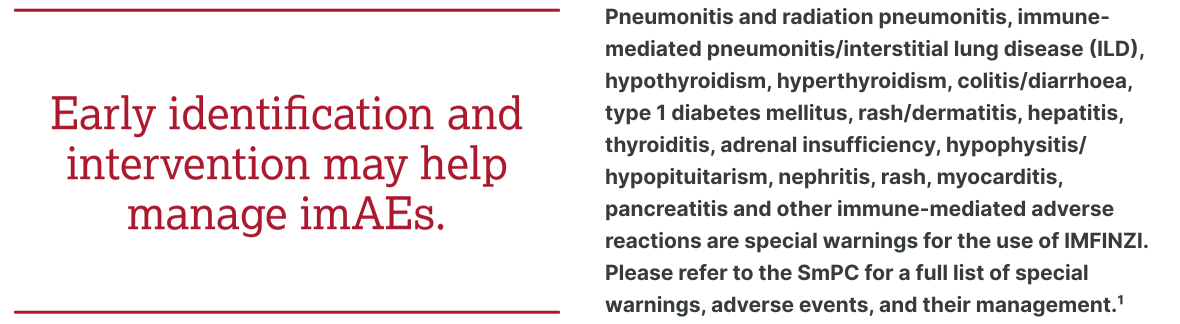
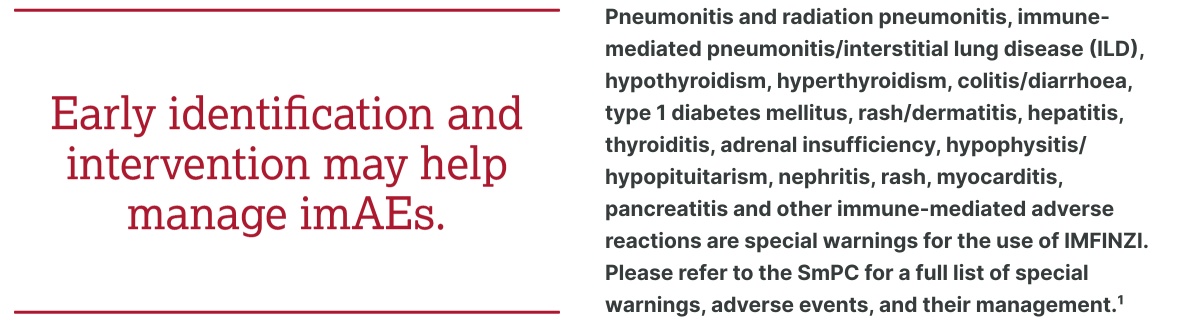
imAEs are a special warning and routine monitoring of patients for signs and symptoms is essential.1 

Back to top

ADRIATIC indication: IMFINZI as monotherapy is indicated for the treatment of adults with limited-stage small-cell lung cancer (LS-SCLC) whose disease has not progressed following platinum-based chemoradiation therapy.1


CASPIAN indication: IMFINZI in combination with etoposide and either carboplatin or cisplatin is indicated for the first-line treatment of adults with extensive-stage small-cell lung cancer (ES‑SCLC).1


NICE recommends IMFINZI can be used, within its marketing authorisation, as an option to treat limited-stage small-cell lung cancer that has not progressed after platinum-based chemoradiotherapy in adults. IMFINZI can only be used if the company provides it according to the commercial arrangement.²


SMC has accepted IMFINZI for treating adults with LS-SCLC. It is used in patients whose disease has not got worse after platinum-based chemoradiation therapy (chemotherapy and radiotherapy given at the same time).4

Continue exploring the ADRIATIC regimen

Learn more about the dosing details in the ADRIATIC Regimen

Explore dosing and administration

Take a closer look at how IMFINZI works within the ADRIATIC Regimen

Explore MOA

Discover more about the ADRIATIC study design and efficacy outcomes

Explore efficacy data

AEs, adverse events; CRT, chemoradiotherapy; cCRT, concurrent chemoradiation therapy; ES-SCLC, extensive-stage small-cell lung cancer; IO, immunotherapy; imAEs, immune-mediated adverse events; LS-SCLC, limited-stage small-cell lung cancer SAEs, serious adverse events; sCRT, sequential chemoradiotherapy.

  1. IMFINZI (durvalumab) Summary of Product Characteristics. [Accessed September 2026]
  2. NICE. Durvalumab for treating limited-stage small-cell lung cancer after platinum-based chemoradiotherapy -TA1099 (October 2025). Available at https://www.nice.org.uk/guidance/ta1099/resources/durvalumab-for-treating-limitedstage-smallcell-lung-cancer-after-platinumbased-chemoradiotherapy-pdf-2973528765889477. [Accessed September 2026].
  3. NICE. Durvalumab with etoposide and either carboplatin or cisplatin for untreated extensive-stage small-cell lung cancer. TA1041 (February 2025) https://www.nice.org.uk/guidance/ta1041 [Accessed September 2026].
  4. SMC. IMFINZI (durvalumab) https://scottishmedicines.org.uk/media/8945/durvalumab-imfinzi-abbreviated-final-jan-2025-for-website.pdf [Accessed September 2026].
  5. SMC. IMFINZI (durvalumab) https://scottishmedicines.org.uk/medicines-advice/durvalumab-imfinzi-abb-smc2734/ [Accessed September 2026]
  6. Cheng Y, et al. Durvalumab after Chemoradiotherapy in Limited-Stage Small-Cell Lung Cancer. N Engl J Med 2024;391(14):1313–1327 (including protocol).

GB-76776 | DOP: September 2026

Adverse events should be reported. Reporting forms and information can be found at www.mhra.gov.uk/yellowcard or search for MHRA Yellow Card in the Google Play or Apple App Store. Adverse events should also be reported to AstraZeneca by visiting https://contactazmedical.astrazeneca.com/ or by calling ‌‌‌0‌‌‌8‌‌‌‌‌0‌‌‌‌0‌‌‌ ‌‌7‌‌‌‌‌‌8‌‌‌3‌‌‌ ‌‌0‌‌‌‌‌0‌‌‌‌3‌‌‌‌3‌‌‌.

Connessiallasalute.it

This website was created for UK HCPs and has been designed to provide information to educate, empower and enable them in the great work they are doing for patients across a range of therapy areas. This website is intended for doctors, nurses, and pharmacists in the UK. Other UK residents please visit astrazeneca.co.uk.

Terms of use

Privacy Policy

Cookie Policy

Contact Us

LinkedIn

Twitter

©2025 AstraZeneca. GB-73925 | February 2026

Enhance your knowledge, stay informed

Be the first to know. Hear about events, products and ways to support your patients.

Thank you. We will be in touch

GB-74216| DOP : February 2026